
North Korea’s New Destroyer Demonstrates Cutting Edge Missile Warfare Capabilities in Live Fire Drills
Military Watch Magazine Editorial Staff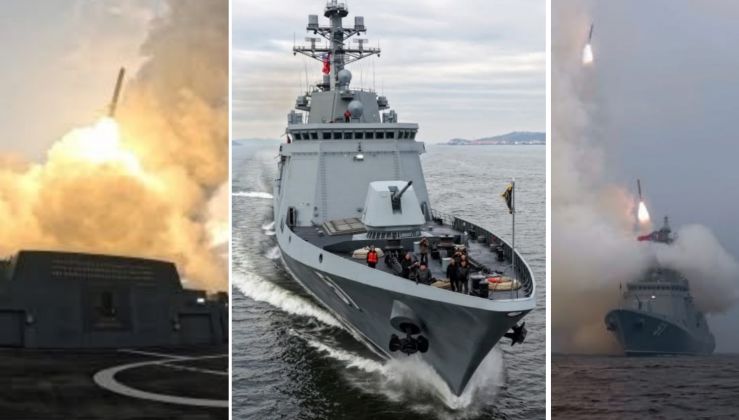
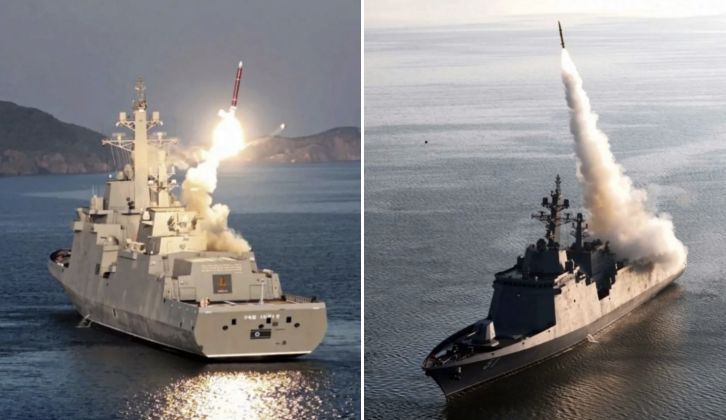
North Korean Destroyer Choe Hyon During March Live Fire Exercises
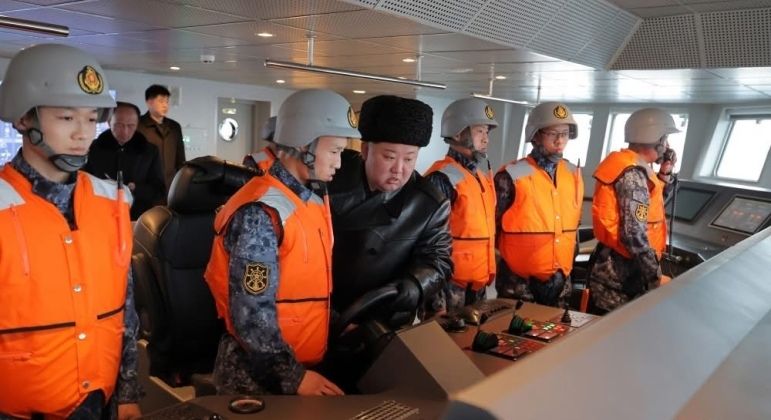
The Korean People’s Army Navy has evaluated the capabilities of the first Choe Hyon class missile destroyer, and conducted the first autonomous navigation exercises as part of pre-commissioning operational capability assessment tests. These tests demonstrated the ship’s ability to rapidly launch missile salvos at sea using its vertical launch system. Chairman of the ruling Korean Workers’ Party Kim Jong Un from March 3 to 4 inspected the Choe Hyon to learn about its progress during testing, personally observing the sailors' preparedness for controlling warship and handling various weapon systems, and expressing high confidence in their performance. “The tests of operational efficiency of the new-type destroyer, a new symbol of sea defence capability of our state, are going on smoothly as planned,” the chairman observed, praising the sailors onboard for having perfectly acquired the military and technological qualifications to operate the ship, which had been set by the Party Central Committee.
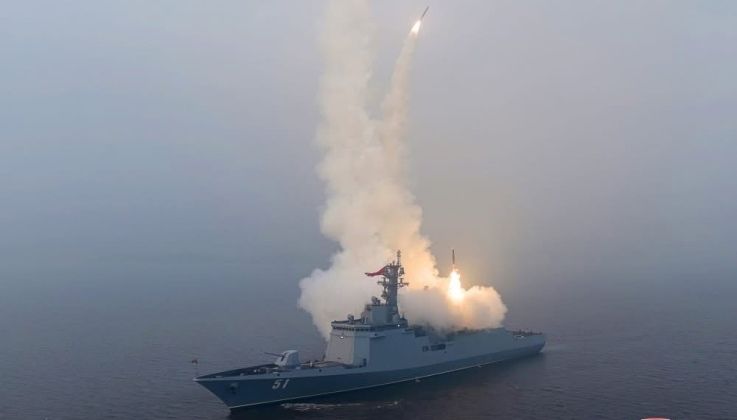
Chairman Kim confirmed the construction progress of the third Choe Hyon class destroyer, while revealing that there were plans to produce ten similarly capable destroyers over the coming five years. “Every year during the new five-year plan period we must build two surface warships of this class or of a higher class, and correctly implement the gigantic plan of increasing the fighting strength of surface warships,” he observed. Choe Hyon class destroyers stand out for their integration of outstandingly large armaments suites, particularly relative to their sizes, with each integrating 74 vertical launch cells, despite displacing just 5,000 tons. To place the in perspective, British Type 26 class frigates displace 7,700 tons, but integrate just 24 cells, while U.S. Navy Arleigh Burke Class destroyers displace 9,700 tons, making them almost twice as large, but integrate just 33 percent more cells at 96. The number of missile cells integrated is all the more outstanding when considering that they include 20 much larger cells for ballistic missiles.
Choe Hyon class ships’ primary land attack capability is provided by Hwasong-11 ballistic missiles, Hwasal-2 cruise missiles, and a yet unconfirmed other cruise missile type. Kumsong-3 anti-ship cruise missiles are reportedly relied on for anti-shipping roles, although unconfirmed reports indicate that a hypersonic anti-ship cruise missile class is also expected to be fielded. Each ship also integrates two dual torpedo tubes integrated into the superstructure and a bow sonar system. The Korean People’s Army Navy first test launched multiple missiles from the new destroyer in April 2025, with the state run Korean Central News Agency announcing that these earlier trials included the launches of supersonic cruise missiles, nuclear-capable cruise missiles, surface-to-air missiles, and electromagnetic jamming projectiles, as well as the firing of the ship’s 127mm gun.
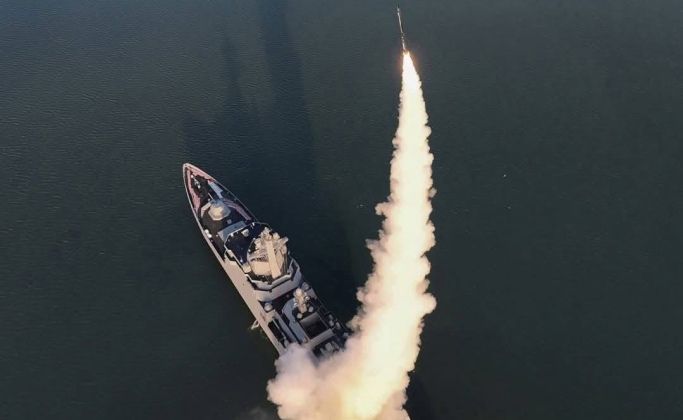
North Korea launched its second Choe Hyon class destroyer, the Kang Kon, during a ceremony at Rason port on May 22, although this saw the ship fall on its side causing damage to its structure. At the time Western analysts were near unanimous that the damage to the ship would prevent it from being relaunched in the near future, although concerted efforts allowed it to be relaunched just 22 days later on June 13. It remains uncertain how many Choe Hyon class destroyers are intended for service entry, and whether a new larger destroyer type may be planned. The ships represent a step change for the Korean People’s Army Navy’s surface capabilities, with their standings against rival vessels fielded by the United States being unprecedentedly high, where previously the surface navy had for decades been among the weakest sections of the country’s armed forces.
The Choe Hyon class’ ability to conduct long range air and missile operations, and to launch nuclear strikes using ballistic missiles that follow complex trajectories, may seriously complicate defence planning. Destroyers with similar capabilities are fielded only by China, the United States, South Korea and Japan, with neighbouring Russia notably having launched no new destroyers for its own navy since the disintegration of the Soviet Union. It remains highly uncertain to what extent the North Korean defence ministry is planning to invest in developing an ocean going surface naval capability, although should further investments be made, it would allow the Navy to establish a continuous far sea presence in the Pacific, complementing progress being made to begin fielding nuclear powered submarines in the early 2030s.
