
New Israeli F-16 Configuration Delivers Four RAMPAGE Ballistic Missile Strikes From Safely Outside Iran’s Airspace
Military Watch Magazine Editorial Staff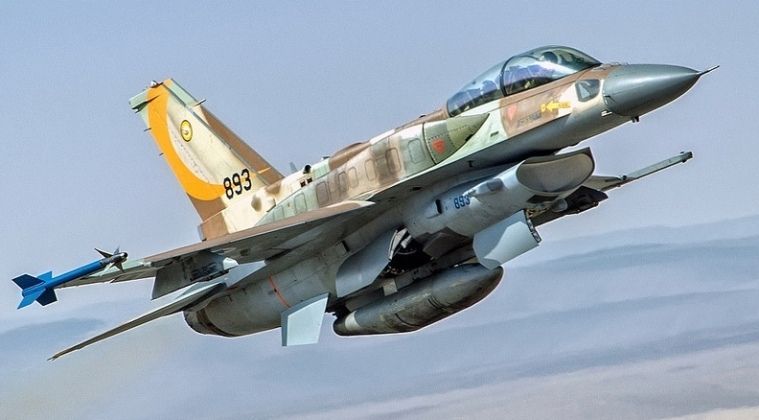
Israeli Air Force F-16I Fighter
The Israeli Air Force has unveiled a new configuration for its F-16I fighter optimised for beyond visual range medium range strikes against well defended ground targets. The F-16I currently forms the backbone of the country’s fighter fleet, and has been responsible for the bulk of offensive operations against Iran, with its twin seat configuration allowing a weapons systems officer, referred to in Israel as a navigator, to fly in the second seat and operate air-to-ground weapons. The F-16 has been configured with four RAMPAGE ballistic missiles, although lacking external fuel tanks usually carried by Israeli fighters, indicating that the aircraft will be heavily reliant on aerial refuelling support to engage targets in Iran. The F-16’s light weight means it would likely be unable to take off with its standard carriage of two to three external fuel tanks if carryng four ballistic missiles.
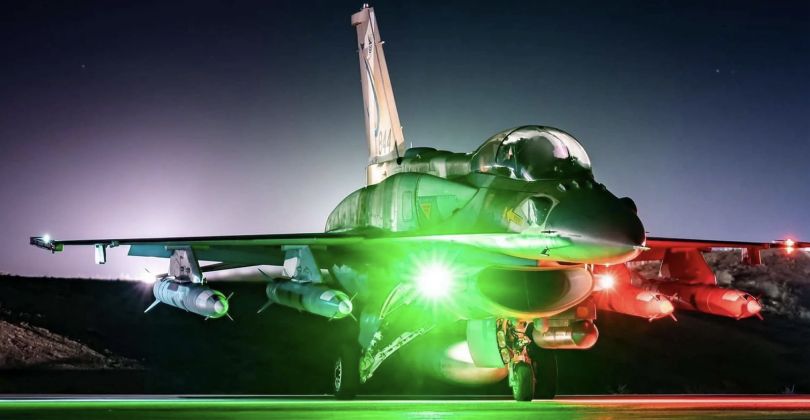
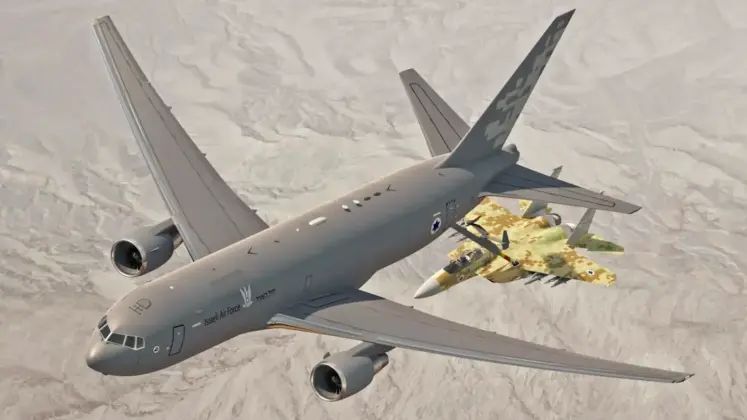
Israel and the United States initiated a large scale assault against Iran on February 28, with the F-16 having served as the primary workhorse for Israel’s high intensity campaign of air attacks against Iranian targets. Iran has retaliated by launching ballistic missiles to strike strategic targets across Israel, as well as U.S.-linked targets across the Middle East. It is likely that the direct participation of the United States in attacks on Iran from the outset has allowed the new configuration to be used, since the U.S. Air Force deploys a much larger fleet of KC-135 and KC-46 tankers that can provide aerial refuelling support, reducing Israeli fighter units’ reliance on external fuel tanks. The RAMPAGE missile was developed in the mid-late 2010s as a joint project by Israel Aerospace Industries (IAI) and Israel Military Industry (IMI) in response to the Israeli Air Force’s requirement to be able to strike targets defended by advanced air defences, most notably those in Syria. The missile was developed as a derivative of the Extended Range Artillery (EXTRA) guided rocket. With an engagement range of 150-220 kilometres, the missile can be delivered from relatively safe distances.
The ability to engage targets from longer ranges has been critical for attacks on targets in both Syria and Iran, with Syrian air defences having proven capable of shooting down Israeli fighters multiple times, although Israel has denied the majority of claimed shootdowns, while Iranian air defences have shot down large numbers of U.S. and Israeli high value drones, which are used for higher risk missions within Iranian airspace. Commenting on the importance of the RAMPAGE missile, director of marketing and business development for IAI’s Malam, Amit Haimovich, observed: “If you take the Middle East arena and areas protected by air-defence systems, the whole point of this missile is that it can hit targets within standoff ranges,” all without threatening the launching aircraft.
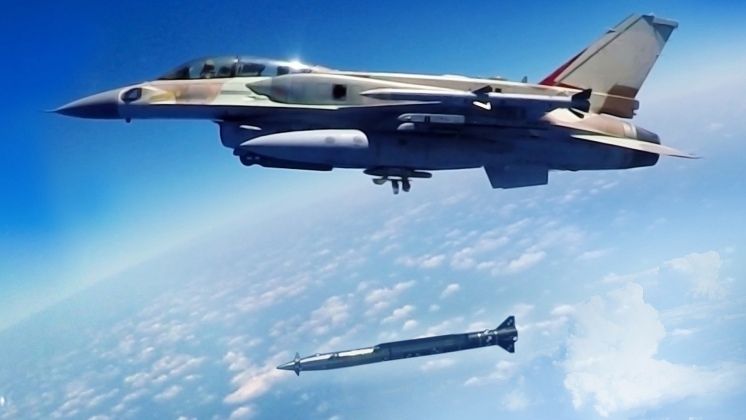
Western fighter aircraft have much shorter ranges and lower missile carrying capacities than their average Chinese and Russian counterparts, with even the West’s longest ranged fighter type the F-15 requiring multiple external and conformal fuel tanks to be able to overfly Iran from airbases in Israel. The Su-35 fighters Iran has ordered from Russia, by contrast, could comfortably overfly Israel from Iranian bases with a full weapons load and no external fuel. The F-16 has a significantly shorter range than the F-15, which makes refuelling support and carriage of longer range missile types particularly vital. Carriage of four RAMPAGE missiles could potentially allow each F-16I to strike for separate Iranian targets with each sortie, serving as a force multiplier for the fighter fleet. Missiles have Mach 2 speeds and follow quasi-ballistic trajectories, which makes them more challenging to intercept than most subsonic cruise missiles.
An estimated 95 F-16I fighters are currently in service, with the design being heavily oriented towards air-to-surface roles, rather than air-to-air combat, and using conformal fuel tanks to extend their ranges. Their dorsal avionics compartments integrate predominantly indigenous avionics including computers, processors and interfaces produced by Elbit systems and communications systems produced by Rafael. The fighter’s Elisra electronic warfare suite includes radar warning receivers, missiles approach warners and jamming systems, making the aircraft optimal for air defence suppression operations. The extra weight from this fuel and additional avionics, however, has resulted in a significantly poorer flight performance than most other F-16 variants. The fighters have benefitted from support from F-35I fifth generation fighters, which although themselves incapable of firing air-to-surface missiles, integrate much more advanced sensors including passive electronic sensors that can detect adversary radar emissions and provide early warning of potential targeting by Iranian ground-based air defences.
