
New American Maritime Strategy Focuses on Assertive Power Projection Targeting China and Russia
Military Watch Magazine Editorial Staff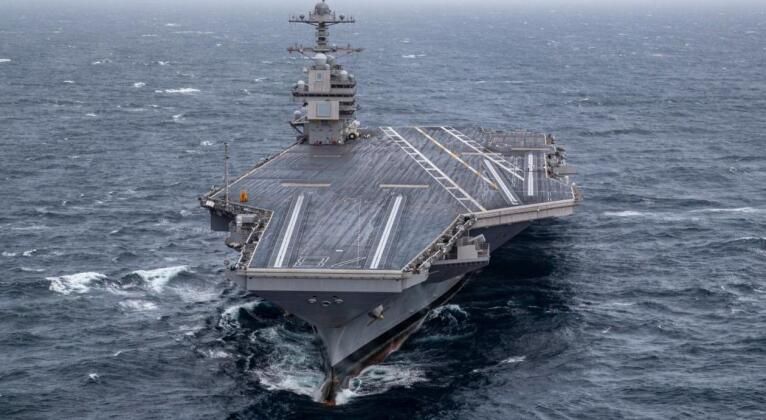
U.S. Navy Gerald Ford Class Supercarrier
A new tri-service strategy document released by the U.S. Navy, Marine Corps, and Coast Guard has revealed a renewed emphasis on maritime power projection aimed specifically at the United States’ leading near peer military challengers China and Russia. The document stresses the importance of assertive if not outright aggressive power projection to targeting these countries, and covered both blue water and littoral operations. Titled Advantage at Sea: Prevailing with Integrated All-Domain Naval Power, the paper discusses a number of operational concepts that the three services have been considering, including a greater focus on smaller and more mobile units and on the use of distributed sensor and communications networks and unmanned aircraft and ships. This comes as the U.S. Marines Corps has begun a drastic restructuring program, under which all of its battle tanks and much of its heavy equipment will be retired for a greater focus on light, low cost and mobile operations. The U.S. Navy, too, its considering drastic cuts to its planned orders for Gerald Ford Class supercarriers, possibly of up to 60%, and a greater focus on lighter and cheaper ships such as America Class carriers which are less than half the size.
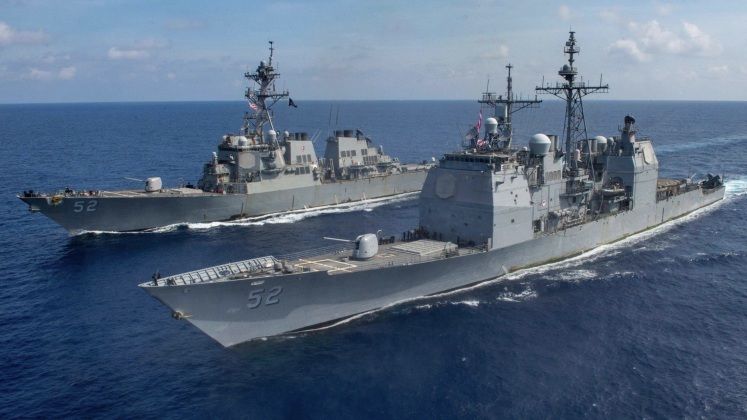
Highlighting the growing challenge to American control of blue waters, the document's forward states: “Significant technological developments and aggressive military modernisation by our rivals are eroding our military advantages. The proliferation of long-range precision missiles means the United States can no longer presume unfettered access to the world’s oceans in times of conflict. Our integrated Navy, Marine Corps, and Coast Guard must maintain clear-eyed resolve to compete with, deter, and, if necessary, defeat our adversaries while we accelerate development of a modernised, integrated all-domain naval force for the future." Stressing the importance of preparations for conflict with China and Russia in particular, the forward further states:
“Since the beginning of the 21st century, our three Sea Services have watched with alarm the growing naval power of the People’s Republic of China and the increasingly aggressive behaviour of the Russian Federation. Our globally deployed naval forces interact with Chinese and Russian warships and aircraft daily. We witness firsthand their increasing sophistication and growing aggressiveness. Optimism that China and Russia might become responsible leaders contributing to global security has given way to recognition that they are determined rivals. The People’s Republic of China represents the most pressing, long-term strategic threat.”
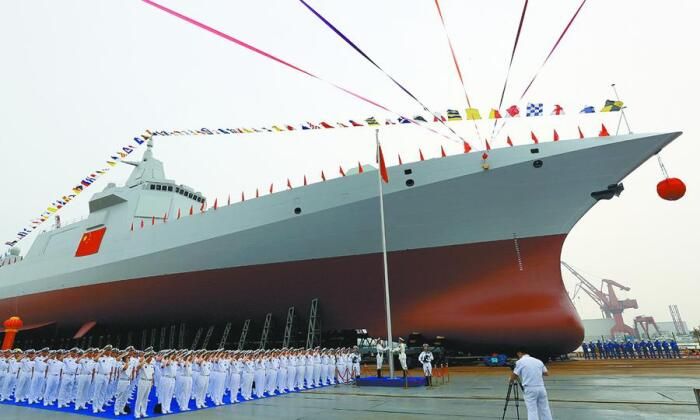
American primacy at sea, although seriously challenged by the rapid expansion and modernisation of the Soviet Navy in the 1980s, was considered unchallenged in the 25 years following the Cold War’s end. Of the four states it considers great power adversaries, two have not laid down a single surface destroyer for their navies since the collapse of the Soviet Union - these being Russia and North Korea. They have instead focused overwhelmingly on asymmetric assets and in particular the use of submarines to provide a defence against the much larger U.S. Navy. The third of these states, Iran, has recently laid down a small number of destroyers which are technologically several decades behind their counterparts fielded by the Soviet Navy in the late Cold War years, or those in the U.S. Navy today. China has thus come to represent the U.S. Navy’s only peer level challenge in terms of surface warfare capabilities, although Russia’s modernisation drive through reliance on highly sophisticated corvette sized ships and on retrofitting Soviet era ships with modern missiles and sensors could also seriously challenge U.S. forces if fighting near Russian waters. China’s Type 055 Class destroyer is widely considered the most capable warship of its kind in the world, and with the country’s shipyards launching 8-10 high end destroyers per year the rate of its fleet expansion has been very considerable. The high likelihood that the Chinese destroyer fleet could field greater firepower than its U.S. counterpart in the near future is thought to have played a major role in pressing the U.S. to focus more on asymmetric means of waging war at sea.
