
World’s Longest Ranged Rocket Artillery Demonstrated in North Korean Exercises
Military Watch Magazine Editorial Staff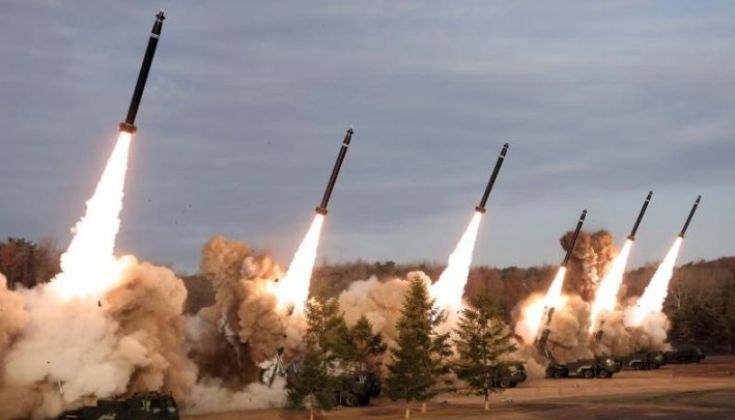
North Korean KN-25 Rocket Artillery Salvo
The Korean People’s Army on January 27 conducted live fire exercises using an upgraded variant of the country’s longest range rocket artillery system, referred to by Western sources as the KN-25, which was first introduced into service in 2019. The firing of four lockets from the system demonstrated its ability to strike targets at ranges of 358.5 kilometres, with analysts highlighting that the test underscored the KPA’s focus on precision long-range fires able to survive complex jamming. The test was overseen by the Missile General Bureau, as well as by the chairman of the ruling Korean Workers’ Party Kim Jong Un. State media referred to the exercises as a practical demonstration of the KPA’s “strategic deterrence” capabilities, with Chairman Kim describing the launcher as being adapted for “special attack” missions and featuring an “autonomous precision guidance flight system” intended to keep the weapon effective even when facing interference.
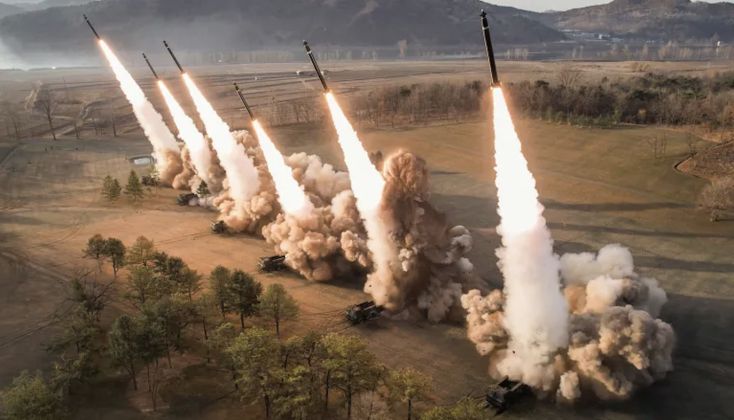
The KN-25 is considered by a significant body of analysts to be the world’s longest ranged rocket artillery system, and while the Chinese PCL-191 can engage targets up to 500 kilometres away, it does so using ballistic missiles rather than rockets, with its maximum reported rocket engagement range being 350 kilometres using 370mm rockets. The KN-25, by contrast, has a reported 400 kilometre range. KN-25 system is deployed using both 6-cell and 4-cell variants, with variants using tracked launchers favoured for their ability to operate off road in the country’s mountainous and forested terrain, which makes them significantly more difficult to target. North Korea fields the largest artillery force in the world, with its rocket artillery forces including a wide range of types capable of striking various respective ranges across the Korean Peninsula.
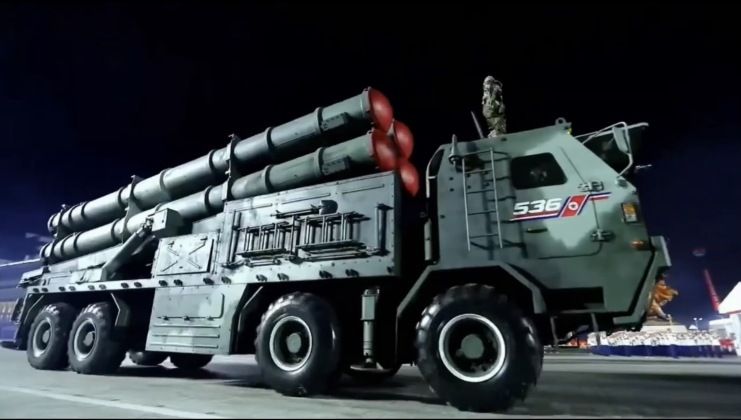
Addressing the new capabilities introduced by the KN-25 in 2019, a U.S. Congressional Research Service report the following year noted that the system “blurs the line between rocket and missile,” and boasted “advanced avionics, inertial and satellite guidance systems, and aerodynamic structures.” The KN-25’s extreme range is longer than that of many ballistic missiles, and allows North Korean forces to engage targets across the large majority of the Korean Peninsula. The system can be used for strategic bombardment, placing Seoul and other population centres at greater risk, but its tactical value is likely to be far greater due to its ability to bombard airfields, command centres and other vital facilities. The recent testing of the system may partly represent an effort to market it to Russia, which is importing over $10 billion worth of North Korean equipment annually including a wide range of artillery assets.
