
Is China's Military Simulating Amphibious Landings and Rocket Artillery Strikes on Taiwan?
Military Watch Magazine Editorial Staff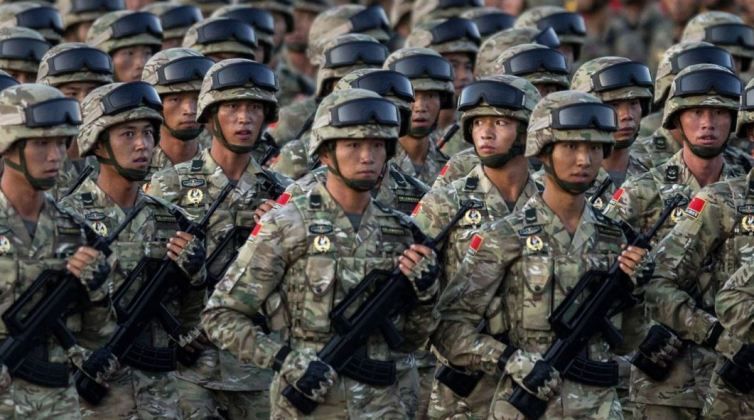
Chinese PLA Soldiers
The Chinese People's Liberation Army (PLA) had conducted major exercises primarily involving ground and naval units, which have focused on amphibious landings among other maritime manoeuvres. These come amid growing tensions in the Taiwan Strait and more broadly between Beijing and Washington, and have particularly significant implications for the former conflict given that the PLA will be required to conduct major amphibious operations in the case of an all out war in the strait. Exercises reportedly centred around the PLA 74th Group Army, which conducted a beach assault in a mock confrontation with defending units in southern China's Hainan Province. The units are usually based in Guangdong Province. The drills saw a brigade board landing ships at dusk, and arrive at the frontline in the morning of the next day. Conditions reportedly simulated those of the Taiwan Strait, and the brigade made use of saturated artillery fire from multiple rocket launcher systems to successfully complete the simulated battle and seize the beach. The PLA has notably recently commissioned a new rocket artillery system, the PCL191, which can strike targets across the vast majority of Taiwanese territory from the Chinese mainland. The system is second in the world in range only to the North Korean KN-25, and can strike targets up to 350km away with each carrying eight 370 mm rockets, allowing the PLA to lay down heavy covering fire if landing forces on Taiwan's coasts.
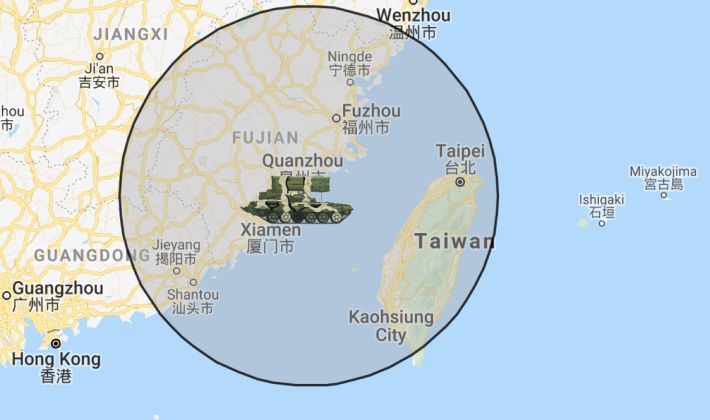
China has invested heavily in improving its amphibious assault capabilities, and alongside a very large fleet of Type 071 Class assault ships it began to launch heavier and more capable Type 075 Class ships in 2019 - with these ships being the largest in the world of their kind outside the U.S. which deploys nine similar sized vessels. The PLA’s naval infantry has also been rapidly expanded, at the same time as the ground force’s amphibious forces have also grown, despite the number of ground troops overall facing deep cuts. The PLA is expected to enjoy total air superiority in the Taiwan Strait in a war’s opening hours, due not only to the massive capability gap favouring its combat jets and air defence systems but also due to the proximity of Taiwanese airspace and its airbases to the mainland’s territory and the island’s lack of strategic depth. Taiwan’s ageing surface navy, comprised largely of second hand American designs which have been retired from U.S. service, is also not expected to provide an obstacle to the PLA at sea.
