
Iran’s Battle Tanks; Evolution of the Iranian Ground Forces’ Armoured Warfare Capabilities
Military Watch Magazine Editorial Staff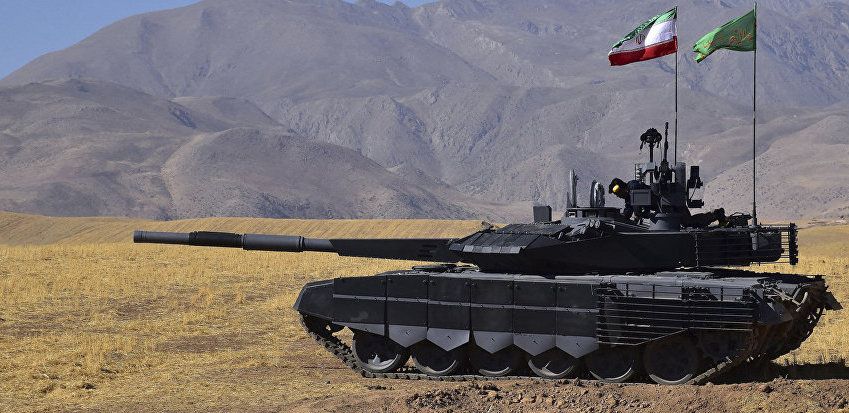
Unveiled in March 2017, the Karrar main battle tank - meaning Striker in Farsi - was developed as an indigenous heavy Iranian armoured platform designed to reduce the country’s longstanding reliance on Russian made armour and match the latest tanks fielded by rival powers in the Middle East. While the Iranian Army and Revolutionary Guards Corps had to rely on antiquated British and U.S. tank designs during the Iran-Iraq War - namely the Chieftain and M60 acquired in large numbers under the Western aligned Pahlavi dynasty - to counter more capable Iraqi armour, the country moved to acquire advanced artillery from North Korea to compensate for this disadvantage and would go on to acquire Soviet made battle tanks in the war’s aftermath. With the Warsaw Pact disintegrating and the USSR collapsing, the opportunities for Iran to acquire battle tanks from cash strapped eastern European countries and Soviet successor states were manifold, providing the country with considerable opportunities to modernise its capabilities.
Iran’s ground forces would acquire 104 T-72M1 battle tanks from Poland and 37 of the same model from Belarus, alongside approximately three hundred older T-62 and T-55 platforms. To enlarge its T-72 divisions, Iran acquired a licence from Russia to produce the T-72S - manufacturing over 2,500 of the battle tanks domestically. This licence production revolutionised the country’s armoured warfare capabilities, and made the formidable battle tank the mainstay of the country’s armoured divisions. While the T-72 also formed the backbone of Russia’s armoured units, and continues to do so until today as the country upgrades older tanks to the highly sophisticated B3 variant, export variants of the platform sold to Iran, much like those sold to Iraq and Warsaw Pact nations, were considerably less capable than those deployed by the Russian Army itself.
Alongside acquisition of Soviet platforms, Iran’s armed forces would from 1996 also manufacture Type 72 tanks under a joint program with Sudan - a heavily modernised variant of the Chinese Type 59. While the platform’s design was essentially obsolete even when heavily upgraded, it nevertheless provided the country with a highly cost effective armoured warfare capability and with considerable experience in the manufacture of battle tanks. The Zulfiqar 1 and Zulfiqar 3, heavily based on the obsolete American M60 but integrating a number of features from the advanced T-72, were somewhat more capable indigenous designs. Their capabilities nevertheless were considerably behind those of even the relatively basic T-72 variants acquired from Russia. It was only with the commissioning of the Karrar, a platform announced in March 2017, that Iran appeared to have developed an indigenous platform on par with the T-72 - based on what little is known of its capabilities. The platform appears remarkably similar to the T-90 battle tank, itself an advanced derivative of the T-72, and reportedly deploys an electro optical fire control system, laser rangefinder, ballistic computer and advanced night fighting capabilities. To enhance its survivability, the platform makes use of composite and explosive reactive armour, while the vehicle also makes use of an autoloader. The Karrar has been heavily influenced by the latest Russian designs, using the same 125mm smoothsabre cannon, though it is heavier than either the T-90 or the T-72 at over 50 tons. The Karrar and its future derivatives are set to form the backbone of Iranian armoured warfare capabilities, and their manufacture could well lead to older designs such as the T-62 being removed from frontline service and placed in reserve or used in a training role.
