
Indian Navy Makes First Carrier Landing With Indigenous Tejas Fighter - A Look to the Program's Future
Military Watch Magazine Editorial Staff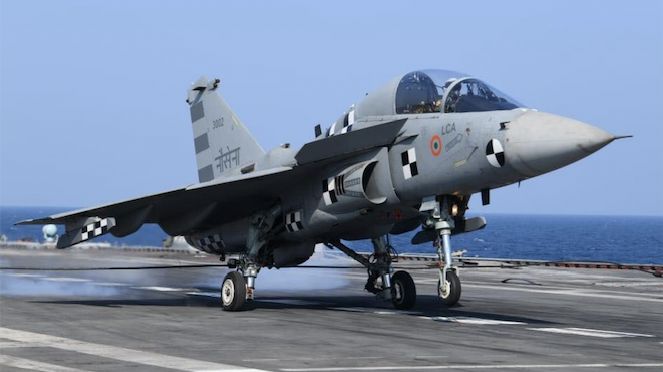
Tejas N Carrier Based Fighter Prototype
The Indian Navy carried out its first aircraft carrier landing using a navalised variant of the Tejas single engine lightweight fighter on January 12th, with this aircraft being designated the Tejas N. This successful test comes less than a year after the conventional ground based Tejas fighter was accepted into service in the Indian Air Force, after almost four decades under development, and paves the way for further tests of the carrier based variant. The Indian Navy currently fields a single aircraft carrier, the INS Vikramaditya, but will receive a second lighter ship, the INS Vikrant, by the end of 2022. Both fighters make use basic ski jump launch systems, and will deploy Russian MiG-29K twin engine medium weight fighters. Should the fighter be deployed from Indian carriers in future, the Tejas N will be the only fourth generation single engine carrier based fighter in service, and will provide a lighter complement to the MiG-29K. A number of navies have adopted combinations of two separate but complementary classes of fighters from different weight ranges - including the U.S. with the F-18E and F-35C, Russia with the Su-33 and MiG-29K and China with the J-15 - which is expected to be joined by a lighter fifth generation fighter possibly based on the J-31. Should it be accepted by the Navy, the Tejas N will field by far the lightest carrier based fighter in service - over 33% lighter than the Rafale M and MiG-29K.
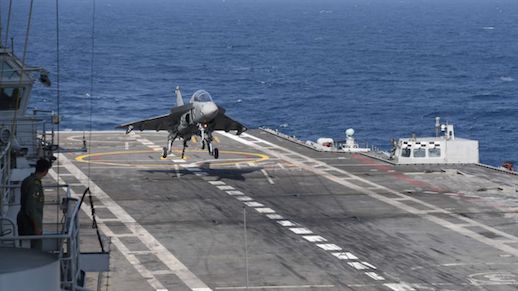
Military officials involved in the Tejas N program were quick to emphasise that the successful test had placed India among a select group of countries which had designed modern fighters capable of operating from carriers. Defence minister Rajnath Singh marked it as a “great event" in the history of Indian military aviation, congratulating the Navy and the Defence Research and Development Organisation (DRDO) for their work. The Tejas lacks the speed, manoeuvrability, weapons payload, altitude and climb rate of the MiG-29K, and carries a considerably smaller radar, but is prized for its low cost and low maintenance requirements. While officially an indigenous design, the fighters rely heavily on foreign technologies including an American General Electric F404 engine, Russian R-77 and R-73 air to air missiles and EL/M-2032 multi mode fire control system and EL/L-8222 ECM jamming pods from Israel’s Elta. It remains uncertain how the Tejas N program will evolve, but this will likely depend heavily on the course taken by India’s third carrier program - the INS Vishal - which may lead to requirements for a Tejas fighter variant compatible with an electromagnetic catapult rather than a ski jump launch system. The only other manufacturers of carrier based fighters are the United States, China, Russia and France.
