
China’s HQ-9B Can Now Provide Multi-Layered Long Range Air Defence: New Missiles and Launchers Unveiled
Military Watch Magazine Editorial Staff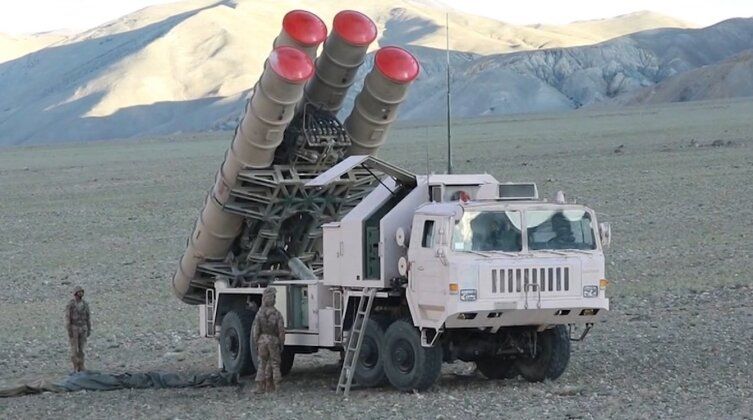
HQ-9B System`s Surface to Air Missile Battery
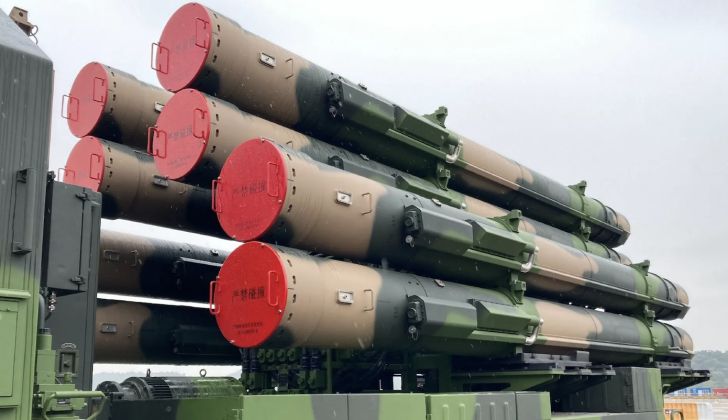
The Chinese People’s Liberation Army (PLA) Central Theatre Command has confirmed the deployment of a new variant of the HQ-9B long range air defence system, with images released by the command showing HQ-9Bs in a new configuration with transporter erector launchers carrying a smaller lighter class of surface to air missile and accommodating up to eight per launcher. Previously HQ-9s deployed only larger and longer ranged missiles, of which four could be accommodated on each launch vehicle. Commenting on the images, the state run Global Times noted that the new smaller missiles were designed to engage targets at shorter ranges, thus complementing the longer range missiles to allow each HQ-9B to provide more layers of protection. The HQ-9B is by far the most widely produced long range surface to air missile system outside Russia, and much like its better known Russian counterpart the S-400 it emphasises high mobility and deploys missiles, radars and command units from mobile trucks to improve survivability. The much more sophisticated state of China’s electronics and radar industries have led analysts to widely consider the HQ-9B to retain advantages over its Russian rivals in associated performance areas.
Unlike Russia, which has made only minimal investments in its fighter aviation capabilities since the end of the Cold War, and relies on ground based systems as its primary means of protecting its airspace, the Chinese PLA invests far more in fighter aviation, and deploys ground based systems in a complementary supporting role. Russian industry was notably the first to produce air defence systems capable of deploying multiple missiles classes with very different but complementary ranges, with this considered revolutionary for allowing a single system to respond to several kinds of threats with different missiles optimised to each one. Chinese and North Korean systems have since demonstrated a similar capability. The HQ-9B has seen growing successes on export markets, with British sources having reported that the system has been exported to Turkmenistan, Uzbekistan and Pakistan, with the former two having selected the system over competing Russian alternatives to succeed Soviet era S-200s. Unconfirmed reports have also indicated that exports have been made to Morocco. A lighter counterpart to the HQ-9B, the medium ranged HQ-22 system, was also selected by Serbia despite Western pressure to acquire NATO-standard systems, with these having been delivered in April 2022.
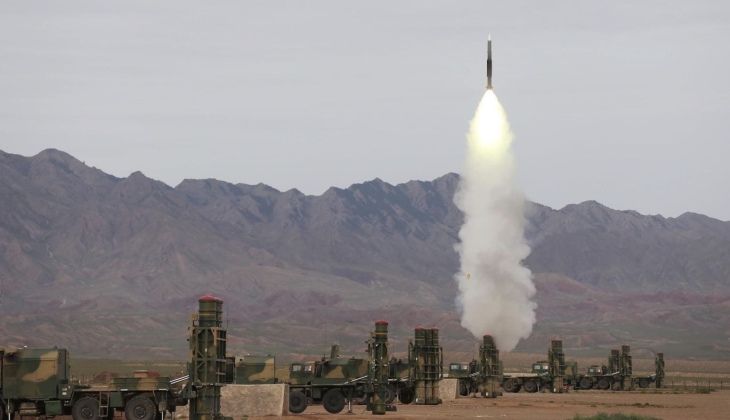
The HQ-9B’s 250 kilometre engagement range allows each system to engage targets over areas of almost 200,000 square kilometres, with its 360 degree radar coverage and cold launch system allowing for engagements in all directions. This alongside improved sensors and data links was one of the system’s primary improvements over the HQ-9A, which began entering service around ten years before it in 2000-2001. Early development of the HQ-9 in the 1990s is reported to have benefitted significantly from technology transfers both from Soviet successor states, most notably Russia which made massive exports of S-300 systems that decade, as well as from Israel which had access to technologies from the latest variants of the American Patriot system. Significant improvements to China’s defence sector and broader tech sector allowed it to end its reliance on technology transfers, and to rely on indigenous technologies to develop and improve the HQ-9B.
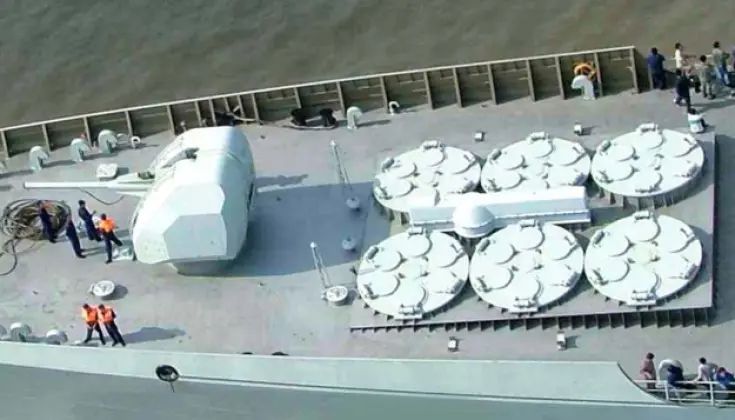
Exercises featuring the HQ-9B have been reported frequently, and included launching electromagnetic attacks on the systems and simulated air attacks in red vs. blue team drills. Former PLA officers have stressed the need to operate these systems in unfamiliar terrain, and to test personnel intensively from the beginning of new systems’ commissioning into service. The system has deployed in significantly numbers to major potential hotspots, including strategically located islands in the South China Sea. HQ-9Bs were in 2015 deployed to Hotan in Xinjiang province, close to Indian claimed territories in Kashmir, with the lack of comparable systems in Indian service thought to have been a major factor in Delhi’s decision to place orders for Russian S-400s three years later. Alongside ground based deployments, a navalised variant of the HQ-9B, the HHQ-9B, has been widely used by the PLA Navy from the mid-2010s on over three dozen surface destroyers - namely the Type 052C, Type 052D and Type 055 classes. Complementary shorter ranged air defence on these destroyer classes is provided by close in weapons systems and HHQ-10 short ranged surface to air missiles.
