
How Russia is Restoring the 2S7M Malka Nuclear Capable Superheavy Artillery Systems For Frontline Service
Military Watch Magazine Editorial Staff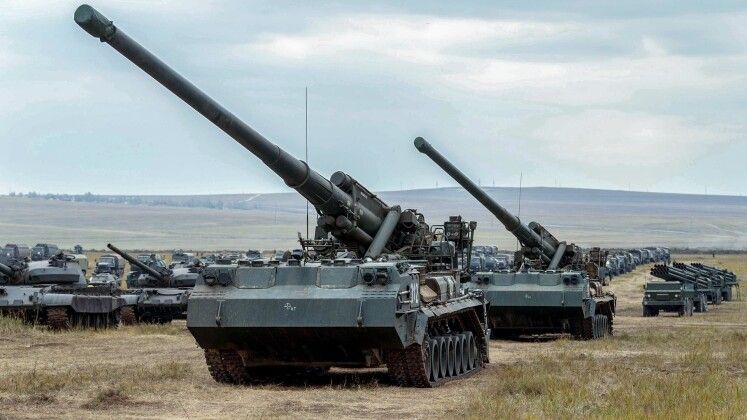
2S7M Malka Artillery Systems
Russia has invested heavily in the modernisation of its Soviet era 2S7M Malka superheavy self propelled artillery systems, with these systems having first entered service 1976 as the older 2S7 Pion and seeing a 15 year production run. The artillery systems had 203mm barrels and shells, where 155mm systems were the norm and the 170mm Koksan systems used by neighbouring North Korea was already considered abnormally large. Modernised versions of the artillery system began to be received in April 2020, which built on previous improvements made in the 1980’s to improve the rate of fire, greater accuracy and a larger ammunition load. The 1980s round of modifications saw the system re-designated as the 2S7M Malka. The latest upgrade saw the system’s gearbox, internal communications and radio station replaced and all Ukrainian made components phased out entirely, while also improving all major characteristics of the gun as well as the vehicle’s running characteristics and manoeuvrability. The Malka system is notably based on the chassis of the T-80 - the Soviet Union’s heaviest class of battle tank - and with much of the infrastructure and one of the main T-80 production lines and maintenance facilities located in Ukraine investments were required for Russia to be able to fully service the Malka domestically.
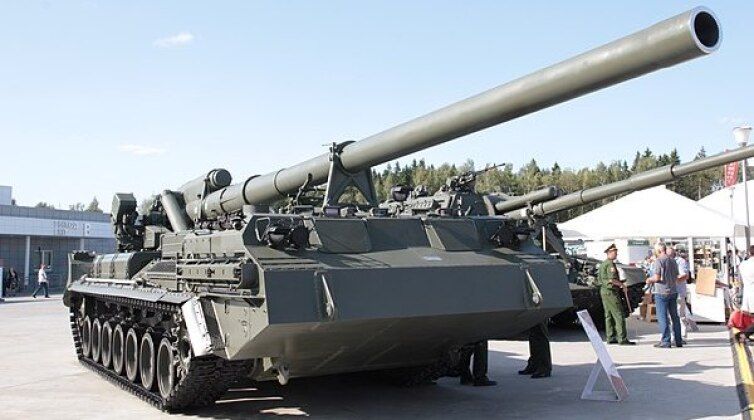
Malka artillery systems were previously primarily held in storage, and the decision to return them to frontline service and refurbish and modernise them notably comes at a time of high tensions between Russia and NATO and following cuts to Russian defence spending. Their age and questionable preservation in storage had meant that rusting gears and navigation mechanisms also needed to be replaced. Although the Malka artillery system has a shorter range and much lower rate of fire than rival designs, the sheer size of its shells makes it ideal for neutralising more durable or fortified targets. High explosive charges fired by the system weigh over 100 kg and carry 17.8 kg of explosive materials - sufficient to leave a five meter crater in the ground with a single shot. More expensive active rocket ammunition with laser navigation systems have more recently been integrated onto the artillery system, and provide a higher degree of precision.
The Malka system can also fire tactical nuclear warheads, which is potentially a highly valuable capability considering the Russian Military’s general heavy reliance on the use of such weapons in the event of a war with NATO and the overwhelming numerical disadvantage the Russian Army faces on the ground. Despite the considerable strength of their shells the Malka has a relatively short engagement range of just 50km - compared to ranges of approximately 70km for both the newer and lighter Koalitsiya-SV and the Korean Koksan and a 100km range for the Chinese Type 05. It remains uncertain whether Russia will invest in developing new ammunition types for the systems to extend their ranges and bring them closer to the level of more modern systems.
