
Chinese Destroyers’ Unique Vertical Missile Launchers Provide Distinct Advantage with Combined Hot and Cold Firing Capabilities
Military Watch Magazine Editorial Staff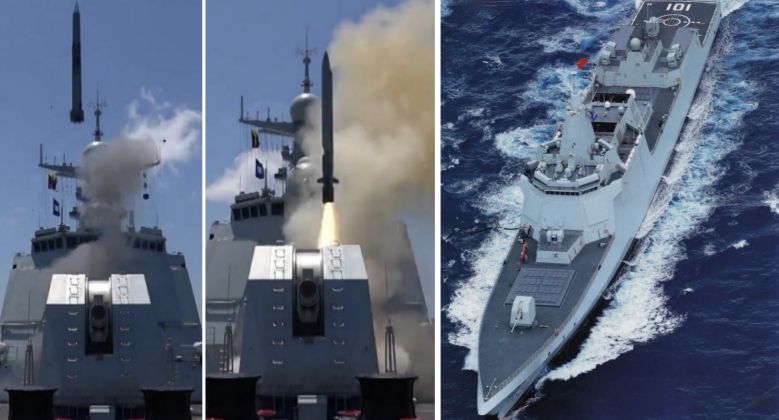
HHQ-9 and YJ-18 Launches and Chinese Type 055 Destroyer
New footage released by the Chinese People’s Liberation Army Navy’s East Sea Fleet has provided a rare close view the vertical launch system aboard a Type 052D guided missile destroyer, with launch cell covers opened to expose the configuration of China’s universal missile launch system. The images offer one of the clearest looks yet at how the Navy’s standardised vertical launch system accommodates a wide range of missile types using both cold and hot launch methods. The destroyers use the same Haitong-1 universal vertical launch system as the larger Type 055 class destroyers, which provide a common launch architecture across the Navy’s modern surface combatant fleet. At least 59 Type 052D and Type 055 class destroyers have been laid down for the Navy, with at least 45 now in service.
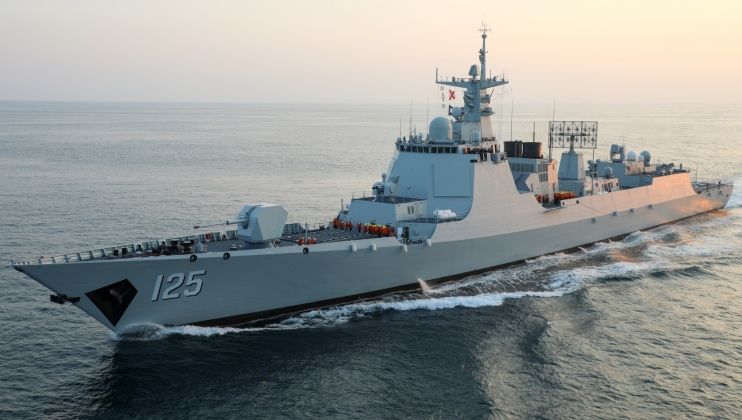
Key to the Haitong-1 system’s ability to accommodate missiles of significantly different lengths is the fact that each launch cell has a diameter of approximately 850 millimetres and is produced in three depth variants - 3, 6 and 9 metres. Its compatibility with both cold-launch and hot-launch missiles within the same launcher is one of its most outstanding features, and contrasts with many Western and Russian vertical launch systems, which generally specialise in one launch method or the other. By standardising launcher dimensions while permitting both launch techniques, the Navy can deploy a diverse mix of weapons tailored to different missions.
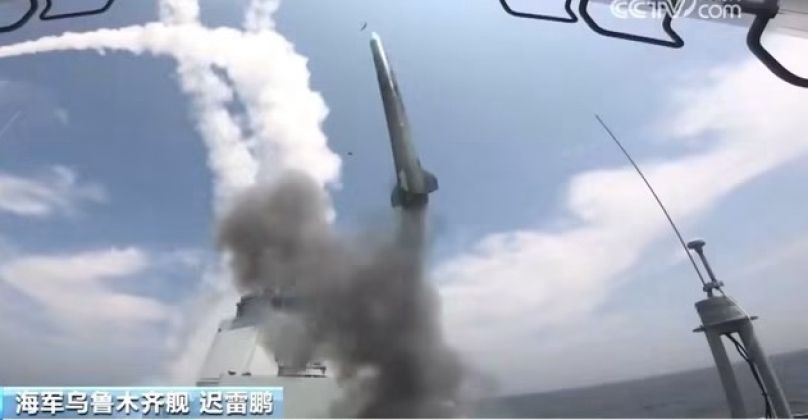
The newly released imagery distinguishes between the two launch types by highlighting different cell covers. The cells identified by red labels house YJ-18 anti-ship cruise missiles, which use a hot-launch process. In this configuration, the missile ignites its own rocket motor while still inside the launch cell, using its thrust to burst through the protective cover and leave the launcher under its own power. Because the missile itself breaks through the cover, the protective cap can employ a lighter raised design than that used for cold-launched weapons.
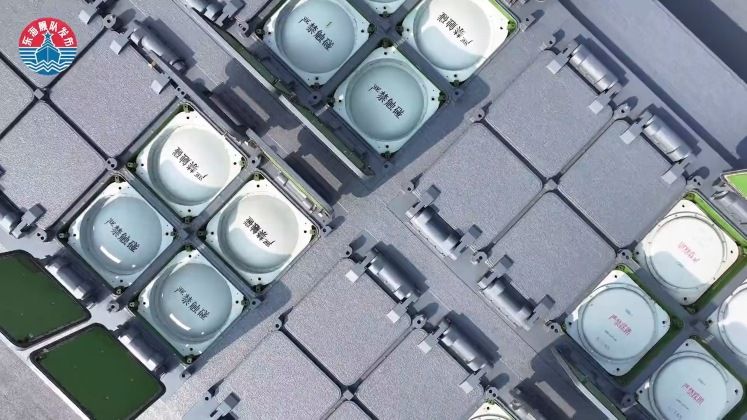
Beneath the black-labelled protective covers are HQ-9 long-range surface-to-air missiles, which employ a cold-launch technique. Before launch, an explosive charge breaks apart the protective cover, after which a gas generator ejects the missile vertically out of the launch tube. Only once the missile has safely cleared the ship does its main rocket motor ignite. This approach reduces thermal stress on the launcher and allows missiles to be safely launched without directing rocket exhaust into the ship. The new YJ-20 hypersonic ballistic missile recently integrated onto Type 055 and Type 052D class destroyers also uses a cold launch system.
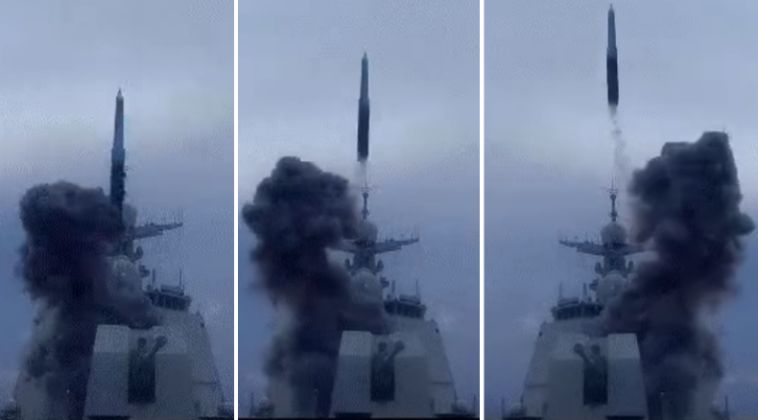
The universal nature of the Haitong-1 system has been one of the defining characteristics of China’s latest generation of major surface combatants. Depending on operational requirements, Type 052D and Type 055 warships can carry combinations of long-range air defence missiles, anti-ship cruise missiles, land attack cruise missiles, anti-submarine rockets, and other future weapons without requiring different launcher designs. The Type 052D currently fields 64 vertical launch cells, while the Type 055 integrates 112 cells, both using the same launcher standard. The shared architecture simplifies logistics, eases integration of new missile types, and provides considerable flexibility in configuring each vessel’s weapons loadout.
