
China Expands Counter Space Capabilities as U.S. Puts New Weapons in Orbit
Military Watch Magazine Editorial Staff
Satellite Engagement Using Laser Weapon - Artwork
China is expanding its arsenal of counterspace weapons, including systems designed to operate in orbit and threaten satellites at higher altitudes, according to a new report from the U.S. Defence Intelligence Agency (DIA). The third edition of Challenges to Security in Space, released in late October assesses that the People’s Liberation Army (PLA) is developing space-based directed-energy weapons and electronic warfare systems alongside ground-based lasers and anti-satellite missiles. The report marks an expansion of previous U.S. intelligence assessments by explicitly identifying on-orbit jamming systems as part of China’s counterspace capabilities. Its release follows a statement by U.S. Air Force Secretary Troy Meink on September 14 confirming for the first time that the U.S. Armed Forces had placed weapons in space.

The DIA states that China already possesses ground-based laser weapons capable of disrupting, degrading or destroying satellites in low Earth orbit. By the late 2020s, the PLA may field space-based directed-energy systems and more powerful ground-based weapons capable of threatening satellites operating in higher orbits. Such systems could employ high-powered lasers or other forms of directed energy to interfere with satellite sensors and potentially damage spacecraft. Lasers capable of dazzling optical sensors could temporarily or persistently impair satellites’ ability to observe the Earth, while more powerful systems could pose a broader threat to spacecraft. The report also assesses that China probably intends to deploy additional anti-satellite missiles capable of destroying spacecraft in low, medium and high Earth orbits.
Electronic warfare represents another major area of development. The report states that the PLA’s jamming capabilities combine ground-based and orbital systems, giving Chinese forces multiple options for disrupting adversary space assets during a conflict. It also identifies Chinese development of jammers designed to target synthetic aperture radar (SAR), including systems carried by military reconnaissance satellites. SAR satellites can produce images of the Earth’s surface in darkness and through cloud cover, making them valuable for tracking military movements and identifying targets regardless of weather conditions. Disrupting these systems could therefore complicate US efforts to monitor Chinese forces and provide targeting information to deployed units.
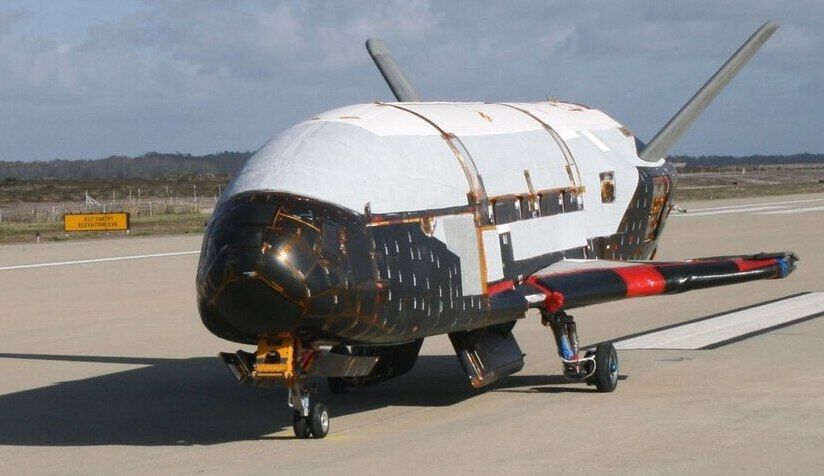
The DIA report also includes a rare image of China’s experimental reusable spaceplane, captured by commercial satellite imagery provider Maxar. The spacecraft has frequently been compared with the U.S. Space Force’s X-37B orbital test vehicle because of its broadly similar configuration and potential for extended orbital missions. According to the report, China’s spaceplane has released objects into orbit and subsequently manoeuvred around and rendezvoused with other satellites. Such operations demonstrate an ability to conduct complex activities in space, although the spacecraft’s precise mission and the extent to which it is intended to support military operations remain undisclosed.
