
Can Russia’s New Jet-Powered ‘Kamikaze’ Drone Punch Through Western Defences?
Military Watch Magazine Editorial Staff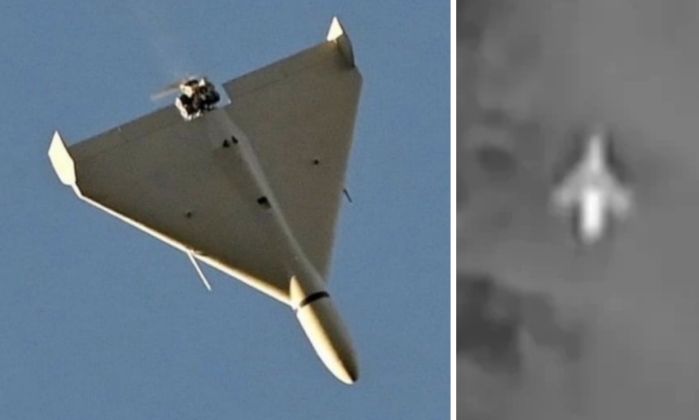
Shahed 136 and Unknown Jet Powered Drone
Footage from the Ukrainian theatre has confirmed that the Russian Armed Forces have begun using a new type of jet-powered single use drone, which was seen striking and destroying a rocket artillery launcher from a U.S.-supplied HIMARS system. The footage, published by the unit operating a supporting reconnaissance drone, captured the moment the target was detected and coordinates were passed to the jet powered kamikaze drone, which appeared as a fast arrow-shaped airframe that approached at high speed. Although Russia began widely useing single-use drones against Ukrainian forces from September 2022, when the first Shahed 136 drones were supplied by Iran, these used propellers and were thus more limited in their speeds, leaving them more vulnerable to being shot down and delivering less kinetic energy upon impact.
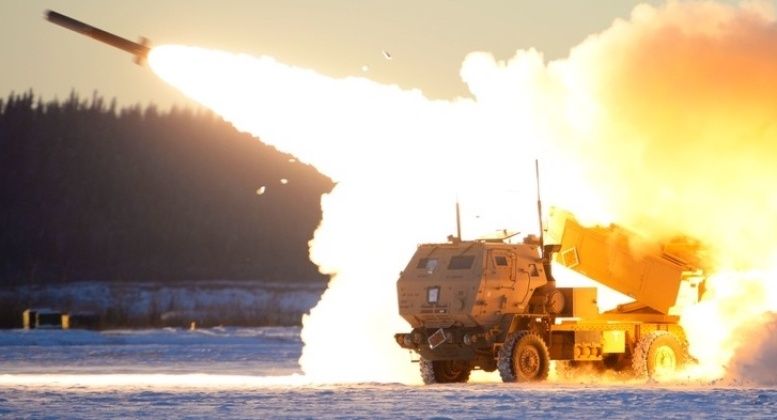
The new aircraft seen in the latest footage was notably not the first jet-powered single use attack drone operated by Russian forces in the theatre, with the Iranian Shahed 238 reported to have first been used to strike targets in Ukraine in January 2024. The aircraft had first been unveiled in November the previous year, with its development in Iran thought to have been largely influenced by the need to meet Russian demand. The lack of widespread use of the Shahed 238, however, indicates that it was not favoured by Russian forces, possibly due to its limited cost effectiveness compared to the much cheaper Shahed 136. The newer single use drone seen in the latest footage has a distinct appearance, with a swept-wing layout, a small jet engine, and a guidance setup consistent with FPV operation, and has a high level of responsiveness allowing it to pursue moving targets. These capabilities are expected to make it highly costly.
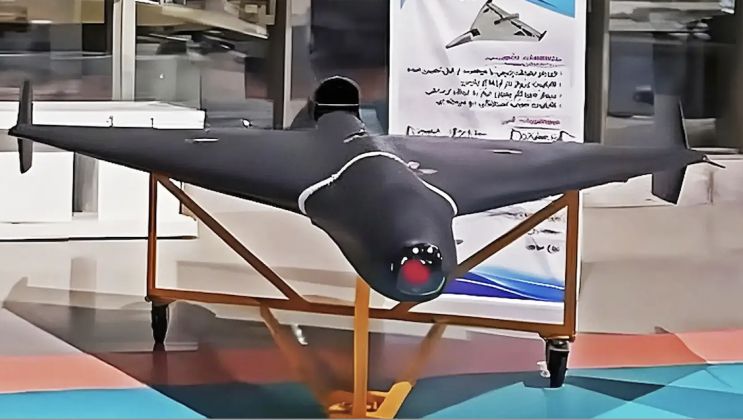
It has been speculated that the new aircraft seen in the latest footage may be the Geran-5, which uses a more conventional aerodynamic configuration than the Shahed 136, and combines a 90 kilogram warhead capacity with a 1000 kilometre range. The Geran-5 has a tube-like fuselage with a centrally mounted straight wing, and a straight horizontal tail, making it distinct from the Shahed series, with some similarity to the Iranian Karrar drone. There remains a significant possibility that the aircraft was developed jointly by the two countries. Ukrainian intelligence reports have claimed that, other than its engine, the Geran-5 uses similar components to the Shahed 136, which indicates that it may not be the latest aircraft seen targeting the HIMARS launcher, which reportedly has far more advanced guidance capabilities.
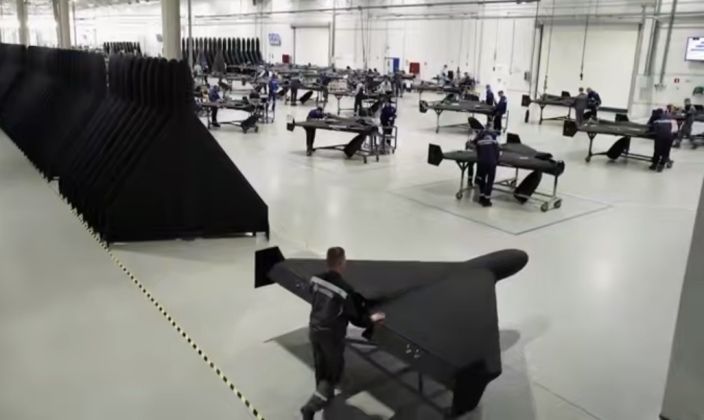
The new jet-powered single-use drones are expected to fill a niche in the Russian inventory between lower cost guided rocket artillery and Shahed 136 drones, and higher cost cruise and ballistic missiles. They will likely be procured on a fraction of the scale of the Shahed 136 and reserved for use against higher value targets. The speed seen in the footage indicates that the drone can be deployed quickly following target detection, which reduces the ability of Ukrainian units to react. This is particularly important when targeting mobile systems such as HIMARS or S-300 launchers, which can quickly redeploy to complicate targeting. With NATO members’ air defences having struggled to intercept even limited numbers of much slower single use drones when they crossed over from Ukrainian airspace, the new aircraft could pose significantly greater challenges for Western Bloc defences.
