
Britain Announces Biggest Defence Budget Hike in Over 30 Years: Assessing the Implications For UK Military Power
Military Watch Magazine Editorial Staff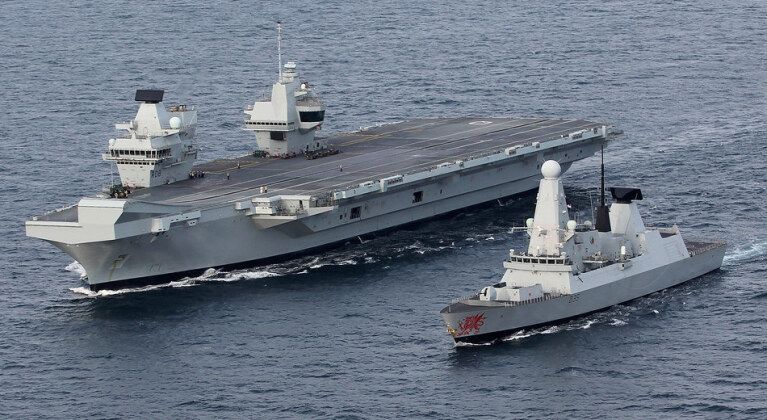
British Queen Elizabeth Class Carrier and Type 45 Class Destroyer
The British Armed Forces are set to benefit from the greatest increase to their budget in over three decades, with Prime Minister Boris Johnson vowing to end the country’s “era of retreat” and pledging to add an additional $22 billion to spending over the next four years. “Our national security in 20 years’ time will depend on decisions we take today… The international situation is now more perilous and intensely competitive than at any time since the Cold War,” he stressed when announcing plans to boost spending. This development came as a major surprise to a number of analysts, with Britain being among the worst hit by the COVID-19 crisis with the effectiveness of its response widely criticised. The resulting economic contraction has been unprecedented since the Second World War, leading to widespread expectations that the defence budget would see deep cuts alongside other fields of public spending. The British defence budget suffered from prior cuts throughout the early and mid 2010s in the wake of the 2008 financial crisis under a stringent austerity program, and with the economic contraction of 2020 being far sharper than that 12 years prior it was expected that, if anything, cuts to spending would be deeper. With the British Armed Forces oriented overwhelmingly towards projecting power overseas, rather than territorial defence, the rise in spending will almost certainly lead to greater activities overseas.
Britain is expected to become the largest defence spender in Europe, with funds set to be diverted towards an artificial intelligence centre and a Royal Air Force Space Command - following on from the U.S. which established its own Space Force under the Donald Trump administration. The spending increase would also supposedly “restore Britain’s position as the foremost naval power in Europe,” with the state of the Royal Navy leaving much to be desired following the previous rounds of budget cuts and combat readiness rates remaining low. The spending hike comes as Britain commits to a ‘Pivot to Asia’ initiative similar to but more moderate than that of the United States, and pledging to establish a major military presence in East Asia. Indeed, when previously serving as foreign minister Boris Johnson had pledged that the first deployment of Britain’s first new carrier battle group, built around the warship HMS Queen Elizabeth, would be to the East Asian region. Britain has already committed heavily to patrolling waters near the Korean Peninsula to enforce Western drafted United Nations Security Council resolutions restricting the country’s commercial trade, and with the modernisation of China’s armed forces increasingly seen as a threat to Western primacy British and other European support for U.S. efforts in countering Chinese power in East Asia is expected to grow.
