
An Update on Russia’s Su-57 Fighter Program: Assessing Current Production and Possible Future Orders
Military Watch Magazine Editorial Staff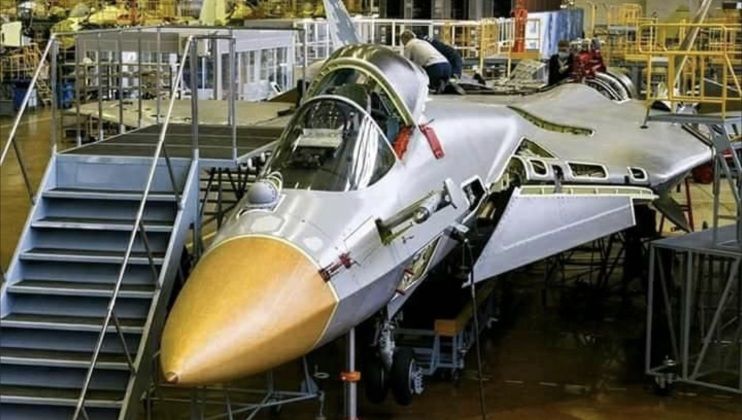
Su-57 Next Generation Fighter in Production
Russia’s Ministry of Defense has released the first images of the Su-57 next generation heavyweight fighter in mass production, after an order for 76 of the jets was placed in 2019 with production to fulfil it beginning in July that year. Russia previously released images of Su-57 fighters in serial production in 2019 - although these were fulfilling a much smaller order for 12 fighters which had a production rate of under 1.5 jets per year, and could not be considered mass production at all. The Russian Air Force still has yet to receive any serially produced Su-57 fighters, and it remains uncertain whether the order for 12 fighters was terminated once the one for 76 fighters was placed or how, if the two orders are being fulfilled simultaneously, the production lines have merged them. It is widely thought that 76 jets are currently on order, rather than 88, and that the order for 12 fighters was cancelled when the larger one was placed.
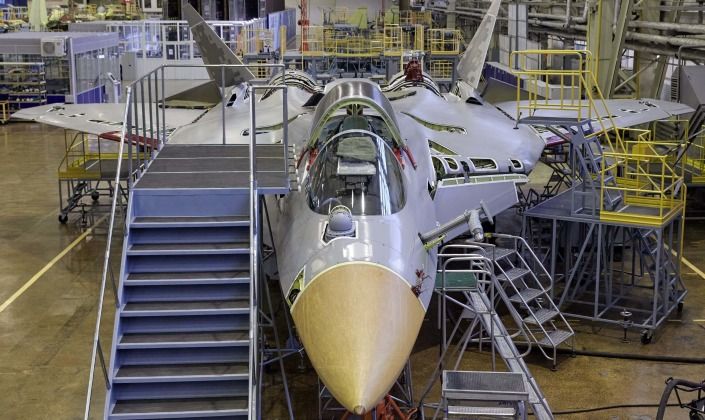
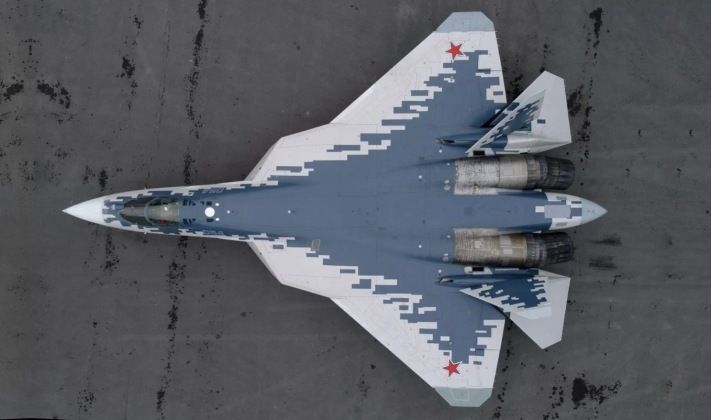
Russian Defense Minister Sergey Shoigu led a delegation to Sukhoi’s Komsomolsk-on-Amur aviation plant on August 12th 2020, where the images of a Su-57 fighter under serial production was taken and publicised. The serial production aircraft are expected to have significant differences to those of the flight prototypes, one visible one being modified asymmetrical air inlets at the base of the leading edges of the twin vertical stabilisers. Another is a lower radar cross section due to different production methods, which is very common when comparing prototypes to mass production aircraft. Compared to the previously released image of small scale production, some Western analysts have also pointed out that new mass production aircraft appear to have a superior manufacturing quality - with the Defense Editor of American magazine Aviation Week, Steve Trimble, citing the tolerances on the skin panels in particular. It is notable that issues were repeatedly highlighted with producing the Su-57 on such a small scale to fulfil the initial order, and it is to be expected that mass production aircraft will be both cheaper and of a better quality.
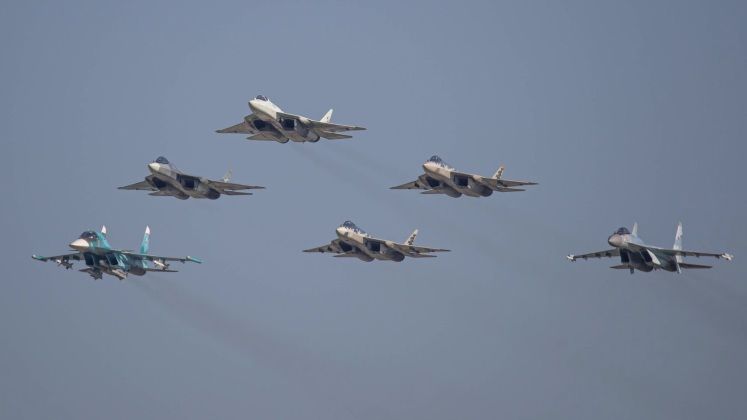
Although an order for 76 fighters over an eight year period is not particularly high, with an average production rate of 9.5 aircraft per year, it must be taken into account that the Su-57 is just one of five fighters currently being produced for the Russian Air Force alongside the Su-35, Su-34, Su-30SM and MiG-35 - all but the MiG-35 in greater numbers than the Su-57. This contrasts to the United States Air Force, which until 2020 had seen only a single fighter class, the F-35A, being produced to meet its needs. Producer Lockheed Martin was producing approximately 100 of these per year, although a significant proportion of these were being diverted for export to almost half a dozen clients which meant the U.S. Air Force was not actually receiving new aircraft at a much higher rate than the Russian Air Force.
With Russia in 2019 revealed two be producing the Su-57 with a flyaway cost of $35 million each, significantly less than the F-35A at $80 million despite being a much larger aircraft produced on a much smaller scale, the possibility that the Russian Air Force will in future cut orders for Su-30SM, Su-35 and possibly even Su-34 fighters to focus on the program is significant. Not only could this allow for a production rate many times as high, but could also drive costs down further due to the benefits of economies of scale. By this time, the Su-57 design is expected to have matured considerably with a number of next generation technologies currently under development likely to be ready for integration onto serial production airframes - from new hypersonic missile classes to artificial intelligence and new electronic warfare systems.
