
After the Queen Elizabeth Class; What the British Royal Navy’s Lighter Amphibious Assault Carriers May Look Like
Military Watch Magazine Editorial Staff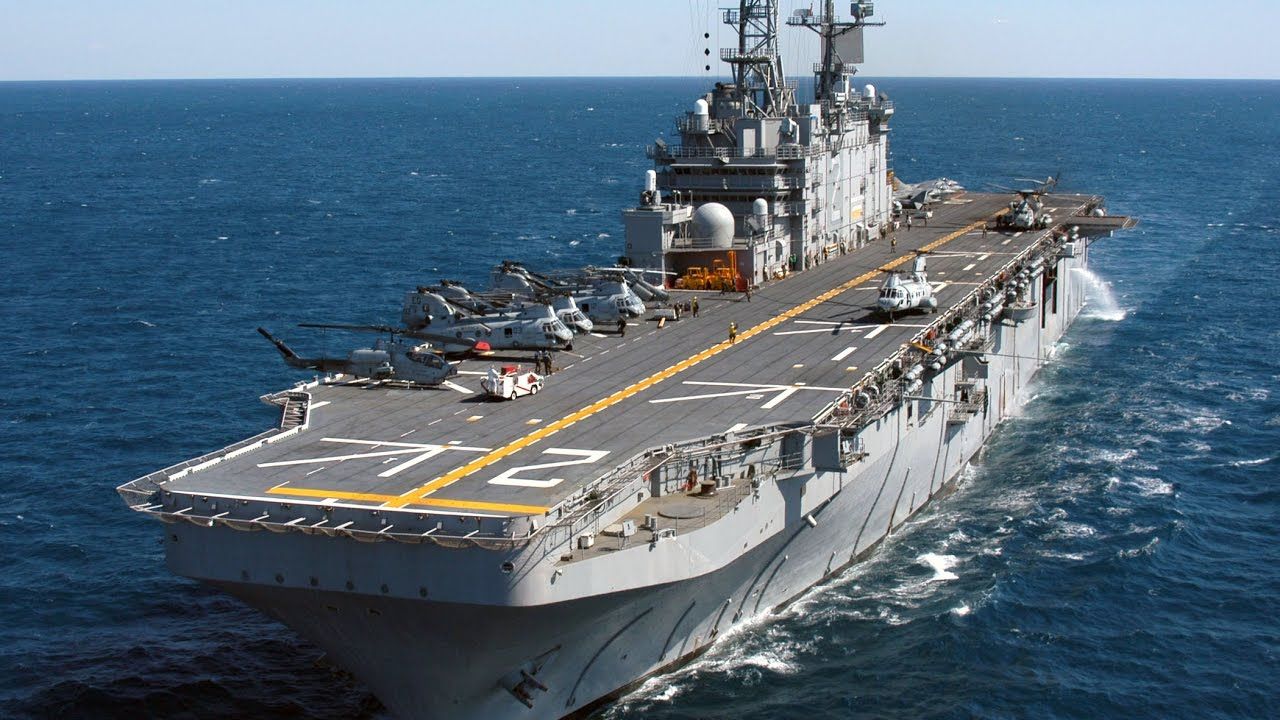
USS Saipan Amphibious Carrier
With Britain’s Defence Committee strongly advocating for the acquisition of aircraft carrying amphibious assault ships to serve in a complementary role alongside the Royal Navy’s heavier Queen Elizabeth Class carriers, the country could potentially deploy a fleet of four or more carrier warships by 2030. Calls for more carriers have come amid growing threats to the Western Bloc’s primacy unprecedented since the Cold War, with London taking a leading role in supporting American efforts to respond and deploying considerable military assets across the world. These have included fighters and warships participating in U.S. led wargames in East Asia targeting China - set to later be joined by the Queen Elizabeth Class carriers, as well as participation in drills projecting attacks on North Korea - involving British ground, air and naval contingents, deployment of a fast growing number of ground assets to Eastern Europe facing Russia, and construction of a sizeable naval base 250km from the Iranian coast - to name but a few leading examples. With Britain’s armed forces overwhelmingly oriented towards projection power abroad, rather than a territorial defence role, the country’s current lack of assault carriers since the retirement of the warship HMS Ocean remains a considerable shortcoming.
The shape potential new British assault carriers could take remains to be seen, but can be speculated based on the country’s defence needs, budget and the designs which have proven popular abroad in recent years, which options are likely to be pursued. Even if the country’s defence budget does increase to 4%, as has been strongly advocated by key figures in the military for some time and called for by U.S. President Donald Trump on his recent visit to Europe, the Royal Navy is nevertheless unlikely to commission a large assault vessel comparable to the 40,000 U.S. Wasp and America Class, the Chinese Type 075 or the large carriers currently under development in Russia. The immense cost of these warships, designed to deploy specialised combat aircraft as well as helicopters while carrying sizeable contingents of Marines and armoured vehicles, is very likely to be a prohibitive factor. A more likely possibility is that the Navy will choose to commission a warship of around 20,000 tons similar to the French Mistral or South Korean Dokdo Class - the former displacing 21,000 tons at full load and the latter 18,000.
The Mistral and Dokdo are considerably cheaper to built and operate than large warships such as the Queen Elizabeth Class, and they are capable of carrying approximately 900 and 750 Marines respectively alongside several dozen armoured vehicles. Despite their highly similar size and capabilities, the Korean Dokdo Class was commissioned for less than half the cost of the Mistral. This was also despite the French vessels being built in far larger numbers and thus benefitting from economies of scale. The cost of the British assault carriers are likely to be closer to those of the French warships - around $700 million each, leaving a possibility that the country could attempt to commission them abroad to minimise costs - either in South Korea or Japan. Such a course of action would hardly be unthinkable given recent trends in acquisitions, which have attempted to balance cost effectiveness with the need to support continued indigenous shipbuilding capabilities.
Assault ships of the Dodo and Mistral size can deploy approximately 10 helicopters, and can be pressed into service as anti submarine warfare ships similar to the original purpose of the British Invincible Class - light carrier warships with displacements close to those of the assault ships. The high complement of armoured vehicles and Marines make assault ships of this size a highly viable and cost effective means of projecting power abroad, and an effective complement to the conventional aircraft carrying capabilities of the Queen Elizabeth Class ships. With Britain eyeing a number of potential joint defence projects with Japan, a country with which defence cooperation has fast expanded and which in early 2018 activated its first amphibious warfare unit with an analogous role to the Royal Marines, the potential for a joint carrier program with the East Asian state remains considerable. While the possibility has been raised that Britain will design its new assault ships to deploy short takeoff and vertical landing fixed wing fighters, given that the country already fields a sizeable carrier fleet and already may struggle to acquire enough of the costly F-35B jets to outfit even its Queen Elizabeth Class warships, this remains highly unlikely - with future assault ships most likely to deploy rotary wing platforms exclusively.
