
A New Front; U.S. Destroyer Challenges Russian in Sea of Japan - First Time Since 1987
Military Watch Magazine Editorial Staff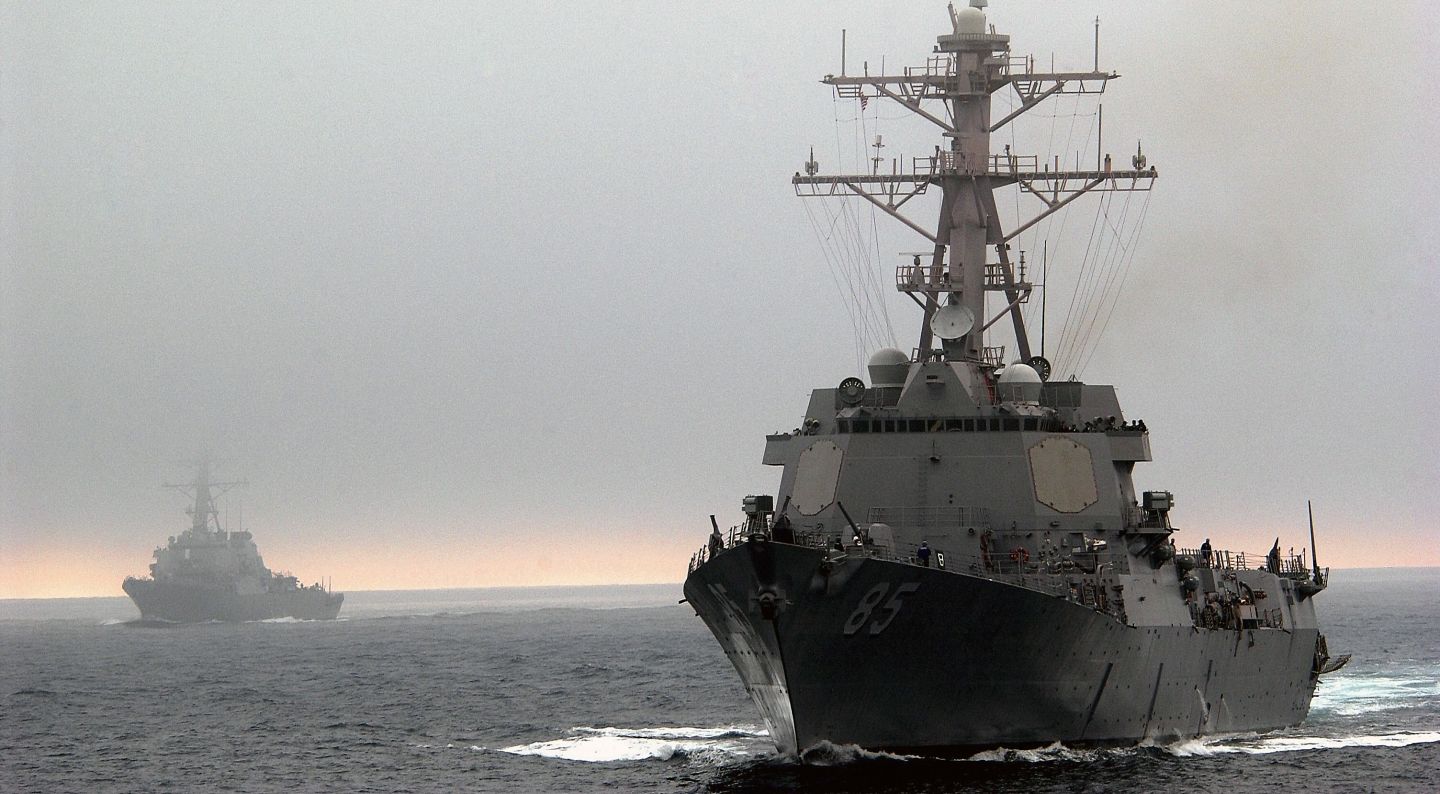
U.S. Navy Destroyers USS USS McCampbell and USS Decatur
The United States Navy’s guided missile destroyer McCampbell, a 9,200 ton Arleigh Burke Class warship, entered the Sea of Japan to challenge Russian maritime claims in the area - according to U.S. Navy spokeswoman Rachel McMarr. The warship "sailed in the vicinity of Peter the Great Bay to challenge Russia's excessive maritime claims and uphold the rights, freedoms and lawful uses of the sea enjoyed by the United States and other nations," a pretext normally used for patrols near the People’s Republic of China’s own seaspace which are likely to increasingly be used to challenge Russia as well. The Peter the Great Bay is the largest part of the Sea of Japan, and home to the Russian Navy’s Pacific Fleet. With Russia having lost its capability to build large warships with the collapse of the Soviet Union, destroyers in service in the Pacific Fleet are all considerably older than the McCampbell which entered service in 2002 - though they have since been upgraded with modern weapons systems and sensors. Russia's plans to restore this capability and construct modern destroyers are unlikely to materialise until the late 2020s.
According the U.S. Navy, the United States does not recognize Russia's claims to the waters near its coast in the Sea of Japan and considers the area international territory. This has provided a valuable pretext to open up a new front against the Eurasian power, as tensions with the Western Bloc continue to escalate. Whether the warship’s presence will be perceived as a threat by the Russian military, which retains advanced anti ship capabilities in the region, remains to be seen, but the McCampbell’s deployment is likely to be the first of many - which could eventually see full U.S. carrier strike groups approach Russian waters in the Pacific. While the McCampbell stayed gave Russia’s claimed Waters a wide berth of over 100km, according to Russian Defence Ministry spokesman Major General Igor Konashenkov, this is likely to change in future operations. The McCampbell's operation marks the first of its kind in over 30 years, since the height of the Cold War when the U.S. Navy had a strong presence near the Soviet Union's Far East. As relations have continued to deteriorate, it was only a matter of time before the U.S. Navy returned to the region. The Russian Navy for its part, while lacking large surface vessels on par with the U.S., deploys among the world’s most capable submarines to the Pacific and relies on these heavily for its defence. Furthermore, the military has recently deployed new air launched hypersonic anti ship cruise missiles to the region which are set to prove a major game changer for the balance of power in the Pacific - threatening hostile warships up to 3,500km from Russian coasts.
