
Defending the Skies for 40 Years; Evolution of Russia’s S-300 Air Defence System - Part Four, S-300V
Military Watch Magazine Editorial Staff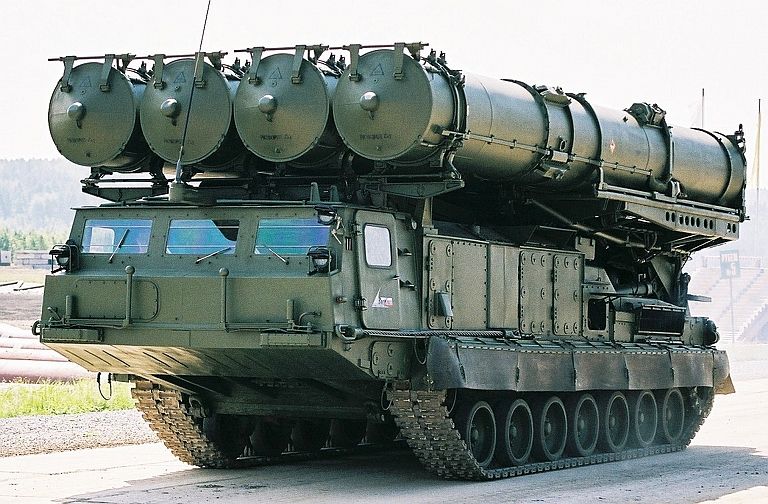
S-300V Surface to Air Missile System
The third S-300 family, the S-300V, remains in production with new variants under development to this day. The original S-300V entered service in 1984, and like systems from the S-300P family was designed as a ground based platform. The missile systems are clearly distinguishable from the S-300P by their tracked launch vehicles, rather than an eight wheel truck, and the different shape configuration of its missile canisters. The platform was built by the Antey Company, rather than by Almaz, before their merger in 2002 to form Almaz Antey which today produces all S-300 variants as well as the S-400 and upcoming S-500. Unlike the S-300P, the S-300V was initially designed as a highly versatile platform able to target ballistic missiles as well as cruise missiles and aircraft. The platform had a considerably longer range than the S-300P, with its GIANT missiles able to engage targets at ranges of up to 100km and altitudes of up to 32km. High altitude targeting was particularly useful for defence against enemy ballistic missiles. Upon entering service, the S-300V became the most advanced air defence platform in the world and far surpassed rival systems both in Russian and abroad in its capabilities.
The S-300V’s use of tracked MT-T launch vehicles made it far more capable of operating off road than other variants - significantly enhancing its survivability. The system’s radars for target acquisition make use of autonomous search capabilities which the S-300P series lack. Mobile transporter erector radars are also used to ensure maximum mobility, and the platform relies heavily on passively scanned array radar systems which can detect targets up to 330km away. The weapons system places a far greater emphasis on ballistic missile defence than other variants, making it a likely priority target for enemy forces - hence why mobility is highly prized.
The successor to the S-300V, the S-300VM, entered service in 2012 and retains considerably superior capabilities relative to its predecessor. Upgrades include new radar systems, new command posts, improved electronic warfare countermeasures and new missiles for a longer engagement range of 250km. Like its predecessor, the platform was truly revolutionary and became the very first in the world capable of engaging cruise missiles, ballistic missiles and aircraft simultaneously. The S-300VM is capable of engaging up to 24 targets simultaneously, a record for its time. The missile system is capable of attacking targets with unprecedented degrees of precision, and makes use of advanced new computer systems and passive electronically scanned array radars with state of the art data processing methods. This has reportedly not only considerably enhanced its ability to counter enemy missile attacks, which require extreme levels of accuracy, but also allows the missile platform to engage enemy stealth aircraft at intermediate ranges. The S-300VM is highly immune to enemy jamming and electronic warfare, and with a high level of automation and maintenance free operations the platform is among the easiest to operate and most reliable. The platform also has a far greater degree of mobility relative to other S-300 variants, and can target ballistic missiles at high altitudes of up to 30km. A new variant of the S-300V, with an improved range and the ability to deploy the S-400’s 40N6 hypersonic missiles, reportedly entered service under the name S-300V4. The platform has since been exported to Egypt, and is deployed to Syria to protect Russian assets in the theatre in a complementary role alongside the S-400. It is currently the newest long range air defence platform in Russian service. The two platforms are set to be jointed by the S-500 in 2020, and between them will be relied on heavily for the defence of Russian airspace from all manner of threats. S-300V4 and S-400 batteries across Russia are further set to integrate greater numbers of the 40N6 missile following the munition's entry into mass production, and export clients such as India and Egypt may also be provided with these high end missiles for their own air defence batteries.
While a number of key sectors of Russia’s defence industries saw serious cuts during the 1990s in the aftermath of the Soviet Union’s disintegration, a time when the country’s economy was estimated to have contracted by over 40% in just five years from 1992, developing long range air defence systems was seen as a cost effective means of retaining parity with potential adversaries - an asymmetric measure necessary in light of massive cuts made to the country’s air force. While the decline in shipbuilding meant that there would be no new surface warships, and the S-300F family thus saw no successor platforms inducted, the S-300V and S-300P families have both progressed considerably since the end of the Cold War, and their latest variants remain among the most capable platforms of their kind today. As older variants of the S-300 system continue to be retired in favour of newer variants, namely the S-300V4 and S-400, Russian airspace will continue to rapidly grow more secure. With the induction of the S-500 imminent, an entirely new platform which will serve in a complementary role to existing S-300 and S-400 platforms, and with unprecedented demand for Russian air defence systems from across the world - including form several longstanding Western defence clients - the future of the S-300 series and of the development of Russia’s long range air defences appears bright.
