
Yemen’s Ansurullah Coalition Successfully Deploy Modified S-75 Missiles Against Saudi Military; North Korean Assistance Likely
Military Watch Magazine Editorial Staff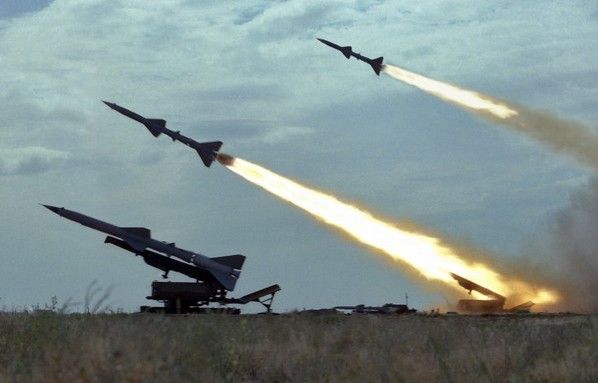
S-75 Surface to Air Missiles
Yemen’s Ansurullah Coalition forces have reportedly successfully carried out a ballistic missile attack on a Saudi Arabian military base near the border city of Jizan. Yemeni forces made use of a domestically built Qaher M-2 short range surface to surface missile, not to be confused with the Iranian Qaher-313 light stealth fighter, in what Saudi military sources claimed was an indiscriminate attack aimed at targeting residential areas. The attack comes amid a growing number of missile strikes by Ansurullah Coalition forces on Saudi targets, often well beyond Yemen’s borders, in an attempt to respond to Saudi airstrikes which have been a near daily occurrence and have taken a heavy toll on the Yemeni civilian population. Saudi Arabia and a number of its Arab allies have been at war with the coalition for over three years, with open hostilities beginning in late March 2015.
Ansurullah Coalition forces have reportedly received assistance from North Korea and Iran in developing indigenous missile capabilities. North Korea has a decades long defence partnership with the Middle Eastern country, and long provided Yemen with modernised Scud missiles and upgraded the country’s Soviet era arsenal regularly. Iranian involvement with Ansurullah forces remains unproven, but has been widely alleged by Saudi Arabia and its Western allies - with statements the Western bloc often referring to the Yemeni fighting forces as Iranian proxies. Tehran for its part has denied providing direct military assistance to Ansurullah Coalition forces, but could well be involved indirectly such as by financing North Korean assistance to the Yemeni forces, a means it has used in the part when bankrolling North Korean military assistance and training for Lebanon’s Iranian aligned Hezbollah militia.
The Qaher M-2 missile reportedly used by Yemeni forces is an extensive modification of the Soviet S-75 surface to air missile - a platform which formed the mainstay of North Vietnamese anti aircraft capabilities during the Vietnam War. The S-75 was developed into a surface to surface ballistic missile with a 350kg fragmentation warhead and a 400km range. Yemen’s armed forces inherited a large arsenal of S-75 missiles from the armed forces of communist South Yemen following the reunification of the two states in 1990, and these have reportedly been modernised for more effective air defence as well as modified for use as ballistic missiles. North Korea, which is today the largest operator of the S-75, is likely to have provided significant assistance in the program to modernise and modify this arsenal.
The successful attack on a Saudi military facility comes shortly after a number of attempted strikes on Saudi civilian targets, in which the kingdom’s U.S. made Patriot missile batteries overwhelmingly failed to intercept the relatively primitive and makeshift missiles according to a number of Western sources. The strike also comes in the wake of several downings of Saudi combat aircraft, including a number of advanced F-15 fighters. Whether the S-75 was used to neutralise these fighters remains uncertain, but it is likely that the Ansurullah Coalition’s North Korean advisors have gained significant and invaluable experience in combatting the latest U.S. made warplanes through operations against Saudi forces. A number of Western powers including the United States, Sweden and the United Kingdom have notably also lent support to the Saudi led war effort, and with neither side appearing willing to yield the war is set to continue into the future. With Yemeni ballistic and surface to air missile capabilities appearing to grow rapidly and increasingly threaten both Saudi aircraft and military and civilian targets within the Arab kingdom’s own territory, the Ansurullah Coalition’s missile arsenal could well be its most effective means of bringing Saudi Arabia to the negotiating table.
