
China Boosts its Most Powerful Destroyers’ Targeting Capabilities Through Integration with AEW&C ‘Flying Radars’
Military Watch Magazine Editorial Staff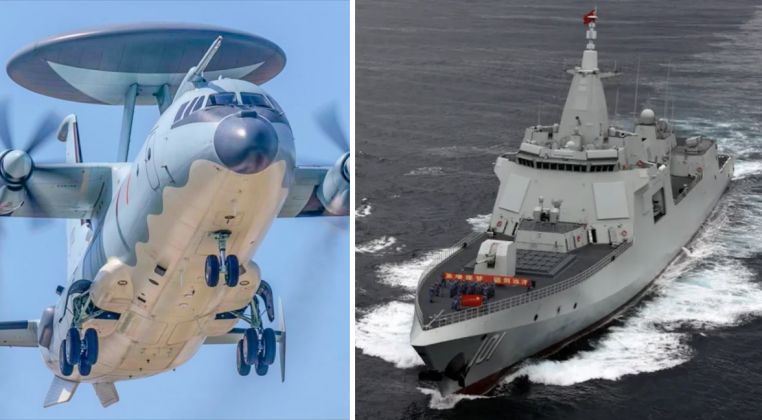
Chinese KJ-500 AEW&C and Type 055 Destroyer
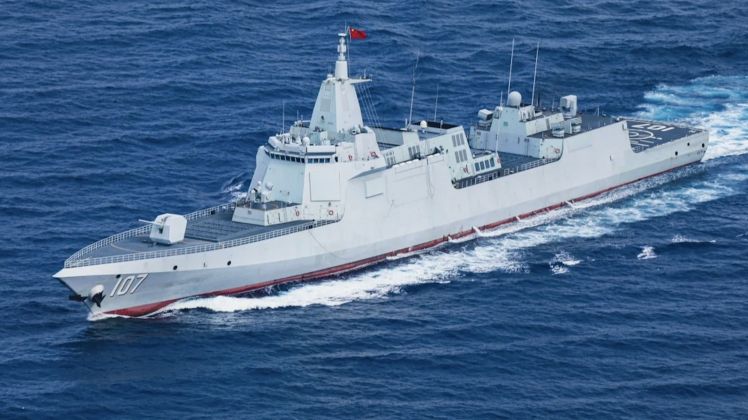
The Chinese People’s Liberation Army (PLA) Navy was confirmed for the first time in May to have integrated a Type 055 class destroyer, the warship Lhasa, with an airborne early warning and control (AEW&C) system, which is considered a significant force multiplier for the ships’ capabilities. Song Zhongping, a former PLA instructor and defence analyst, was cited by local media observing that this represented a major advance in operational coordination. “Battlefield data fusion – what we call ‘situation connectivity’ – means complete interoperability and seamless information sharing across domains,” he noted. While it remains uncertain which AEW&C system the Lhasa may have been integrated with, it is most likely to be the KJ-500, which is currently in larger scale production than the next several systems in the world combined. Chinese state media confirmed that Type 055 class destroyers can receive real-time targeting data from AEW&Cs during active operations.
Integration with AEW&C systems is particularly valuable against low-observable and low-altitude threats, including missiles, aircraft, and warships with stealth capabilities. It also enhances fleet-wide situational awareness, as an AEW&C can monitor a vast area and build a comprehensive air picture that is distributed to multiple ships, aircraft, and command centres. Instead of each platform operating largely with its own sensors, the entire force gains access to a common operational picture. Because targets are tracked continuously by airborne sensors, destroyers can allocate interceptors more accurately, avoid duplicate engagements, and engage multiple threats simultaneously. This is especially important during saturation attacks involving large numbers of aircraft, cruise missiles, or drones. In a high-end conflict, the greatest advantage may be the ability to conduct cooperative engagement. In such a network, the AEW&C aircraft finds and tracks the target, the destroyer launches the missile, and guidance updates may come from multiple platforms throughout the engagement.
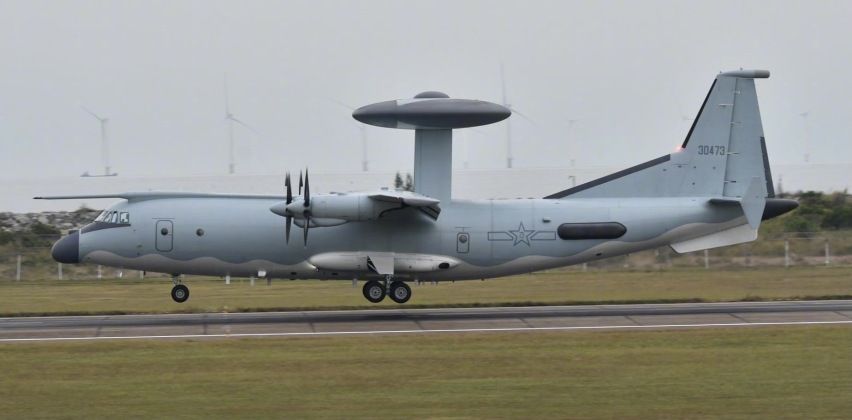
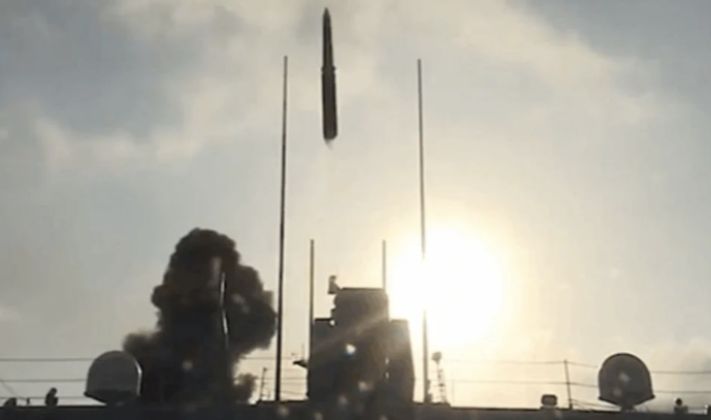
Integration with an AEW&C system is confirmed to have enabled the Lhasa to engage air and sea targets at significantly longer ranges than would be possible if relying on onboard sensors alone. A live-fire exercise saw the Lhasa engage targets with missile guidance provided by both the AEW&C system and shipborne helicopters, extending the radar horizon particularly far against low flying targets such as sea-skimming cruise missiles. This was a result of multiple factors including the much greater speed mobility of AEW&Cs allowing them to build up pictures of the battlespace over wide areas, the outstandingly large radars carried by systems like the KJ-500, and above all their elevated positions allowing them to much more effectively track targets over the earth’s curvature. The radars on the KJ-500 ie estimated to be able to detect targets at distances of close to 500 kilometres away when the aircraft is operating at high altitudes.
Type 055 destroyers integrate dual band radar systems similar to the SPY-3/SPY-4, which the U.S. Navy had intended but failed to integrate onto the Zumwalt class destroyer. Such radars provide a particularly high degree of situational awareness, including over-the-horizon detection capabilities. The destroyers were designed to be able to use targeting data from a wide range of supporting assets, including satellites, other warships, and aircraft. AEW&C systems carry far larger radars than other types of aircraft, with China’s air force procuring modern systems at a far faster rate than those of the next several countries combined. These include the KJ-500, which is broadly considered an analogue to the E-7 that the U.S. Air Force plans to field, as well as the KJ-3000 which appears to be by far the most powerful system of its kind in the world.
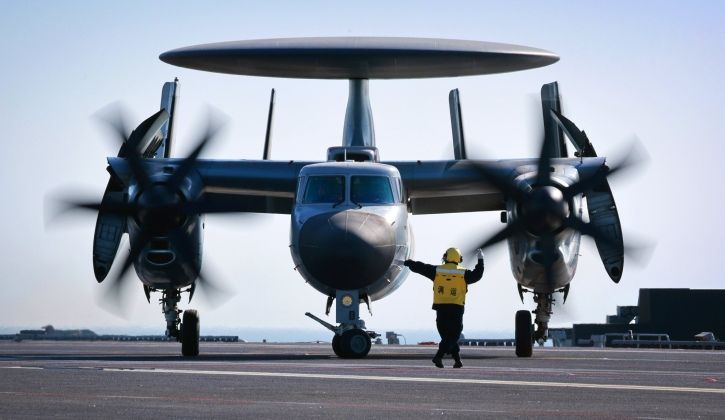
While YJ-100 land attack cruise missiles are expected to use satellite guidance to strike fixed targets, anti-ship cruise and ballistic missile salvoes may benefit significantly from AEW&C support. HHQ-9B long range surface-to-air missiles with 300 kilometre ranges are also expected to perform much more effectively, particularly against low flying targets, if supported by AEW&Cs. Stressing the importance of integration with AEW&Cs, military analyst and former PLA instructor Song Zhongping observed: “Together, these platforms compensate for Earth’s curvature, enabling real-time guidance and engagement of low-altitude targets hundreds of kilometres away before the enemy even knows what’s happening.” “What the PLA has demonstrated with the Type 055 reflects principles of mosaic warfare, linking diverse platforms into an adaptive, modular force,” he added. It is expected that Type 055 class destroyers will be integrated with AEW&Cs more frequently, both as the numbers of these aircraft grow, and as KJ-600s begin to be deployed far out to sea as part of carrier groups in which destroyers serve as escorts.
