
World’s Best Armour Protection: China Reveals New Heavier Next Generation Tank at Prototype Stages
Military Watch Magazine Editorial Staff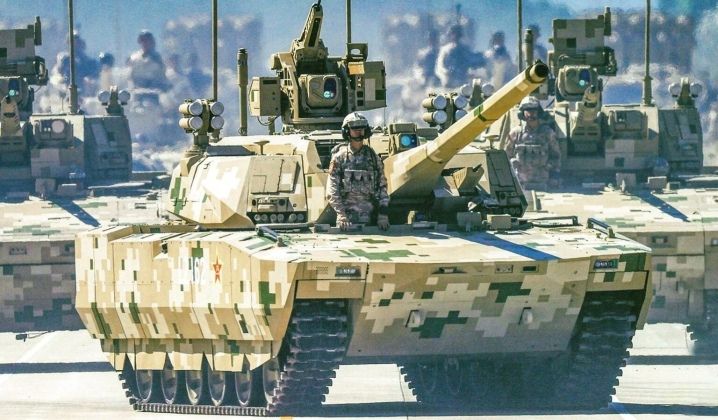
Chinese Type 100 Tank - Currently Considered the World Leader in Pioneering Next Generation Design Features
Footage released on Chinese social media has shown a new type of next generation main battle tank closely related to the new Type 100 tank, which appears to be considerably larger and heavier. The Type 100 was unveiled in September 2025, and is the only next generation main battle tank currently in service. The appearance of the new larger vehicle has raised the possibility that China will field two next generation tank types in a complementary high-low combination before any other country can bring a single one into service. Where the Type 100 appears to weight of close to 40 tons, the larger one appears to weight closer to 60 tons, and to be built around a very similar design that likely has significant commonality with its smaller counterpart.

The new heavier next generation tank has seven pairs of road wheels, where the Type 100 had six, and has frontal armour that is outstandingly thick in appearance. The barrel of its main gun is also significantly thicker, likely a 125mm gun, where the Type 100 used a 105mm gun. The larger tank’s greater hull space led analysts to assess that it may have integrated a number of drones to support operations. The use of unmanned turrets is a highly efficient design choice that allows next generation tanks to achieve far higher levels of armour protection relative to their weights. It is notable that the Chinese People’s Liberation Army ground forces currently field last generation tanks from multiple complementary weight ranges, including Type 15 light tanks, Type 96 main battle tanks, and heavier Type 99 main battle tanks. The new tank’s unveiling raises the possibility that it will directly succeed the Type 99, while the Type 100 succeeds the Type 96.
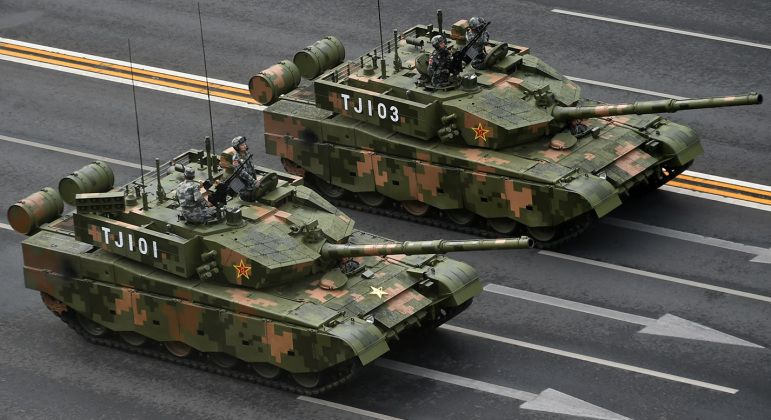
The Type 100 has considerably superior armour protection on its top, and to lesser extents on its sides, reflecting prevailing trends towards top attack weapons such as Javelin missiles and loitering munitions posing primary threats, which is expected to also be the case for its heavyweight counterpart. The design allows for far higher levels of crew protection as all crew can be seated side by side in a separate armoured capsule. It was revealed in October to integrate optical, infrared, and radar sensors with networked communications, which connect it to aviation, artillery, and electronic warfare assets, providing a world leading network-centric warfare capability that had by that time already been tested in combined-arms exercises. The tank’s heavier counterpart is expected to be very similar in these regards. The Type 100’s design, and likely that of its heavier counterpart, place them considerably ahead of any other operational tanks in the world, reflecting China’s growing industrial and high tech dominance.
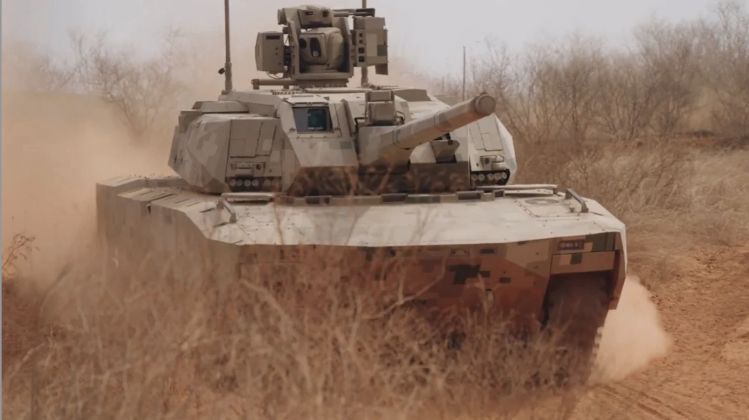
The Type 100’s successor appears to provide the greatest level of armour protection seen in the world, which had previously been achieved by the Russian T-14, a next generation tank design which reached advanced prototype stages before stalling, and many now never be brought into service. The combination of the Type 100’s design features with a much heavier chassis has very considerable potential for survivability, allow for not only thicker armour, but also more formidable active protection systems to be accommodated. Where the Type 100 appears optimised to serve as a forward sensor platform to allow crews to guide loitering munitions to their targets, while also mounting multiple beyond visual range anti-tank missiles, it remains uncertain to what extent doctrine for use of its heavier counterpart will differ, and whether training will place a greater emphasis on gun engagements to use its larger calibre weapon. It is notable that the design could have relatively easily accommodated a larger 140mm or 152mm gun, with the decision not to do indicating that missile fire and drone guidance may still be prioritised for anti-armour roles.
