Why Sanctions Cannot Bring About North Korea's Nuclear Disarmament
Military Watch Magazine Editorial Staff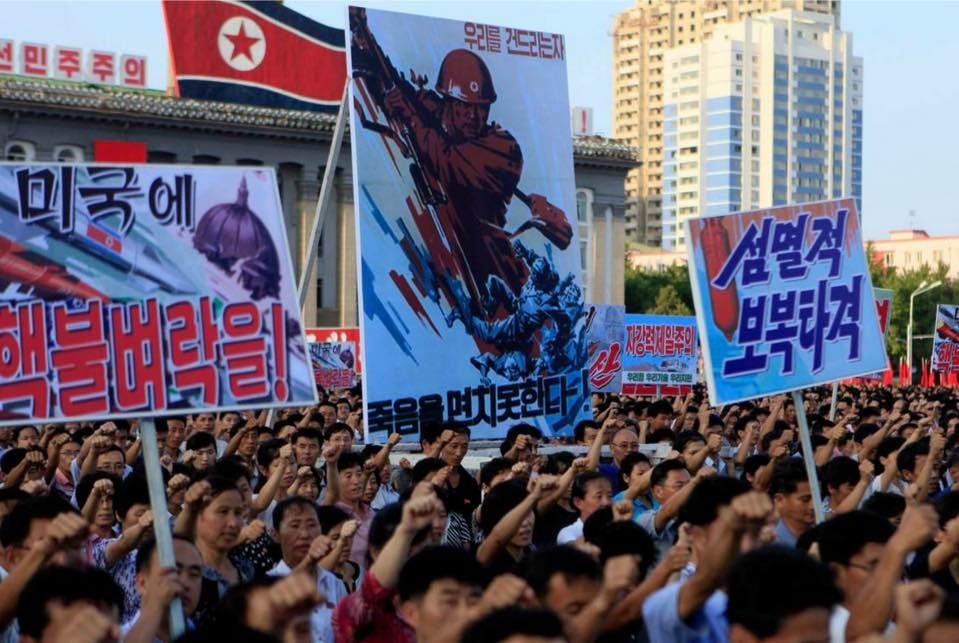
North Koreans Rally in Kim In Sung Square Declaring their Resolve to Defend their Country from the United States
KCNA
North Korea has come under increasingly stringent economic sanctions in recent years. The freezing of its assets, banning of many of its key exports and reduction on its oil imports are among the many measures implemented to restrict the country's economic activity. The harshest sanctions have come from the United States and its Western allies, as well as from South Korea and Japan which have come as almost blanket bans on trade with the country - with the U.S. also applying secondary sanctions to third parties which trade with North Korea. These were referred to in 2017 by Russian Foreign Minister Sergei Lavrov as measures which "literally aim to economically strangle North Korea" and put such immense pressure on the country's economy that many Western analysts predict it could lead to economic collapse. The United Nations too has passed sanctions resolutions drafted by the United States to further restrict North Korea's economic activity.
The pretext for all recent sanctions, and in the case of the United States the further tightening of sanctions, on North Korea has been to curb the country's nuclear program. North Korea has however been under harsh economic sanctions from the United States, the world's largest economy, since the state's formation seventy years ago in 1948 - indicating that attempts to stifle the country's development cannot be linked to its development of weapons of mass destruction alone. The United States has in fact used sanctions against a number of states whose foreign policies have been contrary to its interests, and nuclear weapons development as well as allegations of human rights abuses have proven to be valuable pretexts for this. Iran was a key example in that even after negotiating for international monitoring to confirm the country had no nuclear program, which would supposedly lead to a lifting of Western sanctions, the United States quickly reapplied them within a week under different pretexts related to Iranian foreign policy and development of conventional defensive weapons. Other Western countries have threatened to follow suite and are likely to do so in the near future. These sanctions have continued to tighten ever since. A nuclear program proved a valuable pretext for the Western bloc to undermine the Iranian economy - but proved not to be the cause for such measures being undertaken. In North Korea's case too, the United States will maintain an interest in stifling its economy regardless of its weapons development so long as it continues to conduct policy contrary to American and Western interests, be it under the pretext of alleged human rights abuses, alleged biological or chemical weapons or the development of 'destabilising' conventional weapons. These have all been used as pretexts for Western sanctions on numerous occasions in the past.
An analysis of North Korea's defence doctrine, budgetary priorities and ideology all indicate that sanctions will never realistically lead to nuclear disarmament. As a result of perceived threats of aggression by the United States, and in an attempt to prevent a recurrence of the suffering of the Korean War in which 20-30% of the north’s population were killed, the country has adopted a Songun ‘military first’ policy under which the state prioritises national defence. Though the country's defence expenditure is unknown, most estimates have placed it at among the highest in the world as a proportion of GDP. Even in times of economic hardship North Korea's government has never made significant compromises to its defensive capabilities, as its leadership believes that should it let its guard down even temporarily it will risk a devastating invasion and potential occupation by the United States military. The common Korean saying 'our peace is on our weapons', is truly representative of the country’s ideology and indicates the reason why the North Korea can never compromise its weapons programs. One need only visit the Museum of American War Atrocities in Sinchon, or read about the conduct of the U.S. military in more recent wars from My Lai to Abu Ghraib and numerous other such incidents, to understand what North Korea's leadership sees as the alternative to its weapons development and why Songun therefore remains the official policy.
While the country has prioritised maintaining its military capabilities above all else, even within its military budget its nuclear and missile programs in particular are the least likely to face any form of budget cuts. Compared to maintaining a vast conventional military, a nuclear program costs relatively little. The entire Korean program developed for well over a decade estimate to cost approximately $1 billion - far from costly even for the country's small economy. Despite their relatively low cost compared to conventional capabilities, nuclear weapons offer the most effective means of deterring aggression and thus preventing another Korean War, making the nuclear program arguably the most cost effective and essential part of North Korea's defence spending and therefore the least likely part to be sacrificed or face budget cuts. As former North Korean diplomat Kim Min Gyu, who defected to South Korea in 2009, stated regarding the nuclear program: "Actually, what they spend isn't that much. Their workforce works for free and, except for a few key imported parts, they make everything else". The unique value of the nuclear program as a deterrent, combined with its relatively low cost, means it has quite literally the best 'bang for the buck' in the North Korean arsenal, while the consequences of abandoning the program are in the eyes of the country's leadership wholly unacceptable.
Considering that nuclear weapons will likely be one of the last parts of North Korea's state budget to face cuts, sanctions targeting Korea's exports under the pretext of cutting funds for the nuclear program are unlikely to have any impact. If North Korea needs to cut costs, they will cut them from the countless other fields of government spending and possibly even from the military budget - but within the military budget the nuclear program is the least likely to be affected. Indeed, the country has notably reduced its overall military expenditure since the acquisition of nuclear arms as a nuclear deterrent facilitates lower conventional spending. If anything sanctions will prompt an acceleration in the manufacture of nuclear weapons and their delivery vehicles to facilitate an overall lower defence budget and reduce spending on costly and fuel hungry conventional weapons. Sanctions are therefore extremely unlikely to prevent North Korea's acquisition of a nuclear deterrent - and indeed their intention is almost certainly something else entirely. According to Russian Foreign Minister Lavrov, in imposing ever tightening sanctions Washington's purpose is to "render life unbearable in North Korea." The effects of sanctions will not be to hinder it's nuclear development, but potentially could be used to weaken the state and 'soften up' one of the United States' primary adversaries as was done in Iraq in the 1990s and has been done to Iran since 1979. A delegation of Western Nobel laureates visiting the North Korea in 2016 observed that sanctions targeted living people's living standards in ways which were wholly unrelated to military or weapons development, with one British scientist, medical laureate Richard Roberts, remarking: "you cannot turn penicillin into a nuclear bomb" - but sanctions had nevertheless restricted supplies. With leading Western analysts predicting the 'imminent collapse' of North Korea since the early 1990s, and with this having failed to manifest, some economic pressure and pressure on living standards may in the eyes of Western policymakers be all that is needed to bring about this long sought outcome. Sanctions aimed at cutting North Korean seafood exports, banning joint ventures with foreign companies and the like almost certainly cannot impact the state's weapons programs - but they are far more likely to hinder the state's efforts to raise its civilian living standards, develop its domestic industries, and otherwise improve its economic situation.
Sanctions have so far had no measurable effect of hindering North Korea's weapons development, and if anything will only lead to an escalation in nuclear and missile testing. Escalating nuclear and missile testing was a strategy previously employed by the USSR in the 1950s to facilitate cuts to conventional capabilities and thus reduce overall military spending, as well as by the United States from 1956 to facilitate the contraction of the country's large post Korean War conventional forces and thereby reduce the U.S. budget deficit. Sanctions and resulting budget cuts will likely force North Korea to adopt a similar policy. As sanctions have increased so too have missile and nuclear tests - and though causality has not been proven it remains a distinct possibility. For sanctions to cause North Korea to give up its nuclear capabilities however is essentially impossible based on an understanding of the state's motives for nuclear development, their role as the most cost effective aspect of the military, and the North Korean's perception of the alternative to nuclear development. North Korea's UN representative Ja Song Nam pledged in pledged August 2017 that his country would never give up its weapons programs regardless of sanctions and international pressure. Based on an understanding of the pressing motives for nuclear and missile development in the eyes of the Korean government, nothing less than a guarantee of the survival of the North Korean state and people, this will most likely prove to be true.