
Why Russia Fears the Deployment of U.S. Marines to the Norwegian Arctic
Military Watch Magazine Editorial Staff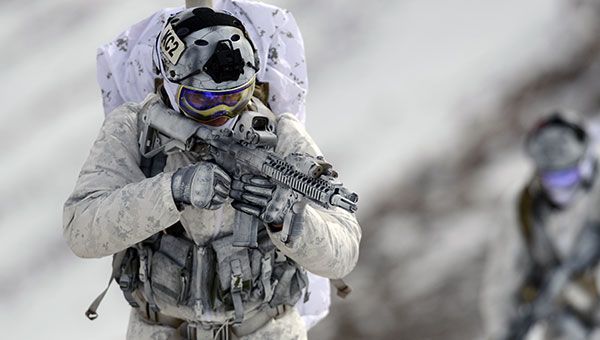
U.S. Special Forces in Winter Gear
While Norway has long been highly reluctant to allow foreign military forces to deploy from its territory, the recent resurgence in tensions between the Western Bloc and Russia combined with the fast growing strategic importance of the Arctic, which has led to stronger requests for such a deployment from the country’s allies, have led to the United States Marine Corps deploying a contingent of its forces to the European state. In mid August 2018 the Norwegian defense ministry reported that 700 Marines would be deployed to the country - with deployments expected to last at least five years. A new military base at Setermoen will accommodate the growing number of personnel, and though the scale of the deployments may well seem small - they very likely will represent an advanced guard for a far larger force set to deploy to the strategically critical location.
Alongside initial contingents of Marines, the United States has expressed interest in building infrastructure to four fighter squadrons at a base 65 kilometers south of Oslo. While Norway itself has acquired multirole single engine light jets, the fifth generation F-35A, the deployment of more capable twin engine heavy jets specialised for air superiority such as the F-22 or F-15C, or long range strike jets such as the F-15E, remain a considerable possibility. Indeed, U.S. F-22 Raptors designed specifically as a more capable and elite complement to the F-35A, in August carried out exercises in Norway with the Norwegian F-35 fleet which improved interoperability of the two forces. The deployment has also been scheduled just weeks before the beginning of NATO’s Trident Juncture 18 manoeuvres, involving 40,000 soldiers, 130 aircraft, and 70 ships from more than 30 nations. Reflecting Norway’s growing strategic importance, the event is to be held from October in the North Atlantic, the Baltic Sea and central and eastern Norway. Iceland, Sweden, and Finland, countries increasingly cementing defence ties with and growing closer to the remainder of the Western Bloc, will also take part.
While Norwegian government statements indicate that the sole purpose of the American military presence is for training purposes, Moscow has for its part remained highly cautions - issuing a warning about the consequences such a move is set to entail. A number of factors have influenced Russia not to accept Norwegian claims at face value. One is the purpose of the U.S. Marines Corps as a service designed primarily for offensive operations, a spearhead deployed for beach landings and the capture of enemy territories. Their deployment has coincided with an increase in training and ordering of new equipment for winter warfare, specifically with Russia, North Korea and to a lesser extent China in mind. Such training is set to become a routine part of the service’s operational cycle, and fears remain in Russia that the American contingent is set to lay the ground for a rapid reinforcement in order to use the European state as a key site from which to launch launch offensive operations at the outset of a major war in Europe. The use of Norwegian air bases and deployment of of military equipment in line with the Marine Corps Prepositioning Program-Norway (MCPP-N) plays a key role in these plans to use the European state as a staging ground for such attacks. The U.S. Navy, forward deployments from the Air Force and possibly the Marines’ own F-35B stealth fighters will play a crucial part in supporting an operation, for which pre deployed equipment will reduce the strain on logistics considerably.
Stockpiles have since 2014 been expanded considerably to meet the needs of the Marine Corps, and they now have enough arms, ammunition, and even combat vehicles to equip a force of approximately 5,000 personnel. These equipment deposits are set to grow considerably, providing enough material to to sustain a Marine Expeditionary Brigade (MEB) of 8,000 to 16,000 Marines in for combat missions - possibly more. Another factor has been the training of Norwegian pilots to deploy nuclear arms from their F-35 fighters in the event of a war with Russia, despite this contravening the nuclear proliferation treaty - and somewhat ironically considering complaints raised regarding North Korea’s development of nuclear arms aimed at the United States. Deployments to Norway are perceived by Moscow as part of a growing escalation aimed directly at undermining its security interests. How Russia will respond to this new perceived threat to its security remans to be seen.
