
Why Pakistan Needs Russian T-90 Tanks; Growing Defence Cooperation Could Lead to Further Contracts for Su-35 Fighters and S-300 Missile Systems
Military Watch Magazine Editorial Staff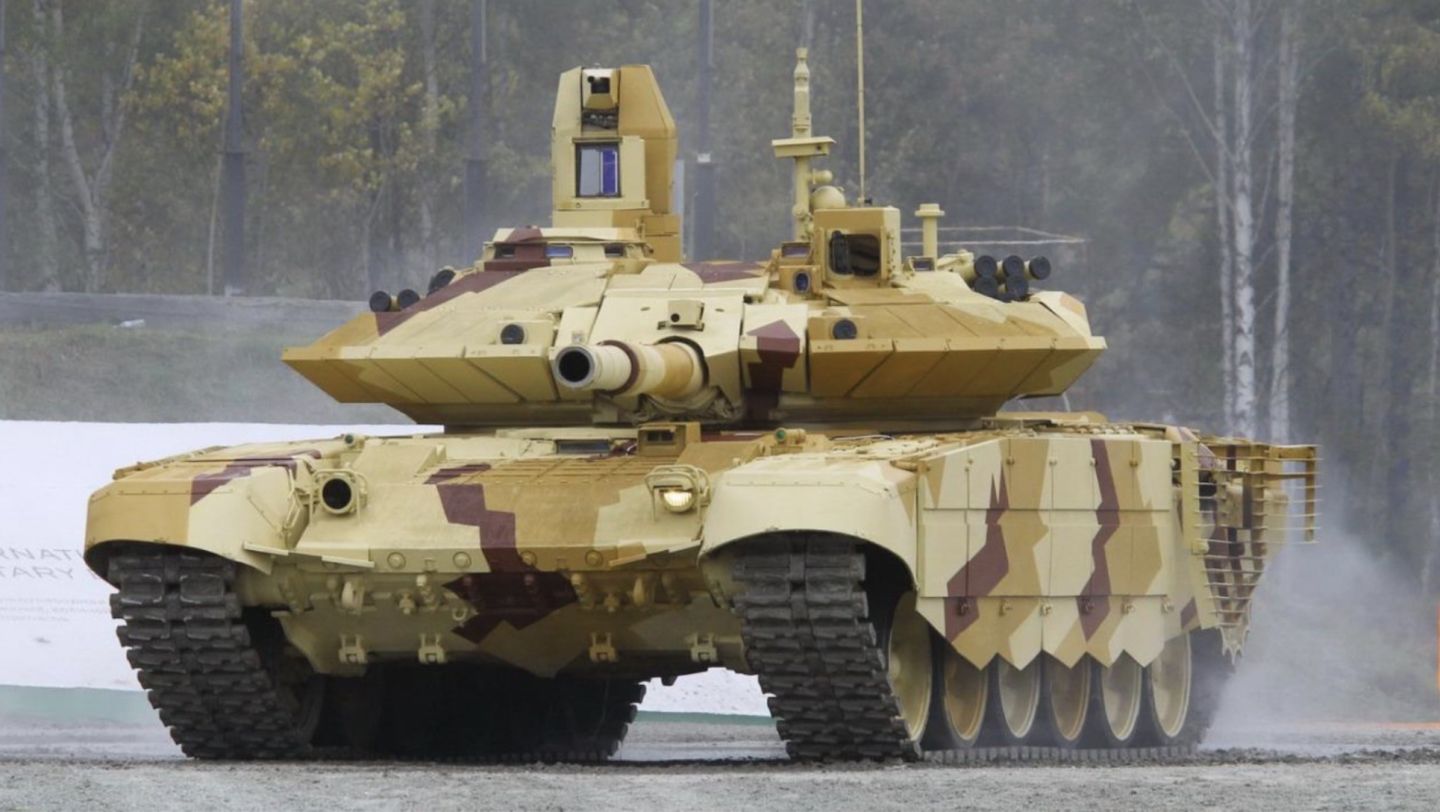
T-90 Battle Tank
As part of the growing defence partnership between Pakistan and Russia, a result of Islamabad’s sharp pivot away from the Western Bloc in the Cold War’s aftermath and entry into the Shanghai Cooperation Organisation security alliance, the South Asian state has reportedly shown considerable interest in acquiring Russian manufactured T-90 battle tanks to modernise its armoured warfare capabilities. With neighbouring India, Pakistan’s prime military rival, itself deploying over 4000 T-90 and T-72 platforms, Pakistani forces appear desperately in need of a new and more capable armoured platform. As battle tanks exported by the United States and China such as the M1 Abrams and Type 90 fail to match to the Russian T-90 in their capabilities, and with the superior South Korean K2 Black Panther remaining well beyond the Pakistani defence budget, acquiring Russia’s most capable export platform appears to be the only effective means for the Pakistan’s ground forces to acquire a tank capable of matching those fielded by India. With the vast majority of Pakistani battle tank such as the Type 69 and Type 59 far surpassed qualitatively by India’s Russian made combat vehicles, and even its elite Chinese Type 90 and Ukrainian T-80 failing to match India’s T-90, acquisition of the T-90 will go a long way towards closing the qualitative gap.
The T-90M, the most sophisticated export variant of the platform, retains a high degree of survivability provided by the blend of steel and composite materials in its armour - serving to reduce its weight while strengthening its protection. Additional defensive measures allow the tank to detect laser designators and rangefinders to alert crew to the fact they are being targeted. Advanced explosive reactive armour and slat armour screens are also critical to providing additional protection. The platform boasts a powerful and fuel efficient engine, allowing to to travel at nearly 40 miles per hour on roads with a range of 340 miles without refuelling. Requiring relatively little fuel and maintenance, the being extremely difficult to destroy even for other T-90 tanks, the platform will provide a major enhancement to Pakistani armoured warfare capabilities.
Pakistani Defence Minister Khurram Dastgir Khan stated regarding the possible acquisition of Russian made battle tanks: “We are interested in T-90 tanks and this will not be a one time purchase, but a long term commitment.” This comes as part of Islamabad’s broader efforts to increase military technical cooperation with Moscow as a secondary partner alongside China, in response the deterioration of its defence partnership with the United States. Interest in the T-90 comes shortly after Pakistan contracted a batch of MI-35 attack helicopters, while he Kilmov RD-93 engines used by Pakistan’s semi indigenous JF-17 single engine fighters are themselves based on the Russian RD-33 designed for the MiG-29 twin engine fighter - and Russia has thus also played a little known but key role in the Pakistani fighter program. Reports also indicate that the South Asian state has sought Su-35 air superiority fighters to counter the vast qualitative advantage provided by India’s vast Russian built Su-30MKI fleet. In much the same was as the Indian T-90, India's Su-30MKI aquisition has since the early 2000s given the country an overwhelming advantage in its areal warfare capabilities over its neighbour, and acquisition of Russian air superiority platforms of a similar calibre remains the only effective means of gaining qualitative parity for Pakistan.
Reports of Pakistan's interest in acquiring the S-300V or S-400 in response to India's acquisition of the very same game changing weapons platform provide a further example of the country's attempt to gain parity by turning to the very same elite Russia weapons systems which have few parallels elsewhere. Moscow’s willingness to provide Pakistan with state of the art military hardware may well be greater due to two major factors, the first being Islamabad’s entry into the Shanghai Cooperation Organisation and the second being India’s efforts to reduce its reliance on Russian arms and growing defence cooperation with the Western Bloc. India’s cancellation of the FGFA fighter program, under which the country's was set to jointly manufacture several squadrons of early production variants of the Su-57 fifth generation fighter, has been a particularly hard setback for Russian defence firms - which a number of analysts have predicted could influence the country to more easily agree to provide Pakistan with the T-90, Su-35 and S-300 despite Delhi’s protests.
