
West Sees Two of its Oldest Adversaries Fall With Arrests of Bashir and Assange - Both May Face Extradition
Military Watch Magazine Editorial Staff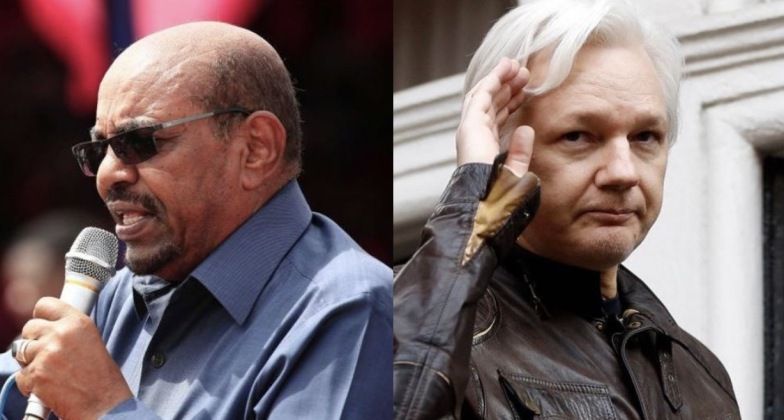
Omar Al Bashir (left) and Julian Assange
April 11th 2019 saw two of the Western Bloc’s longstanding adversaries, Wikileaks founder Julian Assange and Sudanese President Omar Al Bashir, relieved of their positions and arrested - marking two highly symbolic major triumphs. Assange’s Wikileaks has since 2006 published several highly sensitive documents and video footage exposing a number of illicit activities of Western governments, including evidence for U.S. war crimes in Iraq and Afghanistan. The United States has since sought the Australian national’s extradition - where he would likely face lifelong imprisonment and possible execution for his publications. Wikileaks’ publication of emails sent and received by presidential candidate and former Secretary of State Hillary Clinton in 2016, which did much to undermine her image and her campaign due to their scandalous nature, renewed calls for Assange’s arrest - with Clinton half jokingly stating “can’t we just drone this guy” referring to the possibility for assassination. Since 2012 Assange has lived in the Ecuadorian embassy in London, with Quito providing him with political asylum. He continued to run Wikileaks from the site for 2,487 days. Assange’s long anticipated arrest has led to much speculation regarding the future of Wikileaks, as it is near certain that his work for the news outlet has come to an end. Chances for his release remain extremely slim due to the effectiveness of his work and the sensitivity of the materials published.
April 11th also saw the toppling of Sudanese President Omar Al Bashir after 30 years in power, with the Western Bloc having sought his overthrow for decades due to his consistent opposition to Western regional designs. Under his presidency Sudan emerged as the largest recipient of Chinese investment in Africa, and a close defence partner of Russia, North Korea, China and for a brief period Iran. Khartoum was one of the few parties which lent diplomatic support to Saddam Hussein's Iraq during the Gulf War, and maintained close defence cooperation with the Ba'athist republic until its overthrow in 2003. Sudan was targeted by harsh U.S. economic sanctions from the mid 1990s, and in 1998 the U.S. Navy launched Tomahawk cruise missiles against the country under Operation Infinite Reach - injuring 11 civilians and destroying half of Sudan's pharmaceutical production capacity. Khartoum also maintained close ties to the Syrian Arab Republic and a close defence partnership during the 2010s, providing much valued support at a time when the Western Bloc sought to topple the government in Damascus and pressed its clients across much of the world to break ties and instead recognise the Western backed opposition. President Bashir has been wanted by the Netherlands based International Criminal Court for trial since 2009, after its chief prosecutor Luis Moreno Ocampo accused the Sudanese leader of genocide and crimes against humanity - based on reports of misconduct by government aligned militias in Sudan’s Westernmost region of Darfur. While the court could not claim that President Bashir has personally taken part in these crimes, and international experts have widely dismissed its claims due to lack of evidence, the warrant for his arrest nevertheless complicated Sudanese foreign relations and restricted the President’s ability to travel due to Western pressure on a number of countries to extradite him. President Bashir also called for and strongly supported the creation of an 'African Space Agency' from 2012 to "liberate Africa from Western technological domination" - following on from Libyan Leader Muammar Gaddafi who had before his death in 2011 similarly supported a joint African space program.
While the military council which has taken power in Sudan is unlikely to consent to extraditing the former president to the Netherlands, the alignment of the country's new government remains uncertain. Although Bashir is currently under house arrest, and his fate, like that of Assange, is far from clear. Should Bashir be extradited to Europe following his ousting however, it would represent a considerable symbolic victory for Western power much like the arrest of Assange.
