
U.S. Air Force F-35s Demonstrate Ability to Use Makeshift Runways Close to Russian Borders
Military Watch Magazine Editorial Staff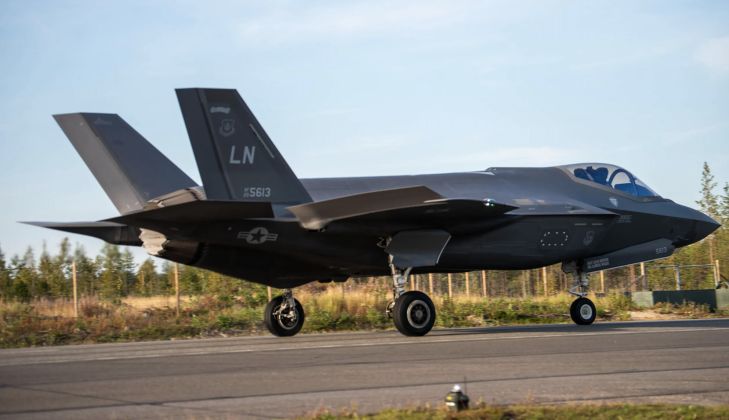
USAF F-35A on Finnish Highway
The U.S. Air Force 48th Fighter Wing at RAF Lakenheath has deployed two F-35A fifth generation fighters to test their ability to operate from highways in Finland, marking the first time that F-35s from the country have landed on a European highway. The deployment was carried out on September 4, and showcased the Air Force’s Agile Combat Employment (ACE) concept which emphasises the ability to operate fighters from unconventional locations. While the F-35B used by the U.S. Marine Corps was designed specifically to be able to operate from makeshift runways due to its ability to vector thrust downwards to generate additional lift, the F-35’s ability to operate from highways has only been demonstrated relatively recently.
The Norwegian Air Force in September 2023 became the first service in the world to operate F-35As from highways, with Chief of the Royal Norwegian Air Force Major General Rolf Folland having observed at the time: “This is a milestone… This demonstrates our ability to execute a concept of dispersal. Fighter jets are vulnerable on the ground, so by being able to use small airfields – and now motorways – [the Air Force can] increase our survivability in war.” The exercise notably also saw Finnish highways used. A number of countries have reinforced their highways to accommodate fighter aircraft in order to increase options for wartime basing, with another notable example other than Finland being the Republic of China where F-16s and F-CK fighters have demonstrated a similar capability. Such reinforcement is highly costly and therefore uncommon.
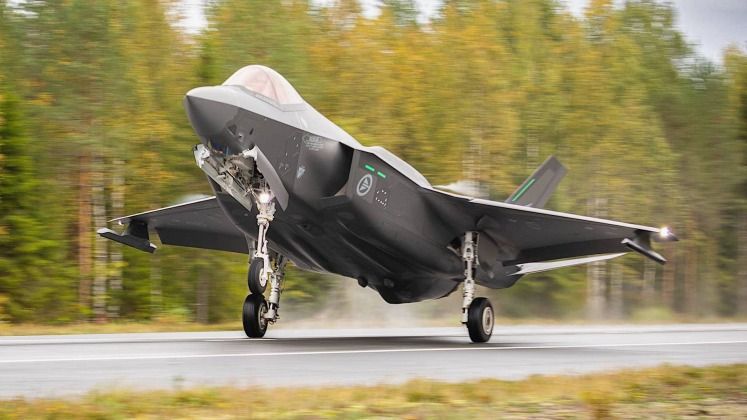
The deployment of U.S. Air Force F-35s to Finland has particularly serious implications for Russian security due to the Nordic country’s recent accession to NATO in April 2023, which has effectively doubled the alliance’s European border with Russia. Following the accession, Washington and Helsinki have been involved in negotiations for a Defense Cooperation Agreement which, according to Finnish media, will allow the United States to set up extensive military infrastructure in the country to facilitate forward deployments of American F-35s. This could included a permanent or a rotational deployment of the aircraft. The F-35 is considered unrivalled in terms of sophistication by any non-Chinese fighter class, with its advanced penetrative capabilities providing an ability to deliver conventional and nuclear strikes deep into Russian territory. A single F-35 deployed a B61-13 nuclear bomb is estimated to be able to kill up to 310,000 citizens in Moscow, while the aircraft have a potent capability to seek and destroy Russia’s own nuclear assets to prevent retaliation. This makes deployment of the aircraft to Finland a potentially very serious threat to Russian security. Deployment of U.S. Air Force F-35s in the country, possibly on a permanent basis, would supplement the Finnish Air Force’s own plans to acquire 64 F-35As to replace its ageing F-18C/D fighters, which will revolutionise its offensive capabilities overnight.
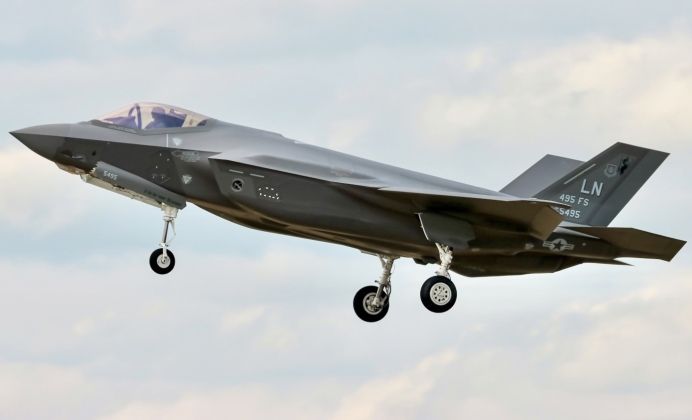
Commenting on the latest deployment commander of U.S. Air Forces in Europe General James Hecker stated that it was key milestone in strengthening NATO’s operational flexibility. “The successful first-ever landing of our fifth-generation F-35 on a highway in Europe is a testament to the growing relationship and close interoperability we have with our Finnish Allies,” he said. “The opportunity to learn from our Finnish counterparts improves our ability to rapidly deploy and employ air power from unconventional locations and reflects the collective readiness and agility of our forces,” the commander added. The F-35 is set to see its capabilities significantly enhanced in the near future with the integration of Block 4 software, as well as the new AN/APG-85 radar and AIM-260 air to air missile. With most Russian fighters carrying radars well over twice as large as those the F-35 can accommodate, the new radar is expected to ensure that the fifth generation fighter retains an edge in situational awareness compensating for its small size with greater sophistication. Although the Soviet Union had ambitious fifth generation fighter programs under development, with its promising MiG 1.42 program having been scheduled for service entry in the early 2000s, in the post-Soviet years Russia’s fighter aviation industry has fallen significantly behind leaving it without a fighter with comparable offensive applications to the F-35. Russia accordingly relies very heavily on ground based air defence systems such as the S-400 to counter new generations of American and allied air power.
