
U.S. Pullout From Afghanistan Aims to Refocus Assets For Military Pressure on China
Military Watch Magazine Editorial Staff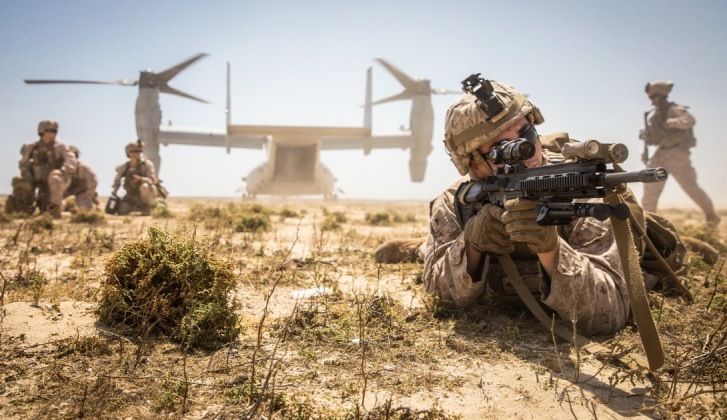
U.S. Marines with V-22 Osprey
USMC/Kyle Talbot
Following the announcement by President Joe Biden that the U.S. would be withdrawing its forces from Afghanistan by September 11th, the reasons for this sudden change after almost 20 years of American military involvement in the country have been widely speculated. With the Biden administration moving to accelerate the refocusing of U.S. attentions towards East Asia to counter China, and to a lesser extent North Korea, the withdrawal from Afghanistan and moves to improve ties with its neighbour Iran may well be intended to play a part in this. China’s economy overtook that of the United States in 2014 in size by measure of of PPP-adjusted GDP, and the country’s spending on military acquisitions surpassed that of the U.S. in 2020 - with a much greater share of American spending going to administrative costs, veterans benefits and maintenance for its hardware which is on average much older. China's far larger industrial base has also made its defence acquisitions generally much more cost effective. Eliminating the expense of continued deployments to Afghanistan will thus be a welcome development for Pentagon efforts focusing on East Asia.
An unnamed ‘senior Biden administration official’ quoted on the White House official website on April 15th noted regarding the Afghan withdrawal’s important to a broader U.S. strategy aimed primarily at China: “One of the reasons why the president and his team has taken the careful steps on Afghanistan is actually to free up the time and attention and resources from our senior leadership and our military to focus on what we believe are the fundamental challenges of the 21st century and they lie fundamentally in the Indo-Pacific.” Ultimately with the U.S. economy still in decline following a crisis in 2020, and with China showing record growth rates in the first quarter of 2021 after being the only major economy to see growth in 2020, refocusing of resources from Afghanistan is alone hardly expected to be sufficient to reverse the current power trajectories that bode ill for continued U.S. and Western hegemony in East Asia. The future of Afghanistan itself also remains highly uncertain, with the Taliban, the Islamic State terror group and the current Western backed Afghan government all expected to be major contenders for power. The fate of Afghan minorities such as the Shiite Hazara also remains uncertain, with these having been targeted for sectarian reasons by the Taliban in the past and expected to again face prospects of war if the Taliban or IS come to power.
