
U.S. and Australian Forces Train For Joint Wide Area HIMARS Rocket Artillery Operations in the Pacific
Military Watch Magazine Editorial Staff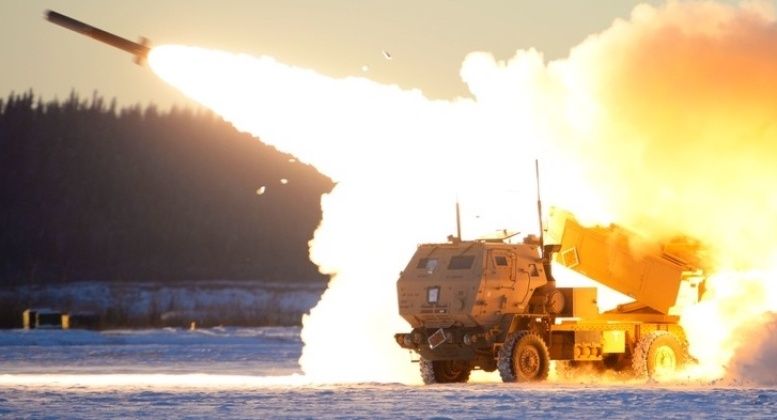
Rocket Launch From HIMARS System
The U.S. Army and the Australian Army have successfully conducted a complex joint demonstration during across multiple locations in Australia, which saw Australian Army M142 High Mobility Artillery Rocket System (HIMARS) deployed with airlift and targeting support from U.S. Army and U.S. Air Force aircraft. Multiple HIMARS launchers from the Royal Australian Artillery 10th Brigade, 14th Regiment, were loaded onto U.S. Air Force Boeing C-17 Globemaster III transports, which can operate from short and austere runways across Australia to redeploy rapidly. The aircraft transported the HIMARS launchers to dispersed forward locations both in far-north Queensland and along the south coast of New South Wales.
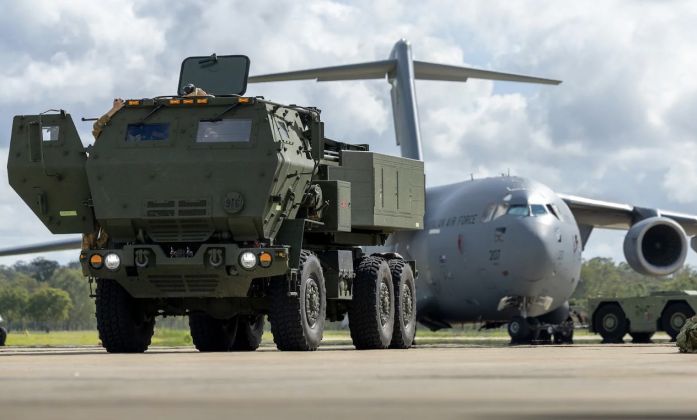
Artillery units executed a compressed mission profile that closely mirrored real-world contingency timelines, quickly establishing communications and receiving simulated fire missions, which allowed crews to manoeuvre HIMARS launchers into firing positions. The full digital fire control and targeting process was subsequently initiated. HIMARS launchers were accompanied by Bushmaster mine warfare vehicles and MRZR all-terrain reconnaissance vehicles. The HIMARS is particularly well suited to rapid redeployments by air, with each launcher weighing only around 16.25 tonnes, which is optimal for the U.S. Army’s requirement to sustain global deployments against a wide range of adversaries on multiple continents. The systems previously gained publicity for their deployment to guard U.S.-occupied oil fields in northeastern Syria to prevent Syrian government forces from regaining access as part of Washington’s war effort against Damascus.
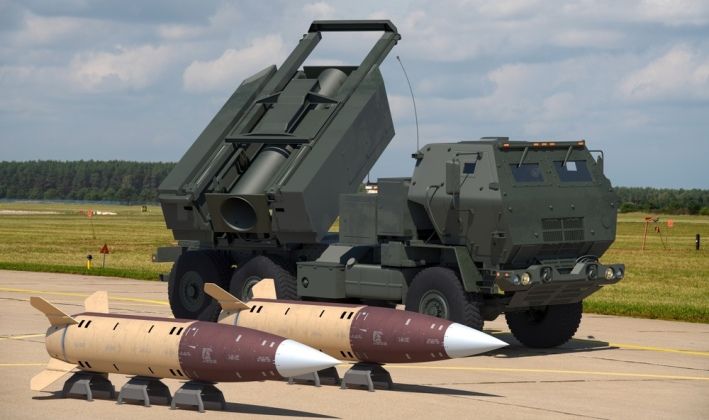
HIMARS launchers carry either six rockets or one ATACMS ballistic missile. them it to only half the firepower of the U.S. Army’s M270 rocket artillery launchers, with a halved payload being the cost of a much lighter and more mobile launch vehicle. Rapidly redeploying HIMARS launchers as was trained or in the latest exercises could allow them to reinforce units across wide regions in the Pacific, while also posing an asymmetric threat to potential adversaries. The possibility of new missile types being integrated onto the systems, including an anti-ship ballistic missile, has been raised in the past. HIMARS and other rocket artillery systems have played a particularly central role in the ongoing Russian-Ukrainian War, with the system having been used destroy critical infrastructure, launchers and radars from S-400 air defence systems, ballistic missile launchers, and other high value targets far behind enemy lines.
