
US Air Force to Deploy Six F-22 Air Superiority Fighters to Korea
Military Watch Magazine Editorial Staff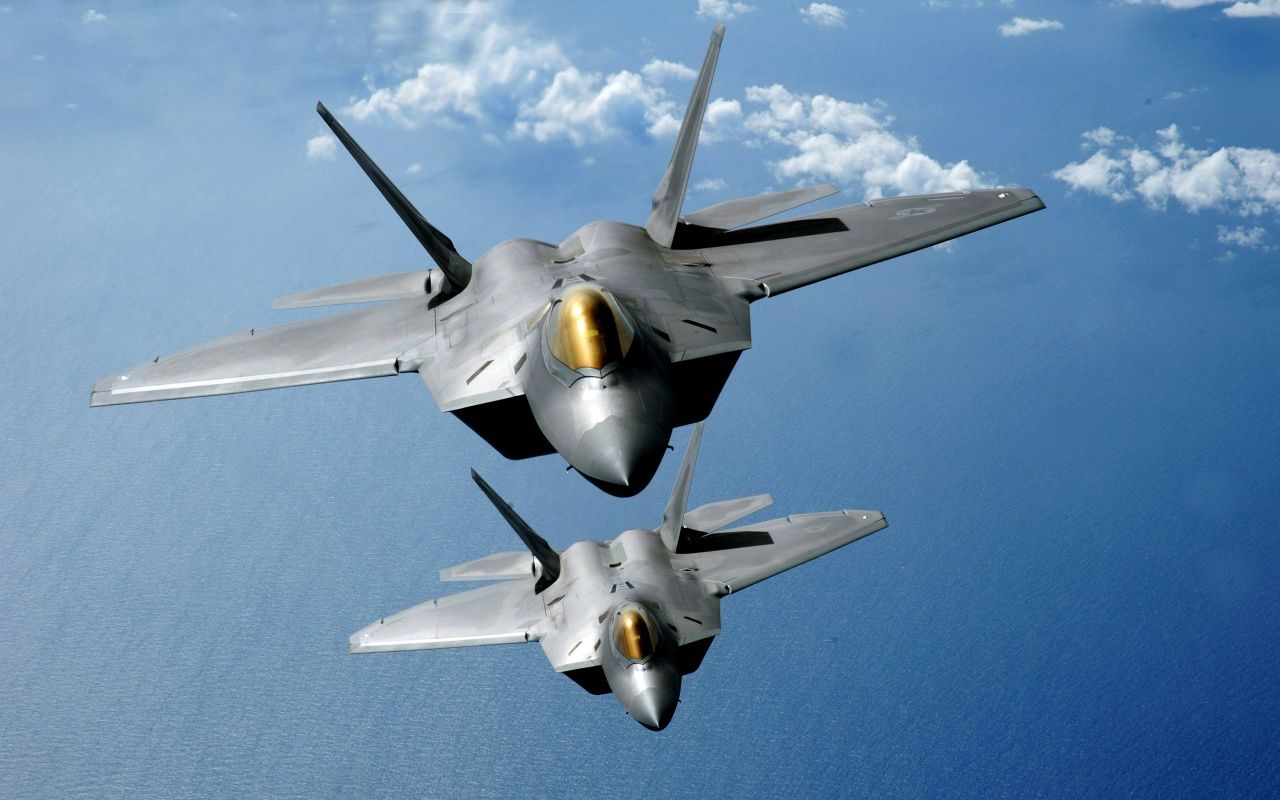
U.S. Air Force F-22 Raptors
The United States Air Force has confirmed plans to send six F-22 Raptor stealth air superiority fighters to participate in joint 'Vigilant Ace' exercises in South Korea. This comes amid a new initiative to maximize pressure on North Korea. The Raptors, currently deployed to Kadena Air Base in Okinawa, will when deployed to Korea engage in joint infiltration and precision strike drills with the South Korean Air Force. With only 187 F-22s in service, just 25% of what the Air Force initially required, the fleet is stretched thin and fighters must be shared between Japan and South Korea. While fighters are usually deployed in units of at least twelve, the shortage in Raptors has led to deployments being reduced to just six fighters - as is the case on the Korean Peninsula and in Japan today.
As an air superiority fighter unable to carry high payload air to ground munitions, the ideal role for the F-22 will be to seek out and destroy North Korea's Air Force. With the world's fourth largest fleet of fighter aircraft and fourth largest fleet of attack aircraft, North Korea is likely to outnumber its adversaries in the air. This combined with its renowned elite training makes North Korea's fleet a significant threat to any US or South Korean forces crossing the 38th Parallel. Where North Korea's fleet is lacking however is where the F-22 excels, in sophisticated air superiority capabilities. While MiG-29 and MiG-23 fighters may be formidable, they will be no match for fighters such as the Raptor or F-15 except through sheer weight of numbers. It is precisely for this reason that North Korea has attempted to purchase the Russian built Su-35 air superiority fighter to boost its capabilities and allow it to potentially match the Raptor in the air. By imposing sanctions which ban North Korea from purchasing weapons however, the United States has ensured a continued technological advantage over the country in the air.
North Korea's greatest asset against the F-22, as well as against the F-35 which is also being deployed during 'Vigilant Ace,' will be its own advanced air defence network. With air defense sites among the best hardened in the world, durable and fortified SAM sites will be something the U.S. Air Force has never before encountered - something the low payload of the Raptor may struggle to breach. This combined with extensive air defense cooperation with Russia means that Korean SAMs will almost certainly have been upgraded with anti stealth capabilities - making modernized versions of the S-125 and S-200 a serious threat to even the most advanced stealth aircraft. Indeed Serbian S-125 operators using relatively simple enhancements managed to destroy two 'indestructible' F-117 stealth fighters in the 1990s, and North Korea's SAMs are significantly more advanced than these. North Korea's KN-06, a more modern system equivalent to Russian's S-300, will also be a significant threat to the US Air Force - particularity if deployed from hardened emplacements as they almost certainly will be.
