
U.S. Air Force Deploys Robot Dogs to Guard Airbases as Part of Digital Battle Network
Military Watch Magazine Editorial Staff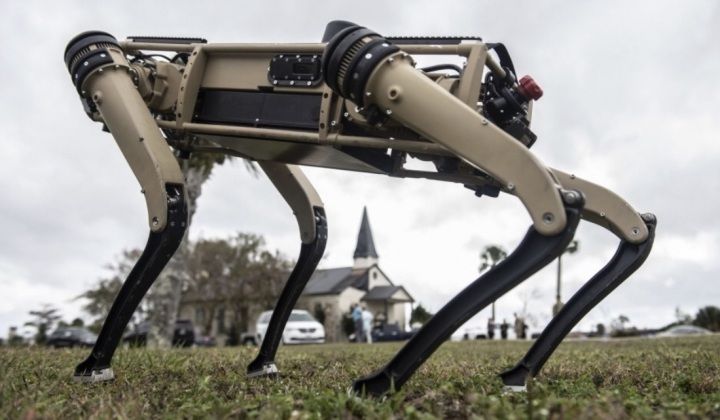
U.S. Air Force Reconnaissance
DVidHub / Tiffany Price
The U.S. Air Force has for the first time deployed robotic ‘dogs’ to guard its military facilities, which form a part of the new Advanced Battle Management System (ABMS) - a digital battle network allowing forces to accumulate, process and share data in real time. The ‘dogs’ demonstrated their capabilities in a recent large scale test exercise, and are currently being used to guard Nellis Air Force Base in southern Nevada - which houses more squadrons than any other American base in the world, as well as Tyndall Air Force Base in Florida. Known as the Q-UGV (Quadrupedal Unmanned Ground Vehicle), the ‘dogs’ do not have any combat capabilities, but are assigned to carry out tasks including remote inspection, Intelligence, Surveillance, Reconnaissance (ISR), mapping and distributed communications. The robots are reportedly data connected to allow them to constantly communicate with other systems.
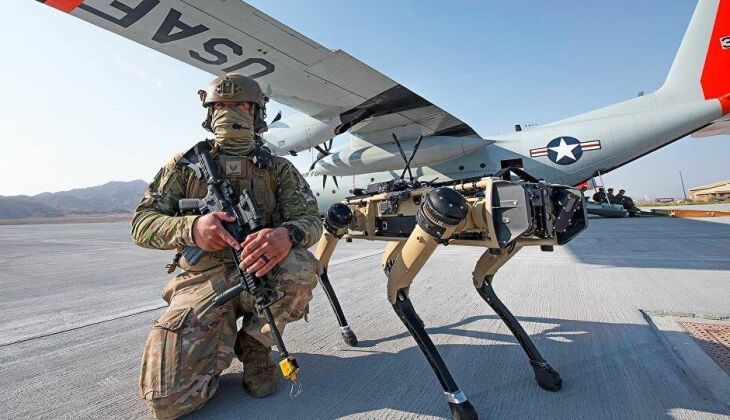
Regarding the new robots’ value, Major Jordan Criss from Tyndall stated in official release: “These robot dogs will be used as a force multiplier for enhanced situational awareness by patrolling areas that aren’t desirable for human beings and vehicles.” He further elaborated: “We will be able to drive them via a virtual-reality headset within our Base Defense Operations Center… We will be able to see exactly what the robot dog is detecting through its mobile camera and sensor platform if desired, we will also be able to issue verbal commands to a person or people through a radio attached to the dogs.” There are reports that the Pentagon is considering inducting combat capable robots into service, some of which are likely to also have dog like four legged designs, and the Q-UGV with its limited reconnaissance role is likely to be just the first of many more ambitious systems which enter service in the 2020s.
