
United Arab Emirates Shows Interest in India’s Tejas Fighter - Is a Purchase Likely?
Military Watch Magazine Editorial Staff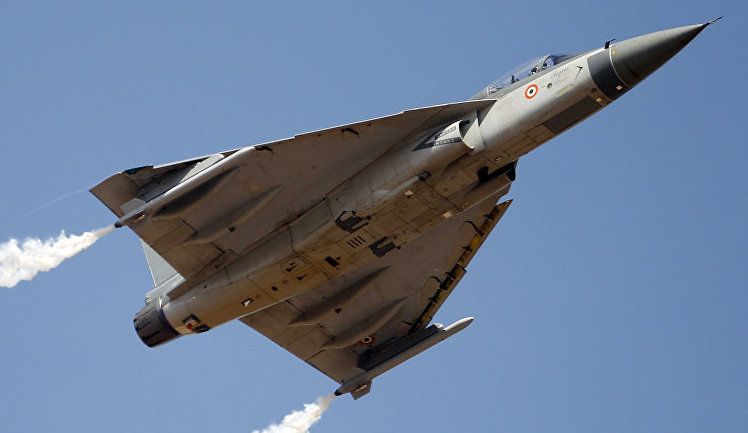
Indian Air Force HAL Tejas Single Engine Light Fighter
The United Arab Emirates has shown interest in acquiring India’s HAL Tejas single engine light fighter, a combat aircraft under development for over two decades for the Indian Air Force, which is reportedly set to enter large scale production in the near future. Designed to make use of an American General Electric F414 engine, Israeli avionics, laser range finders, Litening targeting pods and helmet displays, and Russian air to air missiles such as the R-73, the fighter relies extensively on foreign technologies to compensate for the considerable shortcomings in India’s own military aviation industry to allow the Tejas to better contend with foreign rivals. Approximately 50% of the fighter is currently developed domestically by India, though the country intends to increase this to 70% in the future. As a low cost light platform similar to the Swedish Gripen, American F-16 or Pakistani JF-17, the Tejas is not designed to lead the field or contend with heavy air superiority fighters such as the Su-30 or even high end single engine light fighters such as the F-35 or J-10C - but rather to be manufacture cheaply and fielded primarily in a supporting role.
The UAE's Minister of State for Defense Affairs, Mohammed Ahmed Al Bawardi Al Falacy, paid a visit to HAL’s facilities in Bengaluru on October 17th 2018. The minister received a briefing on the ongoing projects in HAL, and was taken around the Helicopter Complex, LCA Tejas Division and Hawk final assembly hangar. "I am happy to be here and proud to see the sophisticated level of manufacturing that is in place", he remarked. According to HAL, the minister "evinced keen interest in LCA Tejas.” Singapore, Egypt and Sri Lanka have also shown some interest in the Indian fighter - though this has never come past a preliminary interest. The fighter was designed as a more capable replacement to the MiG-21 - currently deployed in large numbers by India’s Air Force, though considering the advanced state and price competitiveness of many rival fighters its ability to succeed on export markets remains to be seen.
Regarding the Tejas’ place in the UAE’s Air Force, with the wealthy Arab state retaining both one of the highest defence budgets in the world and a considerable aversion to casualties, the Arab state is likely to struggle should it attempt to integrate the low cost and somewhat mediocre jet with its high end elite fighters. With the Tejas designed with prioritisation of a low cost in mind, and the UAE by contrast having sought to acquire the most capable and fighters possible - which are often the most costly, the Indian jet appears a poor fit for the Arab state - with the exception of possible limited service in a training role. As the UAE currently relies on the F-16E for the mainstay of its aerial warfare capabilities, and is planning possible acquisitions of Russian Su-35 air superiority fighters, American F-35 single engine stealth fighters and reportedly a fifth generation Russian jet of unknown designation - some of the most capable combat aircraft in the world, acquisition of the Indian Tejas remains unlikely.
