
U.S. Navy New Laser Cannons for Testing; The Importance of Laser Weapons to American war plans
Military Watch Magazine Editorial Staff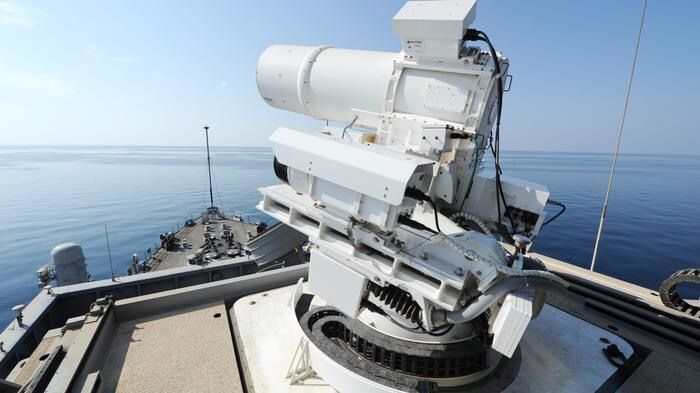
U.S. Navy's USS Ponce Conducts an Operational Demonstration of a Laser Weapon System
Wikimedia Commons - U.S. Navy photo by John F. Williams
In January 2018 the U.S. Navy purchased a pair of Lockheed Martin's "High Energy Lasers," an as of yet experimental platform, for $150 million. One of the cannons will be tested on land, the other on an Arleigh Burke Class destroyer. The weapons system could well become the world's first "directed energy" laser weapon to enter active service. The development of these futuristic weapons has largely been in response to the deployment of low cost attack drones, fielded in large numbers and most often cheaper than the Patriot surface to air missiles traditionally used to intercept them, as capable and cost effective anti drone platforms. The laser built by Lockeed Martin reportedly draws 150 kilowatts of power per shot, making it an ideal weapon for targeting drones and small attack boats. The latter has been of particular concern for the U.S. Navy in the straits of Hormuz, where Iran has developed large numbers of heavily remotely piloted 'suicide' attack boats to swarm larger U.S. warships. Plans to upgrade the laser's power to 300 kilowatts in future would increase its range while also giving it enough power to intercept incoming missiles.
The U.S. Navy's future plans for war with 'great power adversaries', namely Iraq, North Korea, Russia and China, depend heavily on laser weapons. As Adm. William Moran, then Vice Chief of Naval Operations, stated at an industry conference in 2016: "Low-cost directed energy weapons have to be part of our future... If we have to continue to rely on projectiles, we will run out of the ability to defend ourselves." The Navy notably installed a far less powerful 30 kilowatt laser aboard the amphibious ship USS Ponce in 2014, though its performance was unremarkable. MIT researcher Subrata Ghoshroy stated that the tests "reminded me of an old cartoon in which someone shot an arrow at the side of a barn, then painted a bulls eye around the spot where the arrow landed." The Navy hopes for more success in testing these newer more sophisticated platforms.
The cost effectiveness of laser weapons relative to costly Interceptor missiles is a key factor which prompted further investment in their development. According to a report by Ronald O'Rourke, a naval expert at the Congressional Research Service: "In combat scenarios ... against a country such as China that has many UAVs and anti ship missiles and a capacity for building or acquiring many more, an unfavorable cost-exchange ratio can become a very expensive–and potentially unaffordable–approach to defending Navy surface ships." China has already demonstrated successes in moving away from a reliance on gunpowder based weapons, notably by being the first to test an electromagnetic railgun at sea. While the U.S. has struggled to develop its own railgun technology, its successful testing of laser weapons a significant step towards retaining parity with China's growing capabilities.
