
U.S. Navy Does Not Have High Hopes for its Littoral Combat Ship; Reports Reflect Poorly on Next Generation Warship
Military Watch Magazine Editorial Staff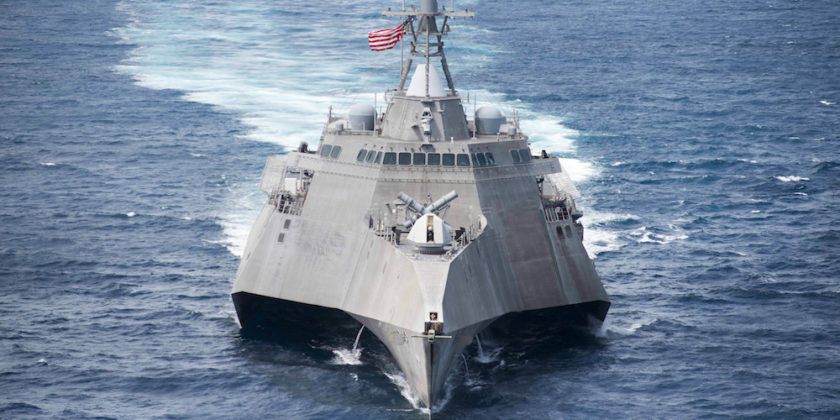
U.S. Navy Littoral Combat Ship
U.S Navy/Mass Communication Specialist 3rd Class Deven Leigh Ellis
One of the U.S. Navy’s most prolific programs to produce a next generation stealth warship, the Littoral Combat Ship (LCS) has been under development for 16 years and cost the military tens of billions of dollars. The warships cost over half a billion dollars each ($637 million for Freedom and $704 million for Independence variants), and 55 warships were set to be commissioned at the program’s outset. Alongside high acquisition costs, the warships’ annual annual operational cost stand at $79 million - compared to $54 million to operate the Navy’s far larger and better armed warships. While warships cost significantly more than comparable platforms of similar sizes fielded by other states, their capabilities have left much to be desired due to a number of design flaws. This has led the Navy to seriously reconsider inducting the platform into service in the large numbers initially planned.
Much like the Zumwalt Class Destroyers before them, a heavier next generation warship set to fulfil a complementary role, the Littoral Class are likely to fail to meet the Navy’s requirements. The Zulwalt Class were cancelled with only three of an initially planned 32 warships built, and with these unreliable warships themselves having to be repurposed for new roles due to their poor performance as multipurpose destroyers. The Littoral Class program too could face early cancellation due to its underperformance, and the U.S. Navy has strongly indicated such an eventuality is likely. A recent report by the U.S. Naval Institute stated that the Navy, despite previous plans to deploy warships to join the 7th and 5th Fleets in Singapore and Bahrain respectively, “may not” deploy any of the warships this year. The report strongly suggests that the Navy has run out of patience for the Littoral Combat Ship, which has repeatedly proven a disappointment in its performance, and that this could lead to the number of warships set to be procured being cut down significantly. The Naval Institute’s report comes after years of significant cost overruns and highly frequent mechanical failures, which led the Navy reduce the number of LCSs on order from Lockheed Martin and General Dynamics in 2014 due to the platform’s underperformance. Further reductions remains highly likely in light of the platform’s continued underperformance, which could well set the Navy’s modernisation program back several decades - particularly when considering the termination of the Zumwalt Class Destroyer program which as of yet still lacks a replacement.
The Pentagon’s operational testing and evaluation arm between 2016 and 2017 conducted a thorough review of the Navy’s LCS fleet, publishing its findings in January 2018. The review revealed significant structural problems with the Freedom and Independence variants of the warship, which included: a concerning deficit in combat system elements (namely radar systems), limited anti ship missile defensive capabilities, and a lack of redundancies for vital systems necessary to reduce the chance that “a single hit will result in loss of propulsion, combat capability, and the ability to control damage and restore system operation.” The warship is therefor both inadequate in its sensors, vulnerable to missile attacks and lacks the survivability to endure damage - a dangerous combination which makes the warship highly unsuitable for combat.
A report from the U.S. Department of Defence stated regarding the Littoral Combat Ship’s underwhelming capabilities, particularly in terms of its survivability: “Neither LCS variant is survivable in high intensity combat. Although the ships incorporate capabilities to reduce their susceptibility to attack, testing of analogous capabilities in other ship classes demonstrated that such capabilities have limited effectiveness in high intensity combat.” A report by the U.S. Navy’s requirements officer for the LCS program, Captain Kenneth Coleman, found that the ships were particularly vulnerable to air launched anti ship missiles - platforms fielded in growing numbers and with ever greater capabilities by a number of potential U.S. adversaries. Despite billions of dollars already sunk into the LCS program, the Navy has already begun to explore options for other light warships to replace them. In July 2017 the Navy posted official requirements for a brand new frigate under a Guided Missile Frigate Replacement Program, which would potentially allow it to make further cuts to orders for the Littoral Combat Ship. Whether the Navy will be able to learn from experience gained from the failure of both the Zumwalt and LCS programs to avoid massive cost overruns and performance issues which plagued the two programs on its new next generation warship remains to be seen.
