
U.S. Military Wary of Growing Russian and Chinese Anti Satellite Capabilities
Military Watch Magazine Editorial Staff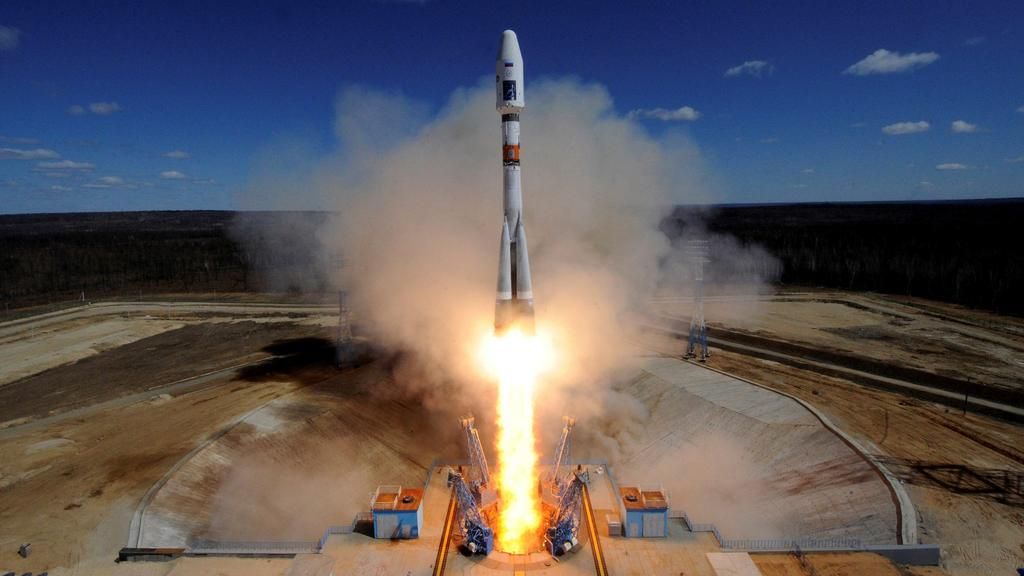
Russian Soyuz 2.1A rocket carrying Lomonosov, Aist-2D and SamSat-218 satellites
The United States military by virtue of its worldwide military facilities and global power projection is today is more reliant on satellites for its operations than any other power in the world. From communications, surveillance and coordination with Special Forces to early warning systems the military's operations across the world would be seriously compromised by the loss of its global satellite coverage. The U.S. maintains a significant advantage in its satellite capabilities, with 129 platforms in space compared to Russia's 75 and China's 35, but growing Russian and Chinese anti satellite technologies are increasing leaving leave U.S. satellites vulnerable. Considering the extent to which the military relies on these platforms, their vulnerability presents a serious threat to the military ability to operate abroad.
In mid 2016 Director of National Intelligence Dan Coats stated that Moscow and Beijing were "increasingly considering attacks against satellite systems as part of their future warfare doctrine. Both will continue to pursue a full range of ASAT weapons as a means to reduce U.S. military effectiveness." According to Coats' testimony to Congress, Russia was seeking a "diverse suite of capabilities to affect satellites in all orbital regimes (i.e. high and low altitudes.)" Alongside advanced anti satellite missiles such platforms could include Electromagnetic Railguns, a technology which China appears to have a lead in, as well as laser weapons. Anti satellite missile systems are already in late testing stages, with China's HQ-19 set to be deployed on its new Type 055 destroyers and Russia's 600km range S-500 system set to be in service in significant numbers by 2020.
Russia is estimated by Western analysts to spend $5 billion annually on ASAT capable weapons, with even its S-400 and advanced variants of its S-300 long range SAM systems capable of reliably targeting low orbit platforms. For hostile platforms in higher orbits, platforms such as the Nudol missile are set to prove highly effective and have been tailored especially for an anti satellite role. China too has invested heavily in such capabilities, which would prove an invaluable asset in disrupting U.S. operations over the Pacific in times of war. Acting CIA Director John McLaughlin stated in January regarding the expanding adversarial capabilities and the growing vulnerability of U.S. satellites: "China's military modernization program clearly includes an attempt to up its game in space. Weapons for space involve more than just ASAT systems, but these are the most overt signs of China's progress."
John Blaxland, Professor of International Security and Intelligence Studies and an expert on U.S. defence, stated regarding the development of anti satellite weapons by American adversaries: "The U.S. Department of Defense is undoubtedly concerned. That is because much of the precision and geolocation technology, on which much of U.S. military technology depends, is heavily reliant on maintaining their network of satellites unhindered by the prospect of ASAT strikes from China or Russia."
Ultimately while the U.S. military is the most heavily reliant on satellites, American anti satellite weapons are also highly sophisticated and present a threat to Chinese and Russian operations. China's defensive strategy to deny the U.S. Navy access to its coastal waters for example has largely relied on the development of formidable satellite guided long range anti ship missiles such as the DF-21D 'carrier killer.' While the U.S. Navy has indicated that its warships currently has no defence against the Chinese platform, knocking out the satellites they use for targeting could well be the only means to restore some form of access for the U.S. Navy to conduct offensive operations against Chinese coasts. Targeting these satellites could also be key to limiting the precision of long range missile strikes against U.S. military facilities in the Pacific such as the Pacific Command in Hawaii or Andersen Air Force Base on Guam - which are otherwise highly vulnerable to missile attacks.
