
U.S. Military Modifies C-130 Hercules Transports for 'Nuke Sniffing' Role as Iran Threatens Withdrawal from JCPOA Nuclear Deal
Military Watch Magazine Editorial Staff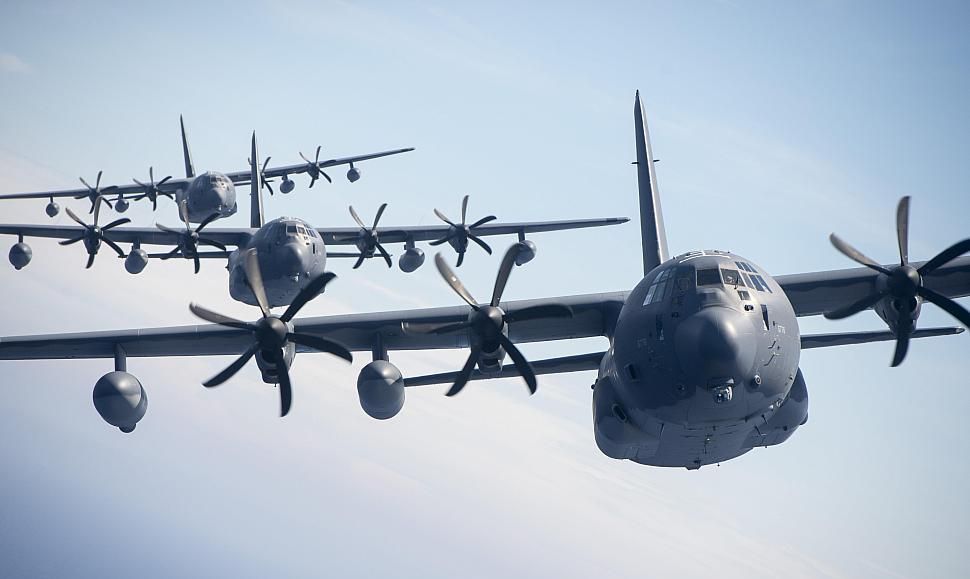
U.S. Military C-130 Hercules Aircraft
First produced in 1954, the Lockheed C-130 Hercules military transport aircraft entered service in the aftermath of the Korean War and remains widely in service today, with over 2,500 of the aircraft having been built over 65 years. The Hercules remains key to the United States’ colossal military transport capabilities, essential to sustaining its vast network of military bases across the world and delivery men and materials for war to where they are most needed. The transport aircraft has been exported to more than 60 countries for military use, and over 10 modifications of the platform have been developed for specialised roles. The Hercules remains one of the oldest vehicle designs in service in the United States military.
The U.S. military has recently allocated several of its Hercules aircraft a new role - detecting atmospheric nuclear particles over enemy territory, or ‘nuke sniffing,’ to better respond to threats from existing or potential nuclear armed adversaries. While the WC-130, a weather reconnaissance aircraft which entered service in 1962, has long been allocated this task, perceptions of increasing nuclear threats from abroad have led to greater needs for ‘nuke sniffers’ - resulting in the modification of standard C-130 aircraft for this purpose. Air Force Chief of Staff General Dave Goldfein stated in a report to Congress that the WC-135 was far too small to meet the needs of the armed forces. “Our mission capable rates, and more importantly our aircraft availability rates to go do this mission, are much lower than not only the Secretary of Defence but the combatant commander’s requirements for that mission,” he reported. The Air Force has thus placed orders for Harvester Particulate Airborne Collection System kits which can be strapped onto a basic C-130 transport to collect microscopic nuclear solids - taking pressure off the WC-135 fleet.
The Harvester kit was reportedly tested by U.S. Customs and Border Protection MQ-9 Reaper drones before being procured by the Air Force. Each includes two sampling pods and a gamma radiation sensor which is key to guiding aircraft to radioactive zones for better sampling. Teams on the ground will also be provided with new radiation protection gear and equipment needed to analyse nuclear particles collected by the Hercules aircraft. While capable, the modified C-130 aircraft will not be able to match the capabilities of the specialised purpose built WC-130, with the latter capable of operating at extended ranges due to aerial refuelling and internal filtration, able to collect nuclear gasses alongside standard particles, and flying a 42% higher altitude which is key to retaining survivability near or over enemy airspace.
The U.S. Air Force’s newly modified ‘nuke hunting’ C-130 aircraft are set to prove an invaluable asset in light of a the vast nuclear capabilities fielded by a number of potential adversaries. With Iran set to restart uranium enrichment following the United States’ withdrawn from the JCPOA nuclear deal, and threatening to withdraw from the agreement altogether, aircraft able to monitor Tehran’s nuclear activities should the deal collapse entirely and IAEA inspectors be evicted from the country remains a highly prized asset. The Untied States is hardly the only country to invest in such capabilities or to modify existing aircraft for a ‘nuke sniffer’ role due to concerns regarding the activities of its potential adversaries. The Soviet Union for one was known to modify its MiG-25 high altitude interceptors to monitor Chinese nuclear testing across the border - and with Beijing’s arsenal at the time aimed squarely at the USSR this was considered a major threat worth monitoring closely. The resulting MiG-25RR flew regular sorties near and at times over Chinese territory to collect valuable data, providing Soviet planners with a critical understanding of developments in the Chinese nuclear program.
In the event of war with a nuclear power such as North Korea or Russia or an aspiring nuclear armed state, which Iran may well become in the near future, specialised aircraft and drones are set to to be be brought to the front to seek and neutralise enemy nuclear capabilities in a conflict’s early stages. Intelligence provided by ‘nuke sniffing’ C-130 and WC-130 aircraft could well become an invaluable asset for such a mission - which will be particularly difficult against established nuclear armed powers such as North Korea and Russia which rely on both highly mobile nuclear delivery systems and heavily fortified installations to retain survivability. Success in neutralising an enemy’s nuclear capabilities from the air assumes the United States military will retain air superiority, as so many of their capabilities do. In a war with Russia, China or North Korea their ability to do so remains highly questionable. Against softer potential nuclear armed adversaries such as Iran or Pakistan, claiming air superiority and providing safe passage for American aircraft over enemy airspace will be much less of an issue.
