
U.S. Military Blocks Inter-Korean Peace Train at the Border; Rift Grows Between Seoul's Peaceful Reconciliation and the Western Maximum Pressure Strategies Grows
Military Watch Magazine Editorial Staff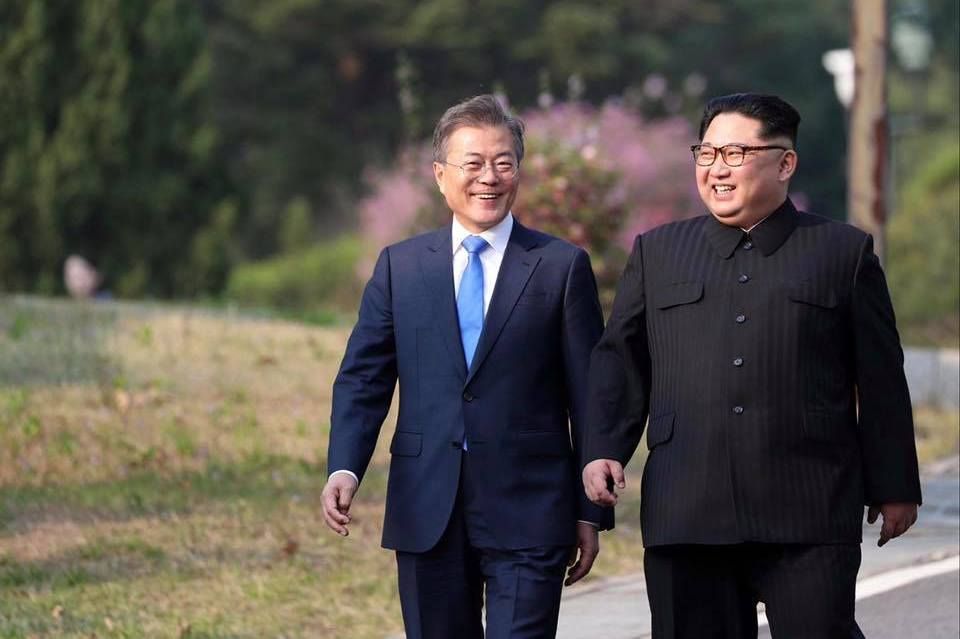
South Korean President Moon Jae In and North Korean Leader Kim Jong Un
A highly prolific railway project meant to connect North Korea and South Korea has been blocked by intervention of the United States military, raising serious questions as to the limits on the autonomy of the government in Seoul when setting policy in regards to relations with its northern neighbour. While the South Korean government has supported a policy of engagement and peaceful reconciliation, the United States has by contrast sought to exert maximum pressure on Pyongyang until the government of the East Asian state yields to its demands unilaterally - imposing hefty economic sanctions to achieve this goal. U.S. attempts to undermine the joint Korean venture, stopping a South Korean train which was set to conduct a field study alongside Pyongyang officials across much of North Korea’s territory - up to Sinuiju and the Russian and Chinese borders, has demonstrated the considerable rift which remains between the East Asian states’ mood of reconciliation and that of the U.S. and many of its Western allies which, by contrast, have emphasised confrontation.
The U.S. led United Nations Command, which retains a considerable military presence on the inter Korean border, was responsible for stopping the train heading to North Korea. The organisation was referred to as a ‘token force’ by President Eisenhower shortly after its formation, and has consistently conducted policy in line with Washington's interests under direct American command ever since. It stated that it required more details on the inter Korean venture - and until such a time its continuation would be blocked. While South Korea’s Ministry of Unification confirmed that its vice minister had met with the commander of U.S. Forces in Korea and head of the UN Command, Vincent Brooks, a day before the railway plan had been blocked, and had provided extensive information on both the railway project and plans to unite families divided by the inter Korean spilt - the fact that the railway project was nevertheless prevented from going through indicated that the prior notification was not the issue. It further indicated that the future the joint Korean venture ultimately lay in Washington’s hands - rather than being an issue to be resolved among the two East Asian neighbours. Citing a lack of prior notification was widely interpreted to be a pretext for blocking the process indefinitely, while sending a strong signal to the government in Seoul that its reconciliation efforts would only be tolerated by Washington to a certain extent.
Other than undermining economic pressure on North Korea, the South’s railway project is also speculated to pose a threat to the United States’ position for another critical reason - one pertaining to Seoul’s economic partnerships with other U.S. adversaries. An inter Korean railway would open the door to a railway linking South Korea both to Russia’s trans Siberian railway and to China’s One Belt Road initiative - drawing Seoul further out of Washington’s orbit. The threat to Washington’s position as the long dominant partner of the strategically critical East Asian state was first highlighted when South Korea joined the Chinese Asian Infrastructure Investment Bank under the previous President, Park Guen Hae, who also attended a major military parade in Beijing in 2015 which had been unanimously boycotted by the Western Bloc. Both of these moves drew Washington’s ire, and demonstrated the threat of a South Korean shift away from its near exclusive reliance on the U.S. during the Cold War - which closely followed China’s emergence and the country’s largest trading partner. A railway linking South Korean to China and Russia through North Korea could thus seriously threaten U.S. interests in this regard - alongside the undermining of its maximum pressure campaign on Pyongyang. Given the nature of the threat to the American position, it is highly unlikely that the railway project will be allowed to proceed in the near future
