
U.S. Marines Deploy F-35B to Japan
Military Watch Magazine Editorial Staff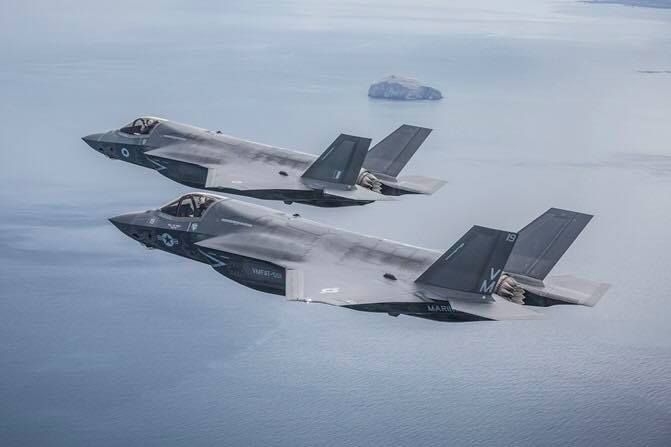
F-35B Light Multirole Fighters
The U.S. Military has deployed further F-35 fifth generation light multirole fighters to Japan where they will serve with the Marine Corps. This comes amid a massive redeployment of US naval and air assets to East Asia in response to both escalating tensions with North Korea and China's own massive military growth - the latter which has come alongside the country's rapid economic rise. With the F-35A already having been deployed to South Korea and Japan to serve with the U.S. Air Force, and with the Navy's F-35C set to begin entry into service in 2018, the F-35B represents a unique variant of the Joint Strike Fighter designed especially for the US Marine Corps. While the F-35C is capable of operating from aircraft carriers such as the Gerald Ford and Nimitz class, the F-35B was designed to be able to operate from smaller helicopter carriers which lacked runways, catapults or arresting gear. The fighters were designed with with vertical takeoff and landing capabilities similar to those of the Sea Harrier - the fighter which they were replacing. Vertical takeoff capabilities do however compromise the combat performance of the fighter, and compared to the F-35C the Marines' fighter carries much less fuel, operates at shorter ranges and can carry less weapons. The small wings the fighters use for vertical takeoff also make them less maneuverable than the Navy's F-35C variant.
The F-35B fighters are set to operate from the Marines' Wasp and America class warships, which carry a maximum complement of around 20 fighters. Their poorer combat capabilities relative to other variants means that the Navy has opted to comprise its fleet entirely of F-35C fighters, and the only operator of the F-35B outside the U.S. Marines will be the Royal Navy and Italian Navy which have commissioned the fighters for its Queen Elizabeth and Cavour class carriers. Japan's Navy is also a potential customer, as such fighters would greatly enhance the capabilities of its Izumo class carriers.
The F-35B provides the Marines with critical air support when conducting amphibious landings, for which the Wasp and America class carriers are specialized. They are however highly unlikely to be effective in air to air combat against better armed, longer ranged and more manoeuvrable platforms such as the J-15. While they do effectively fill the niche of a helicopter carrier based fighter, the F-35B will struggle if competing with land or conventional carrier based platforms such as the Rafale, Su-33 or MiG-29.
