
U.S. Looks to New Technologies to Counter North Korean Missiles
Military Watch Magazine Editorial Staff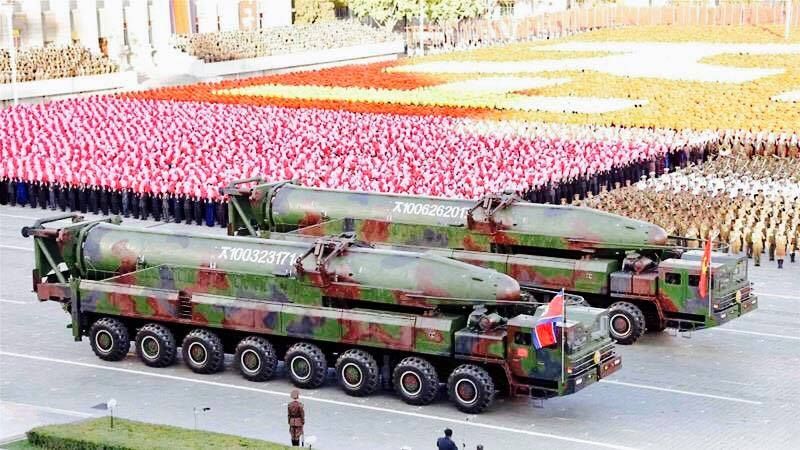
North Korean Hwasong-14 ICBMs on Parade
KCNA
Reports from the military and prominent think tanks have consistently indicated the vulnerability of the United States mainland to strikes from the rapidly advancing North Korean missile program - as well as the unreliability of U.S. missile defenses as proved consistently throughout their testing. As a result the Pentagon has looked for other less conventional ways with which to target North Korean missiles. One example was the Trump administration's requested for $4 billion from Congress to increase cyber operations against North Korea - a budget far greater than that of the Korean missile program itself. Using cyber weapons to disrupt missile launches has however previously had mixed results, and the Obama administration long pursued cyber operations against Pyongyang's missile program targeting its development of intermediate range systems such as the Musudan missile. Cyber operations at best may have slightly slowed progress as the missile has now been designated combat ready and serves as a critical part of the country's missile deterrence force.
North Korea has proven a particularly difficult nation to target, largely due to both its tight security and the United States 'intelligence black hole' with regard to the country as referred to by the CIA. An example was the use of the Israeli-American developed Stuxnet virus which was used to target Iranian and North Korean nuclear facilities. While the virus successfully targeted Iranian systems and caused damage to the country's nuclear centrifuges, it was intercepted in Korea and had no effect. Cyber warfare against Pyongyang's missile program requires substantial knowledge of launch control and guidance systems - which for North Korea is information near impossible to obtain.
With cyber warfare's limited potential to gain results, the Pentagon has also explored the option of using armed drones to patrol the skies over the Sea of Japan and intercept ascending North Korean ICBMs. The early stages of a missile's trajectory represents their most vulnerable point at which their low speed and altitude makes them far easier to target. While missiles are vulnerable to being neutralized by heat seeking missiles however, U.S. drones are also themselves potentially vulnerable to North Korean fighters and, should they come too close to its territory, SAM systems as well. North Korean SAMs have an estimated engagement range of 300km, potentially longer, while its fighters can engage targets up to 130km away using R-27 missiles. With fortified radar installations dotted across the country, as well as airborne radar early warning systems (AWACS), operating anywhere near North Korean airspace is extremely risky for any hostile air units. U.S. drones may as a result require fighter escorts, and this could significantly complicate operations and lead to open conflict in the Korean skies, which could spiral out of control and lead to escalation on both sides. If successful however, these patrols would be highly intimidating and squeeze Pyongyang harder - something the U.S. has shown to be one of its objectives on the Peninsula. With North Korea having successfully tested the Hwasong-14 and Hwasong-12 - missiles significantly more potent than anything the country formerly possessed and capable of striking US population centers - the United States' sense of vulnerability is greater than ever. The extensive measures being put in place to counter Korean missiles have come as a result of a fear that Pyongyang will achieve a form of genuine nuclear parity with United States - something historically unprecedented for any non superpower nation.
