
U.S. Leadership Admits Considerable Strategic Disadvantage When Facing Russian and Chinese Hypersonic Missiles
Military Watch Magazine Editorial Staff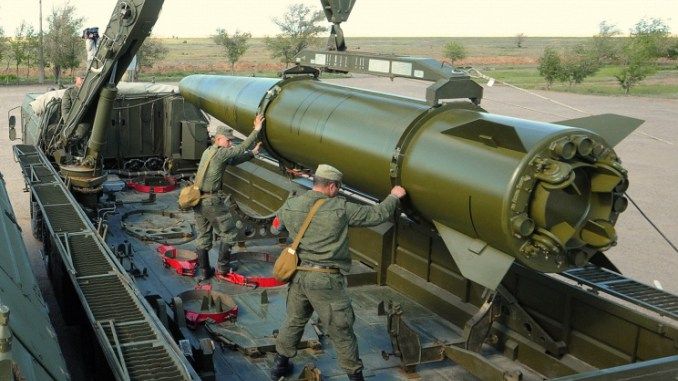
Russian Iskander Ballistic Missile
In the wake of Russia's revelation of its latest strategic hypersonic missile technologies, the U.S. military has admitted that it is lagging far behind both Russia and China in the field hypersonic weapons development - according to a report by The Hill. Russia's latest systems such as the Mach 10 Sarmat and Mach 20 Avangard intercontinental ballistic missiles are capable of significantly outperforming any Western analogue - striking at far greater speeds, with greater accuracy as with a larger payload. Russia retains a significant technological advantage in both the ICBM and anti missile fields, and its missiles are impossible to intercept by any anti missile system currently in service or set to be inducted for many years. As Senator James Inhofe of the Armed Services Committee stated in regards to the massive discrepency in capabilities: "Right now we are helpless."
Head of U.S. Strategic Command General John Hyten stated during a meeting of the Senate Armed Services Committee that the U.S. air defence system was wholly incapable of intercepting attacks by hypersonic platforms such as those recently inducted into service by Russia. The General stated: "We don't have any defense that could deny the employment of such a weapon against us, so our response would be our deterrent force, which would be the triad and the nuclear capabilities that we have to respond to such a threat."
Russia's leadership specifically stated that it had sought the development of hypersonic missiles specifically to evade Western interceptor platforms, and these had been deployed in response to the United States deploying air defence systems around Russia's borders. Such deployments came following the U.S. withdrawal from the Anti Ballistic Missile (ABM) treaty in the early 2000s, and included both land and sea based platforms such as the Aegis, Aegis Ashore, THAAD and Patriot anti missile systems. Russia viewed the deployments as an attempt to undermine the country's strategic deterrent, the most critical part of its defence against a potential Western attack. With no U.S. missile defence system capable of intercepting even a Mach 5 hypersonic missile, the induction of hypersonic platforms will ensure the viability of Russia's deterrent for years to come - possibly indefinitely. The United States in turn has accelerated its own hypersonic missile program in response to induction of the Sarmat and Avangard into active service. China too, though it has yet to induct its first hypersonic missile into service, has in the past cooperated extensively with Russia in developing missile technologies on several occasions and is thought to be well ahead of the United States in the field.
