
U.S. Deploys B-52 Superfortress Bombers to Guam Amid Growing Tensions with North Korean and China
Military Watch Magazine Editorial Staff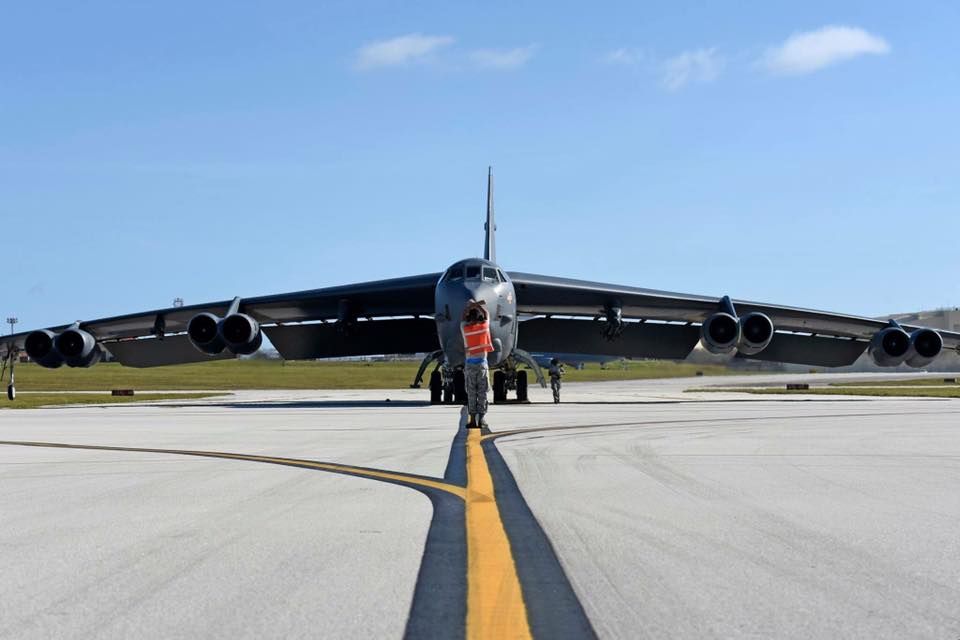
B-52 Stratofortress at Andersen Air Force Base, Guam
U.S. Pacific Air Forces
The U.S. Air Force has deployed its oldest combat aircraft, the Vietnam War era B-52 Stratofortress, to Andersen Air Force Base on Guam. The bombers have been in service since 1955, and have since been modernised - equipped with more capable systems such as AGM-86 ALCM subsonic cruise missiles developed in 1982. These missiles allow the bomber to strike targets over 2000km away to keep the vulnerable subsonic aircraft out of harms way, thereby increasing the platform's survivability. The Stratofortress bombers are joining B-1B Lancers and B-2 Spirits already deployed to the island territory - with the latter having been deployed just days before. The B-52 will likely joint the Lancers in conducting simulated strikes on North Korean targets and flights near the country's airspace - a role for which the B-2 is ill suited due to its delicacy and extreme maintenance requirements which allow it to fly approximately once every two months - not more.
The deployment of the B-52 is intended to send a strong signal in regards to the continued readiness of the U.S. to launch strikes on North Korea - though in light of the Asian state's recent military developments and deployment of a capable deterrent force such attacks remain highly unlikely. B-52 bombers may well have been encountered by the North Korean Air Force in the past, with both the U.S. bombers and the Korean fighters flying extensive sorties over Vietnam. The B-52 has never needed to contend with anything more advanced than a Vietnam War era MiG-21, and would struggle to operate near North Korea's airspace in the event of an actual conflict. Even the MiG-21 fighters in North Korea's fleet have been extensively modernised since Vietnam and today can carry advanced Mach 4.5 130km range R-27 missiles, which when coordinating with AWACS or ground based radar control pose a lethal beyond visual range threat to the lumbering Superfortresses. North Korea's more potent long range platforms such as the MiG-25 and MiG-29 and ground based SAMs such as the S-200 and KN-06, technologically far ahead of the B-52, severely limit the U.S. bomber's usefulness in the early stages of a Korean conflict. The antiquated platforms' presence in Guam is more than anything a symbolic one.
