
U.S. Cold War Plans for a Nuclear Powered Amphibious Tank; Chrysler's Ambitious Plan Which Could Have Replaced the M-60
Military Watch Magazine Editorial Staff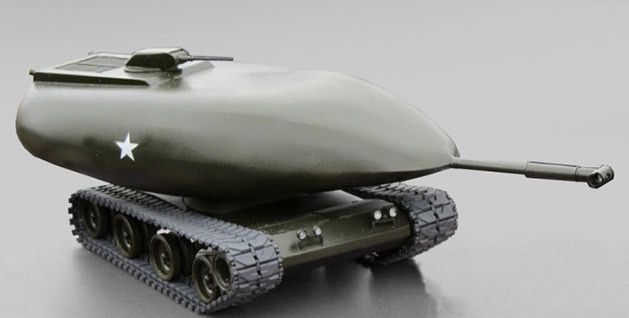
Chrysler TV-8 Battle Tank Artwork
The dawn of the nuclear age in the early 1950s saw several conceptual applications for the world's new source of seemingly unlimited energy, one in which the United States was a pioneer and retained a considerable technological lead over near peer competitors. Following the successful testing and deployment of nuclear weapons against the Japanese Empire, the development of nuclear technologies to provide energy for both civilian and nuclear purposes was widely explored. American automobile manufacturer Chrysler came up with a particularly ambitious use for nuclear technologies at the time, a nuclear powered battle tank which was expected to give the United States a significant advantage in armoured conflict against any potential adversary. The Chrysler TV-8 battle tank was envisioned as a nuclear powered vehicle with an operational range well beyond that of any existing platform and capable of both land and aquatic combat.
The TV-8 arose at a time when the supremacy American military might was threatened, not only by the strength of the Soviet Union whose tank divisions outmatched their U.S. counterparts both quantitatively and qualitatively at the time, but even from smaller adversaries. North Korea which had so recently in mid 1950 with just 70,000 men forced a U.S. military contingent of over 140,000 into a full retreat and encirclement, while prospects for a new war in Asia surrounding the Taiwan straits, Vietnam or even the Soviet Far East appeared high. The battle tank was designed to be lighter but more efficient than previous platforms, with a hull shaped turret that was on a light framework. Unusually for a battle tank, the TV-8 turret housed the engine, the ammunition, and the entire crew. The TV-8 weighed approximately 25 tons, with just 10 tons in the chassis and around 15 in the turret. The reasoning was that this would increase the chances of the tank's crew surviving a nuclear blast.
The United States' nuclear powered battle tank was to be equipped with a stationary T208 — 90mm gun that was installed in the turret with an auto loader, as well as one .50 caliber machine gun and two .30 caliber machine guns. Ammunition stored in the turret was separated from crew by a steel partition. The original design of the TV-8 featured a 300 horsepower Chrysler V-8 engine, which was connected to an electric generator also situated in the turret. Later variants were set to make use of a nuclear fission powered vapour cycle power plant. Though the tank proved a highly unique design with significant room for modernisation in future, it was concluded following a review that the TV-8 design lacked significant advantages over conventional tank designs. The TV-8 was thus terminated in April 1956, and the M-48 and M-60 would instead become the mainstay of the U.S. military's tank forces - to be replaced in the late Cold War by the M1 Abrams which remains in service today. The M-48 entered service in 1953, and remains widely operated today by a number of states including Iran, Taiwan, Turkey and South Korea among others. The more conventional design became the face of U.S. armoured warfare, and was later developed into the M-60 which entered service in 1960. Approximately 12,000 M-48 and 15,000 M-60 tanks would be produced during the Cold War, and prospects for Chrysler's nuclear powered platforms to have been produced and properly maintained in such numbers by both the U.S. and its allies remain unlikely. Though the U.S. did eventually develop nuclear powered warships, namely its Nimitz and Gerald Ford Class supercarriers, plans to use nuclear technology to power a platform as light as a medium tank never came to fruition.
