
U.S. Air Force Pursuing F-22 Modernisation Program Amid the Growing Emergence of Near Peer Threats
Military Watch Magazine Editorial Staff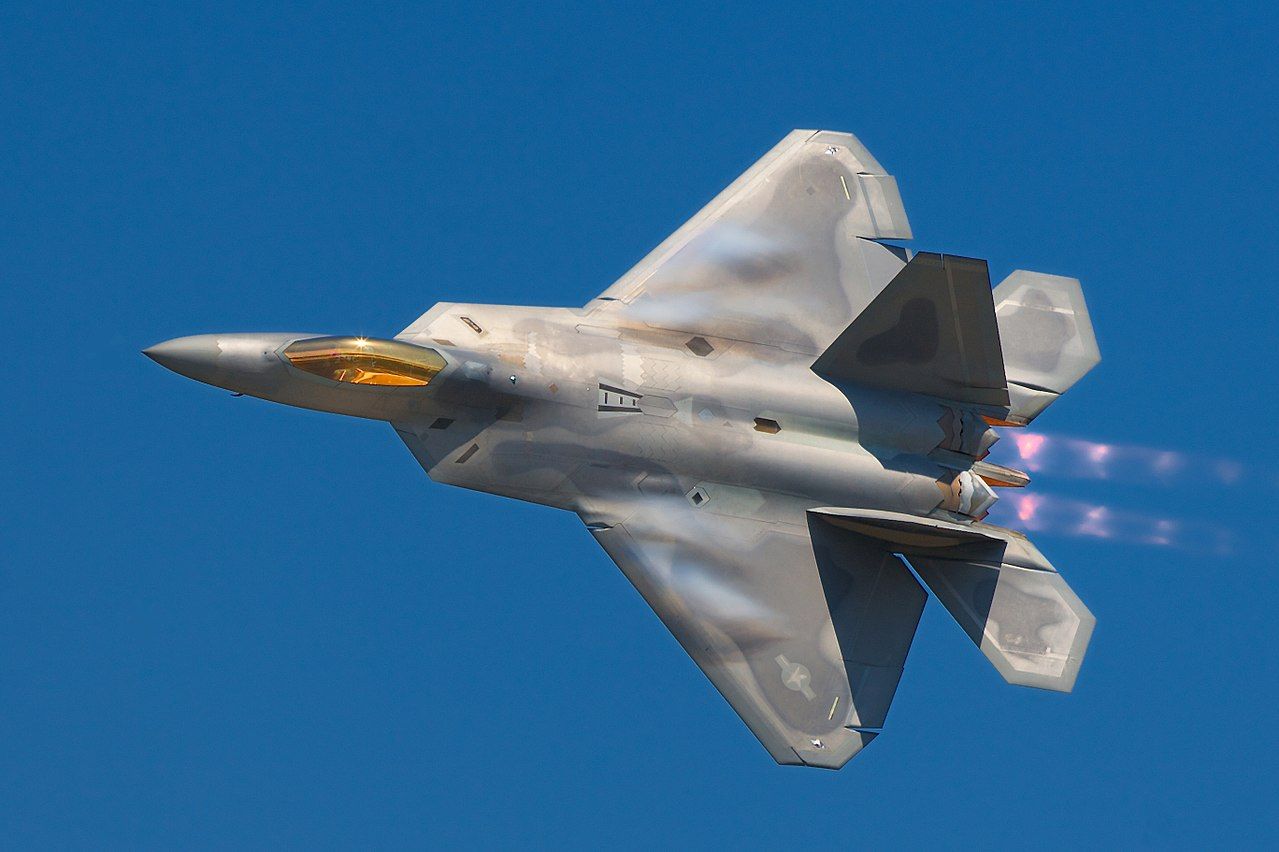
U.S. Air Force F-22 Raptor
Wikimedia Commons
The United States Military begun development of the F-22 Raptor in the early 1980s in response to reports of Soviet development of the Su-27 air superiority fighter. While the U.S. Air Force had previously been able to rely on its F-15 Eagle air superiority fighter to outperform leading Soviet platforms such as the MiG-23, the Su-27 was developed specifically to eclipse the capabilities of the F-15 and it overwhelmingly outperforms the Eagle in air to air combat. To ensure the Soviet Air Force could not consolidate its quantitative advantage with a qualitative one the U.S. needed a new generation of air superiority fighters - which over twenty years later led to the induction of the F-22 Raptor in 2005.
With the F-22 entering service long after the end of the Cold War, at a time when challenges to U.S. military dominance appeared negligible, the program was prematurely cut short with only 25% of the Air Force's requirements and none of the Navy's met. No Raptors being provided to U.S. allies for their own defence needs. Since the decision to prematurely terminate the F-22 program however, the U.S. has witnessed a rapid resurgence in the capabilities of its leading adversaries which threaten its qualitative advantage when contending for air superiority. Other than Russia's development of the Su-35, a '4++' generation air superiority platform potentially capable of challenging the Raptor and since sold to China, both China and Russia inducted fifth generation air superiority fighters analogous to the F-22, the J-20 in 2017 and Su-57 in 2018 respectively. With the U.S. military unable to resume production of the Raptor, and as of yet far from completing development of a new sixth generation air superiority platform, upgrading the F-22 appears the only effective option to retain some form of qualitative advantage or at the very least parity with the new fighters.
The Air Force is hurriedly pursuing an “agile software development” strategy for its F-22 fleet upgrade the fighter's sensors, radar and avionics, weapons and computer processing power. The program to upgrade the F-22 is known as the Raptor Agile Capability Release (RACR). The program is led by Secretary of the Air Force Heather Wilson, and is a key step towards keeping the F-22 viable as an air superiority platform against modern near peer adversaries until 2060 as per the Air Force's goal. As part is this upgrade program, the Air Force is nearing initial production of a new 3.2B software upgrade which will enhance the Raptor's use of IRS weapons. Air Force spokeswoman Captain Emily Grabowski stated regarding the program and the difficulties in readying new systems for the Raptor: “Integrating new software and hardware into weapon systems is a challenge that requires extensive testing. More than 500,000 lines of code have either been modified or added in support of the hardware modifications made to the aircraft."
According to Captain Grabowski, the aim of upgrading the Raptor fleet is to “enhance the lethality of the F-22 when employing the AIM-120D and AIM-9X (air to air missiles)." The F-22's current reliance on the AIM-120C air to air missile for beyond visual range engagement has been a serious handicap when compared to the capabilities of rival platforms. While the missile has a strike range of 105km, Russian, Chinese and North Korean platforms are all capable of deploying the superior R-27 with a 130km range. Russian and Chinese fifth generation fighters will respectively field the 193km range K-77 and ramjet powered PL-15 with a range of over 300km. The U.S. Air Force has as a result desperately sought a more capable missile, which has come in the form of the 180km range AIM-120D. Still not full operational, its induction will do much to brindle the gap between the F-22 and newer fifth generation platforms' beyond visual range combat capabilities. The AIM-120D missiles are being fired as part of operational testing of the 3.2B upgrade through a formal weapons evaluation process, and are set to enter full operational service with the Raptor alongside other upgrades.
Alongside an improved range, the AIM-120D will also present other capability enhancements over its predecessors. "Fire and forget" capabilities and active transmit radar guidance make the new variant of the AIM-120 the most lethal long range air to air missile ever developed for the U.S. Air Force. GPS navigation, inertial measurement units and a two-way data link, will all further enhance capabilities. The Raptors will also be equipped with new AIM-9X Block 2 missiles for close range engagements.
Major General Ken Merchant, Assistant Secretary of the Air Force for Acquisition, noted regarding the urgency of upgrading the F-22 to meet growing near peer threats: “We need the program to go fast enough to meet the threats the Raptor will face in the future. We are changing our contract structure and taking some risk so that the Air Force can prioritize the things they want on the jet. We want to add capabilities incrementally to the jet." Ultimately whether the F-22 will remain the dominant fighter in the skies remains to be seen, but if Russian claims regarding the performance of their Su-57 are true and China's current pace of developing cutting edge fighter technologies continues, the Raptor will find itself outmatched by the air superiority fighters of both rival powers within a short period of time. Upgrading the F-22 can potentially buy time and represents a relatively low cost way of keeping the fighter viable in coming decades, but for the U.S. to regain a qualitative advantage it will most likely need to look to a sixth generation fighter design to succeed the F-22.
