
Turkey Takes Official Steps Towards Potential S-500 Acquisition; Could Ankara Deploy the Prometheus Air Defence System Alongside its Soon to Be Delivered S-400?
Military Watch Magazine Editorial Staff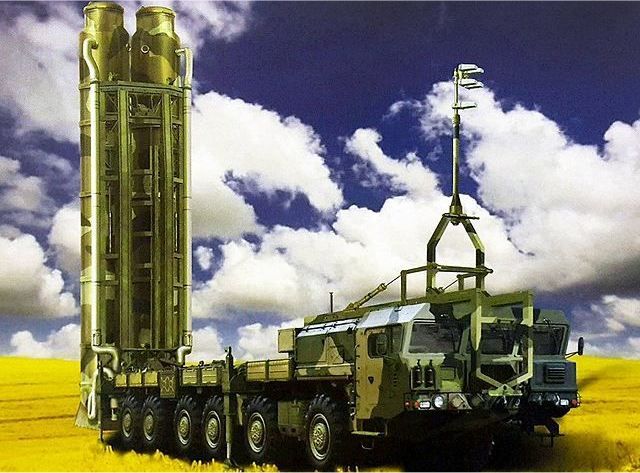
S-500 Air Defence System Artwork
Having declared in October 2017 his country’s interest in acquiring the S-500 Prometheus surface to air missile system, the latest in a long series of cutting edge Russian air defence platforms currently under development, Turkish President Recep Tayyip Erdogan has indicated that official steps are being taken to begin negotiations for the acquisition. While the President’s previous allusion to interest in the weapons platform was largely dismissed as a sign of defiance in the face of growing U.S. and Western pressure not to acquire the older S-400 Triumph missile platform, his recent statement indicates that Turkey could well be on its way to seriously pursuing acquisition of the latest air defence system. President Erdogan indicated that his country was interested not only in acquiring, but also in jointly manufacturing the S-500 system, stating: “I have contacted President Putin with a proposal about the joint production of the S-500… During the second and third stages (of acquisition) we will proceed to the joint production of the S-500 systems.”
While the S-400 is currently the world’s most capable and versatile long range air defence platform, able to strike targets at ranges of up to 400km where its Western made rivals are restricted to half that range or less and striking with unparalleled speed and precision, the S-500 is expected to surpass even these specifications. The platform will have a 600km engagement range against large enemy targets, and will be the first platform of its kind capable of intercepting targets at hypersonic speeds. The missile systems’ ambitious specifications have led to a number of delays in development, and the platform is set to enter service near 2020. According the Russian Deputy Prime Minister Dmitry Rogozin, early production of the S-500 has already begun as of March 2018. President Vladimir Putin ordered preparations to be made for mass production of the weapons system in May 2018, and U.S. intelligence reported a successful test of a long range surface to air missile from the new system days later.
Russia’s agreement to provide Turkey with the S-400 was met with some skepticism by a number of analysts, particularly given the history of Western defence partners allowing Russian hardware and air defence systems in particular to be studied by parties hostile to Russian and its allies to allow for better exploitation of potential weaknesses. Russia’s imminent induction of the S-500 and the provision of an export variant to Turkey with a number of countermeasures to prevent reverse engineering by Western specialists did much to lay these worries to rest. Whether Russia will be wiling to provide Turkey with the S-500, even an export variant, remains in question however. While Ankara is an emerging partner for Moscow strategically placed between Eastern Europe, the Middle East and Central Asia, as a NATO member and longstanding U.S. partner which has frequently altered its allegiances in the past and is very often unpredictable in its foreign policy stances, the level of trust between the two partners may not be sufficient for export of the S-500 in the near future. This could well change within a decade however, as Russia is likely to announce the successor to the S-500 - possibly designated S-600 or S-550, which would facilitate exports of the older system much like the S-500 facilitated sales of the S-400 before it. A newer variant of the S-500 could also serve to free the original platform for variant, much like exports of the S-300 PMU began after the induction of the S-300 PMU-2. With Turkey having shown considerable interest in acquiring the latest Russian hardware, from Kornet-EM anti tank missiles to Su-57 air superiority fighters, and the country’s economy and defence budget able to facilitate large defence purchases, renewed efforts to acquire the S-500 in future remain a considerable possibility.
