
Turkey Not Keen on Western Made Air Defences; No S-400 Will Likely Lead Ankara to Turn to the Chinese HQ-9 - Not the American Patriot
Military Watch Magazine Editorial Staff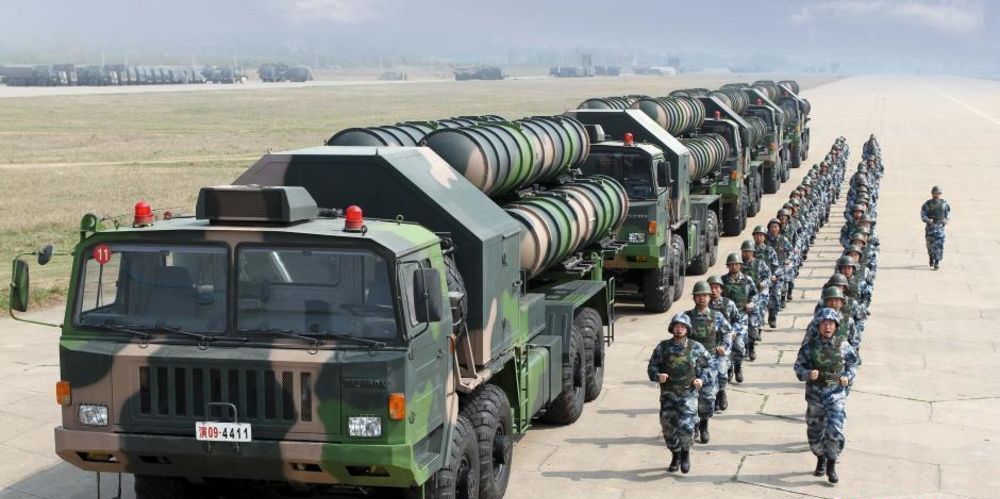
HQ-9B Surface to Air Missile Batteries
With the United States and its Western partners have recently applied considerable pressure to Turkey to cancel its planned acquisition of the Russian made S-400 surface to air missile platform, which the NATO member state selected over Western made alternatives due to its considerably more advanced capabilities, a number of analysts have assumed that should Ankara succumb to Western pressure not to acquire the Russian platform it will inevitably choose a European or American made missile system. Turkey has been heavily criticised for choosing the S-400 because it is not compatible with Western made defence systems used by the NATO alliance, with the United States threatening both economic sanctions and the cancellation a contract to provide F-35 light stealth fighters should Ankara go through with the acquisition. The U.S. has instead offered to consider supplying Turkey with the Patriot missile system, a troubled weapons platform with a highly questionable performance record spanning almost 30 years which Ankara for its part does not seem eager to purchase.
In September 2013 Turkey concluded its T-LORMIDS program to select the most suitable air defence system for its military, under which the most advanced Western platforms including the Patriot contended. The winner however was neither the Russian S-400, which did not take part in the competition, nor a Western platform, but rather the Chinese made HQ-9 - an air defence system similar in appearance to the S-400 but lacking many of its capabilities. The HQ-9B remains a world leading multirole air defence system today, one neither as capable as the S-400 nor as troubled as the Patriot, but considerably less costly than both. While Turkey would go on to cancel plans to acquire the HQ-9, citing China’s unwillingness to transfer key technologies to the Turkish defence industry for development of an indigenous air defence platform, the incident indicated that the a Western air defence system such as the Patriot system not only is not first choice for the NATO member’s defence - but was never even a second choice.
With the Countering America’s Adversaries Through Sanctions Act (CAATSA) targeting the arms exports of Russia, North Korea and Iran, should Turkey be pressed not to acquire the S-400 it would very likely turn to China to acquire the HQ-9 - possibly the upcoming HQ-9C variant. While the United States has raised concerns that the S-400 would compromise NATO security by providing a Russian air defence system with coverage over much of Europe, the threat posed by a cutting edge Chinese system doing the same could well surpass this. As it is, while the Western Bloc leads the field in a number of weapons technologies they lag considerably behind China and particularly Russia in air defence technologies - with a comparison of THAAD and the Patriot against the HQ-9B or S-400 demonstrating this. The fact that a number of Western clients, from South Korea to the Middle East, have increasingly been forced to turn to Russian technologies for air defence exemplifies this phenomenon, and it is as a result of this that efforts to coerce Ankara into relying on Western air defence systems to protect its skies in an increasingly volatile region with growing threats to Turkish security remain unlikely to succeed.
