
Turkey Considers Purchasing Russian Kornet Anti Tank Missiles; Defence Cooperation Continues to Grow
Military Watch Magazine Editorial Staff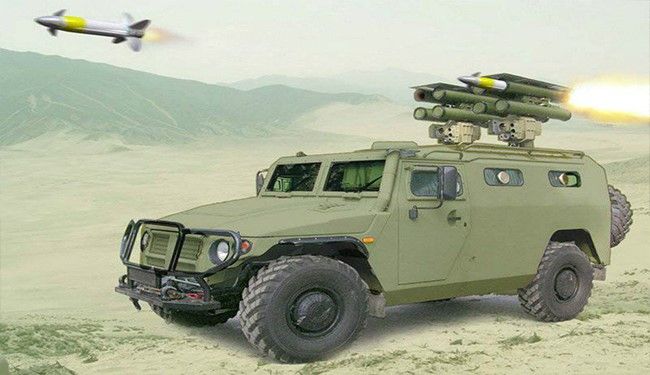
Vehicle Mounted Kornet-EM Anti Tank Missiles Artwork
Turkey's armed forces are reportedly holding negotiations to acquire the renowned Kornet anti tank missile from Russia. This has come amid unprecedented moves by Ankara, one of the oldest members of the NATO alliance, to acquire sophisticated Russian made arms - a move staunchly criticised across the Western bloc. The Kornet first entered service in 1998, and is a solid fuelled and laser guided long range platform intended for use against main battle tanks such as the Leopard II and M1 Abrams. The Kornet has in just 20 years proliferated widely to a number of countries across the world, with approximately 20 state operators and with a number of non state actors having also acquired the platform. The missile’s impressive performance in a number of conflicts, most notably in the 2006 Lebanon War against elite heavily armoured Israeli Merkava III and Merkava IV battle tanks in the hands of Hezbollah militants, has led it to become a leading export platform sought out by states across the world - both Russian aligned and otherwise.
With the U.S. made Javelin long range anti tank missiles facing performance issues, and costing well over $100,000 per missile, a number of state have looked elsewhere for alternatives. The Israeli Spike missile and Russian Kornet have been leading competitors which have been favoured by a number of states. Turkey for its part already operates older variants of the Kornet in large numbers, and also seeks Russian assistance in maintaining these platforms. While the Kornet was initially designed as portable anti tank weapon for use by infantry, the missile has also been modified to be mounted on vehicles and could potentially be used to enhance the long range anti armour capabilities of Turkish combat vehicles and provide transports with advanced defensive anti tank systems. Turkey may also be interested in acquiring newer variants of the Kornet with advanced capabilities, such as the Kornet-EM designed to defeat active protection systems used by a number of modern battle tanks. The EM variant is jamming resistant, has ‘fire and forget’ capabilities, and retains five times the accuracy of previous versions. The system’s autotracker makes it potentially lethal against low flying aerial targets such as helicopters, and the induction of such a platform would represent a serious boost for the Turkish ground forces’ firepower.
Alongside negotiations to acquire the Kornet, Turkey’s armed forces are simultaneously handing negotiations on possible cooperation to strengthen the armour capabilities of Turkish tanks - something the Turkish ground forces desperately need in light of the gross underperformance of their German made battle tanks in recent operations in Iraq and Syria. Western countries including Germany and the United States have proven reluctant to provide such upgrades over concerns regarding how they will be used by the Turkish military - particularly in light of recent military operations against Western backed Kurdish militias. Reports indicate that the maintenance of arms and munitions currently used by Turkish forces in Syria and Iraq are set to be prioritised the scope of Turkish-Russian defence industry cooperation.
Alongside the Kornet, Turkey is reportedly also negotiating for the purchase of Russian infantry equipment and vehicles for its ground forces. Ankara has already contracted the S-400 Triumf long range surface to air missile system, which Russia has pledged to deliver several months ahead of schedule following a Turkish request for an earlier delivery. Turkey’s plans to acquire the S-400 over a Western made alternative have led the Western bloc to threaten sanctions against the country, and the United States has even indicated that it may cancel the delivery of F-35 stealth fighters should the country proceed with the acquisition of the Russian platform. Russia has in turn offered to help Turkey develop its own fifth generation fighter, the TAI TF-X, into a highly capable light combat aircraft - particularly invaluable should the United States carry out its threat to cancel the F-35. Ultimately it appears that the more the Western bloc attempts to apply pressure to Turkey, the more the country pivots towards and increases its reliance on Russia - a trend set to continue into the future. Acquisition of the Kornet EM could well be but the first of many new Russian weapons systems acquired for Turkey's ground forces.
