
The United States Army's Futuristic V-280 Helicopter; A Promising Replacement for the Black Hawk Integrating Several the V-22 Osprey's High End Technologies
Military Watch Magazine Editorial Staff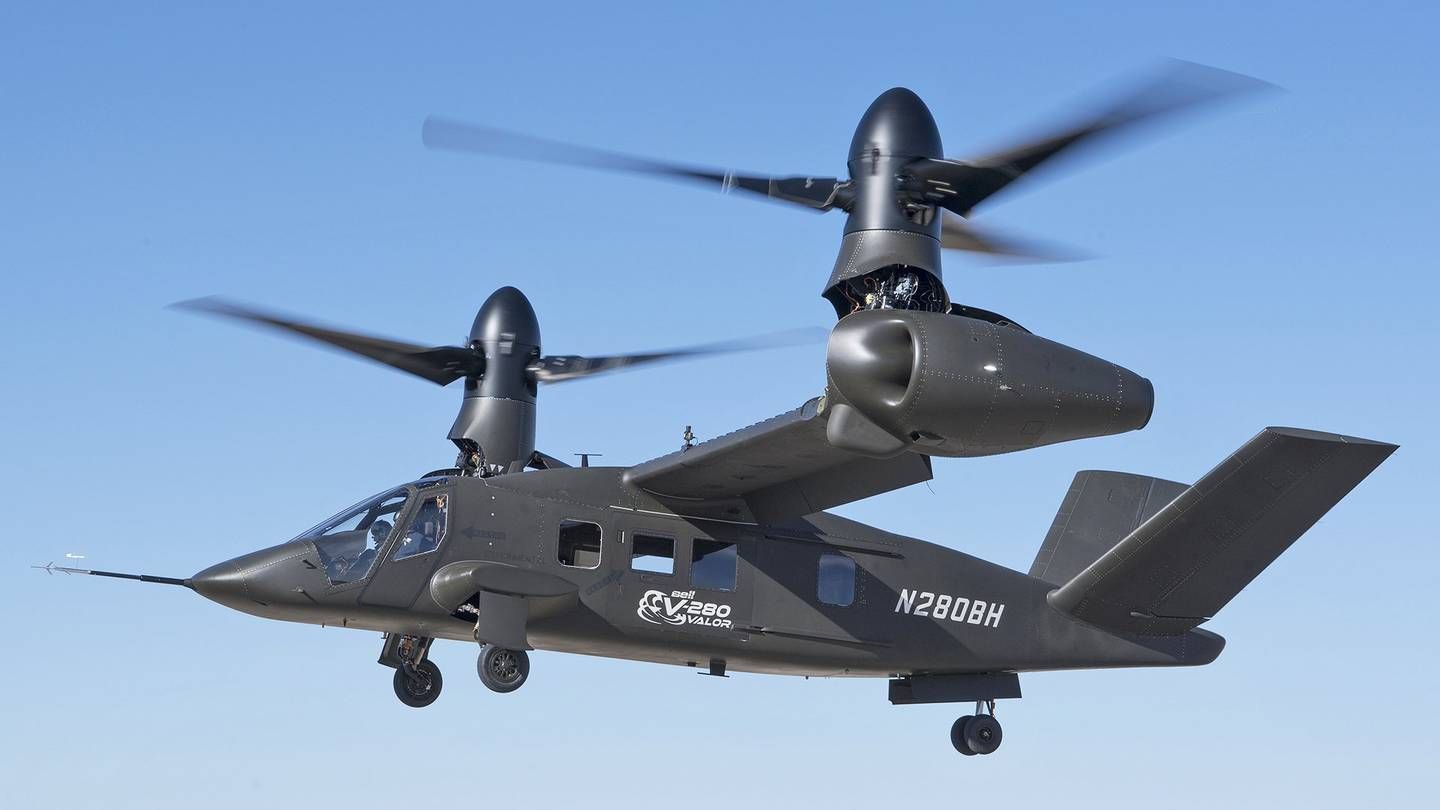
V-280 ValorBell Helicopter Prototype
One of the U.S. military's most prolific rotary wing aircraft - the Sikorsky UH-60 Black Hawk has served with the U.S. Army since 1979. Over 2000 platforms are in service with the U.S. Army alone today, while the helicopter is operated by 26 other countries including South Korea, Japan, Israel and Saudi Arabia. They have seen action in U.S. invasions of Grenada, Panama, Iraq and Afghanistan as well as operations in Pakistan and Somalia - the latter which led to the famous accounting of the heavy losses the helicopters took to Somali militant forces in the 1990s in the book 'Black Hawk Down.' A four propeller platform with a relatively light armament designed primarily as a transport rather than for combat, the Black Hawk has proven itself over several decades to be highly reliable. The U.S. Military has nevertheless sought to commission a more capable and modern replacement, and in 2013 revealed the prototype for a replacement platform - the Bell V-280 Valor under joint development by Bell Helicopter and Lockheed Martin.
While it resembles the V-22 Osprey operated by U.S. Marines far more than it does the Black Hawk, the primary user of the V-280 will be the U.S. Army which will adopt the new helicopter as its first tiltrotor platform. The helicopter is designed to reach speeds of 320mph, almost double the speed of the Black Hawk which was restricted to just 185mph - though slightly slower than the Osprey's 351mph speed. The new platform is also expected to double the range of the Black Hawk, which will make it a far more effective transport for the Army. While the Osprey was designed as a elite platform with extremely high acquisition costs, around four times those of the Black Hawk, as well as high operational costs, the V-280 will seek to integrate many of the same advanced technologies pioneered by the Osprey at lower costs. With the platform set to enter service in far greater numbers, approximately 2000 where the Osprey's numbers are closer to 200, low maintenance requirements and a lower cost will be essential.
The V-280 is set to deploy retractable landing gear, a triple-redundant fly by wire control system and a fuselage closely resembling that of the Black Hawk. The helicopter will have a crew of 4 and be capable of transporting up to 14 troops - a greater capacity than the Black Hawk's 11. The helicopters' wings are to be made of a single section of Carbon fiber reinforced polymer composite, which will reduce both their weight and the production costs. Special efforts have been made to maximise the use of composite materials and thus minimise the platform's weight. This is key to reducing its costs relative to the V-22 Osprey. The new helicopter will have a lower disk loading and longer wing for greater hover and cruise efficiency than the V-22, and will in many ways be the more sophisticated platform taking technologies developed for the Osprey further. Some of the other technologies the platform will employ include ruddervators on the V-tail structure to provide high maneuverability and control to the airframe - made of a combination of metals and composites to increase its strength and reduce its weight. The helicopter's interior will include windows displaying three dimensional mission maps and seats with wireless charging for troops’ radios, night vision goggles and other electronics.
A second variant of the V-280, made for an attack rather than a transport and utility role, is already under consideration - the AV-280. According to Lockheed and Bell the attack variant would be able to carry rockets, missiles and even small UAVs - making it a reliable, fast and well armed attack platform. While the Army is set to be the primary user of the standard transport variant, the Marine Corps is the primary interested party in acquiring the attack variant.
The V-280 carried out its first test flight in December 2017. According to Mitch Snyder, president and chief executive officer of Bell Helicopter, the Black Hawk's replacement would provide game changing capabilities for the Army upon entering service. Snyder stated upon the V-280's first test flight: "The Valor is designed to revolutionize vertical lift for the U.S. Army and represents a transformational aircraft for all the challenging missions our armed forces are asked to undertake." The new helicopter looks to be among one of the U.S. military's most promising defence programs, and its focus on low maintenance requirements and reliability rather than niche capabilities (the F-35 and Zumwalt Class Destroyer programs could be considered its opposites in this way) have set it up to be a major success. The successful development of attack and other variants should the standard airframe prove effective are also highly likely, and the new platform could well surpass the Black Hawk and the Osprey and the U.S. Military's most prolific rotary wing platform - combining the high tech capabilities of the latter with the wide usage, low cost and reliability of the former.
