
The U.S. Military's Development and Testing of the B61-12 Tactical Nuclear Bomb; Why it is Cause for Concern in Russia and North Korea
Military Watch Magazine Editorial Staff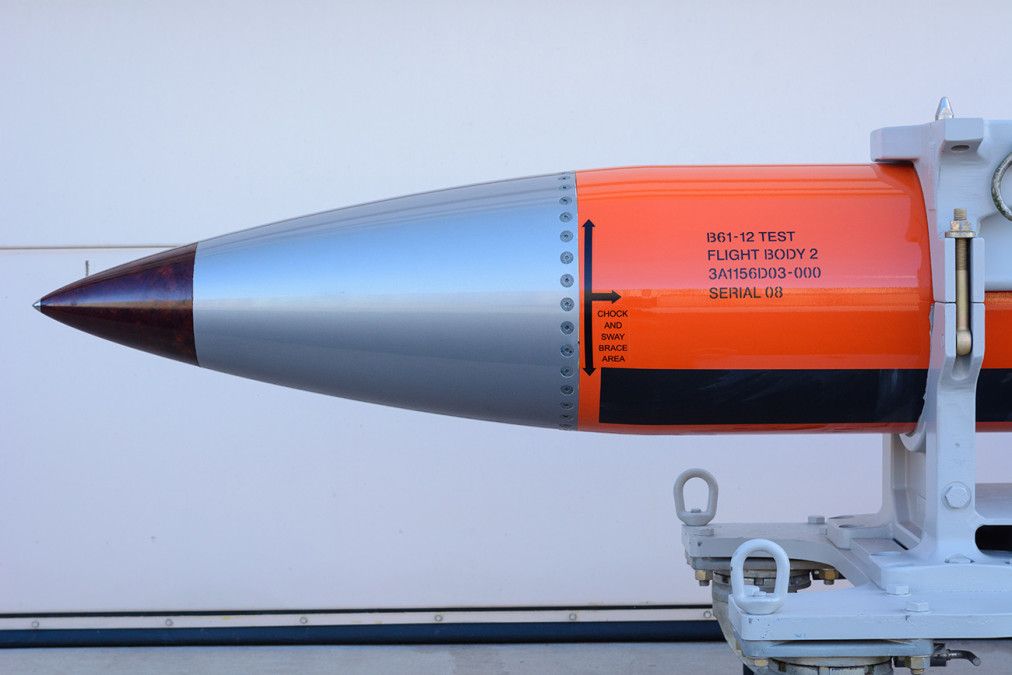
B61-12 Tactical Nuclear Bomb
On August 28th 2017 the United States National Nuclear Security Administration (NNSA) announced the second successful flight test of the new B61-12 gravity nuclear bombs. The tests took place on August 8th at the Tonopah Test Range in Nevada where B61-12 gravity bombs with their nuclear warheads removed were dropped by F-15E Strike Eagles. The B61-12 is a tactical nuclear weapon with a relatively small payload created for precision strikes against well fortified enemy targets and troop concentrations. The effect of making nuclear weapons smaller and more precise is, according to leading American nuclear strategist Joint Chiefs of Staff Gen. James Cartwright, "to make the weapon more thinkable." Tactical nuclear weapons allow for precise nuclear strikes without the number of civilian casualties and collateral damage a higher yield nuclear weapon would entail. Their development is therefore widely seen by defence analysts, General Cartwright included, as a means by which use nuclear weapons will become more applicable and as a result potentially normalised in war.
During testing the B61-12's non nuclear functions as well as the ability of the F-15E, the United States' prime strike fighter, to deliver the weapon were evaluated. Further tests have been scheduled the evaluate the ability of other platforms such as Ohio Class nuclear submarines and B-52 bombers to deliver the bombs, which are set to be deployable even from light fighters such as the the F-16 and F-35. Production for the military is scheduled to begin in March 2020. The testing and commissioning of new tactical nuclear weapons has particularly significant implications considering the current political situation in relation to Russia and North Korea. The B61-12's lower the explosive yield and new $800 million precision guidance system were formerly rejected by the U.S. Congress in 1994 over concerns that they would significantly increase the likelihood of nuclear weapons use. Claims by U.S. military specialists that development of tactical nuclear weapons such as the B61-12 would be more ethical and therefore more usable have led several experts in the field, such as head of the Russian Foreign Ministry's Department for Non Proliferation and Arms Control Mikhail Ulyanov, to predict that weapons development would significantly "increase the temptation" for the United States to conduct nuclear strikes.
U.S. lawmakers have repeatedly pushed for the United States' withdrawal from the Intermediate Range Nuclear Forces (INF) treaty between the U.S. and Russia - one which eliminated intermediate range nuclear missiles and their launchers. With the exception of sea launched missiles, those with ranges of 500-1,000 kilometres (short range) and 1,000-5,500 km (medium range) could not be deployed by either party. Such missiles would however be ideal platforms for the delivery of tactical nuclear weapons. The U.S. withdrawal from the Anti Ballistic Missile (ABM) treaty in the early 2000s, which had limited the United States' ability to develop and deploy anti missile systems, made the strategy of a nuclear first strike far more possible. The country has since embarked on a gargantuan nuclear forces modernisation program expected to cost $1 trillion. Since taking these two steps, the United States has taken measures to circumvent if not withdraw entirely from the INF treaty. An example of this were calls from the U.S. Senate's House Armed Services Committee to transfer weapons banned under the treaty to American allies. This means that the U.S. could be interpreted to have held to its obligations, though weapons held by its allies would in times of war fall under American and NATO command regardless. Failing this, there have been calls within the U.S. leadership to withdraw from the INF treaty altogether once new tactical nuclear weapons systems enter service. In the meantime, deployment of tactical nuclear weapons from long range strike fighters rather than ground based ballistic missiles remains another effective way to circumvent the INF treaty.
The United States military's development of advanced short and medium range nuclear forces, in particularly tactical nuclear weapons such as the B61-12, with the express purpose of deploying them near Russia's borders in Europe has inevitably caused a great deal of concern among Russia's military and political leadership. Russia's President Vladimir Putin expressed his own concern in a 2016 press conference regarding the United States' tactical nuclear weapons development - believing it was a potential signal that the Western bloc would attempt to disrupt the balance of power in Europe by using nuclear forces against Russian conventional forces while themselves being covered by air defences built since the withdrawal from the ABM treaty to prevent Russian retaliation. Mikhail Ulyanov, head of the Russian Foreign Ministry's Department for Non-Proliferation and Arms Control, stated that the development of such a weapon deployable from such widely used systems as the F-16 and F-35 was an attempt to nuclearise NATO by providing its non nuclear member states with weapons capable of being used against Russia. He said: "The most recent variations of the B61-12 bombs are also designed for deployment to the territory of a number of NATO countries in Europe for use as part of the so-called nuclear missions involving pilots from the alliance's non-nuclear member-states. According to our assessment, this runs counter to the NPT (Non Proliferation Treaty) commitments." Considering the nature of the drills which have taken place in Europe simulating tactical nuclear strikes on Russian territory, and the hundreds of tactical nuclear weapons set to be deployed across the European theatre, there can be no doubt that the B61-12's development could potentially have grave implications for Russia's security.
Continued in Part Two
