
The Significance of China's J-11 Deployment Over Pakistan
Military Watch Magazine Editorial Staff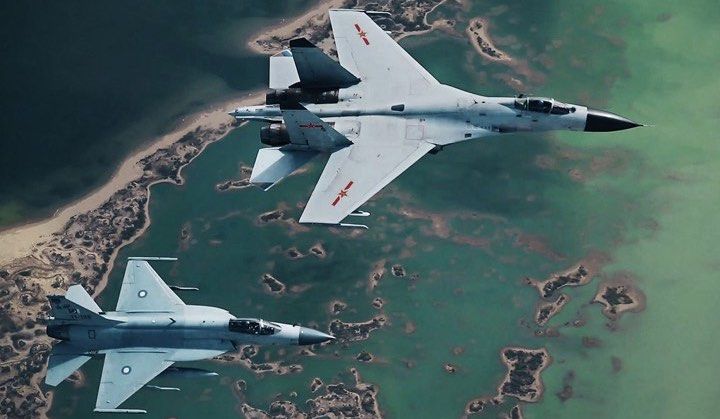
Chinese J-11B Air Superiority Fighter and Pakistani JF-17 Light Multirole Fighter
During China and Pakistan's recent Shaheen IV joint military exercises China's choice of combat aircraft deployed alongside their Pakistani partners had significant implications regarding future cooperation between the two countries' air forces. With the Pakistani Air Force's combat fleet comprised entirely of light single engine multirole platforms such as the F-16 and JF-17, and older J-7 and Mirage III/5, and with no know plans for the acquisition of more specialised high performance platforms, the Chinese aircraft were highly complementary to Pakistan's own force composition. Rather than send their own J-10 multirole fighter, roughy analogous to those comprising Pakistan's own fleet, China deployed its highly specialised JH-7 strike fighter alongside the high performance J-11B air superiority fighter. These combat aircraft both represented highly potent specialised capabilities which Pakistan's own fleet lacks entirely.
With tensions between Pakistan and India simmering, it is worthy of note that the Indian Air Force maintains a far more specialised body of fighters than its Pakistani counterpart. In particular India's large fleet of advanced Su-30MKI air superiority fighters present an air to air combat capability which the Pakistani Air Force would find extremely difficult to match. All previous engagements between light multirole and heavy high performance air superiority platforms have in the past ended similarly - with an overwhelming victory for the air superiority platform. This significant Indian advantage, combined with Pakistan's lack of advanced long range air defence systems to deny Indian Sukhois access to its airspace, leaves Pakistan at the very real risk of losing control of much of its airspace in the event of a future war. China's growing security ties with Pakistan however may well lead to a shift towards a less one sided balance of forces in the air.
The J-11B is roughly analogous in its capabilities to India's Su-30MKI - modernised derivatives of the Soviet Su-27 air superiority fighter. The J-11B provides a capability which Pakistan lacks, and when deployed to Pakistani skies largely nullifies India's primary advantage in the air. China's deployment of the JH-7 strike fighter also gives a much needed boost to Pakistan's otherwise sorely lacking penetrative strike capabilities - at speeds and ranges and with high payloads which light jets such as the JF-17 cannot match. What the Chinese deployment signifies is that the country seeks parity and stability in South Asia - and ultimately for neither party to be capable of waging an aggressive war on the other. The appearance of the J-11B on India's Western borders sends a strong signal that should China provide Pakistan with even minimal air - either directly or through the transfer of high end arms - India would not enjoy such a one sided advantage in an air war with Pakistan as it otherwise would against its fleet of light F-16 and JF-17 fighters. By deploying the J-11B rather than more advanced platforms such as the J-20 however, a fifth generation platform currently unmatched by anything in the Indian inventory, or the elite J-16 strike fighter which considerably surpasses the JH-7 in its performance China has indicated that it does not seek an arms race or destabilisation in South Asia - only strategic balance between the two regional powers. The J-11B and JH-7 thus symbolise an attempt to match but not to suppress Indian capabilities - as this is the most effective means to prevent war. Ultimately maintaining regional peace remains the Chinese strategic priority, not only because it already faces far more serious security threats on its eastern borders from the Western Bloc but also because the future of its One Belt Road initiative depends on such peace and stability.
