
The Need for a New Air Superiority Fighter; Why the U.S. Air Force Can No Longer Rely on the F-22 Raptor Alone
Military Watch Magazine Editorial Staff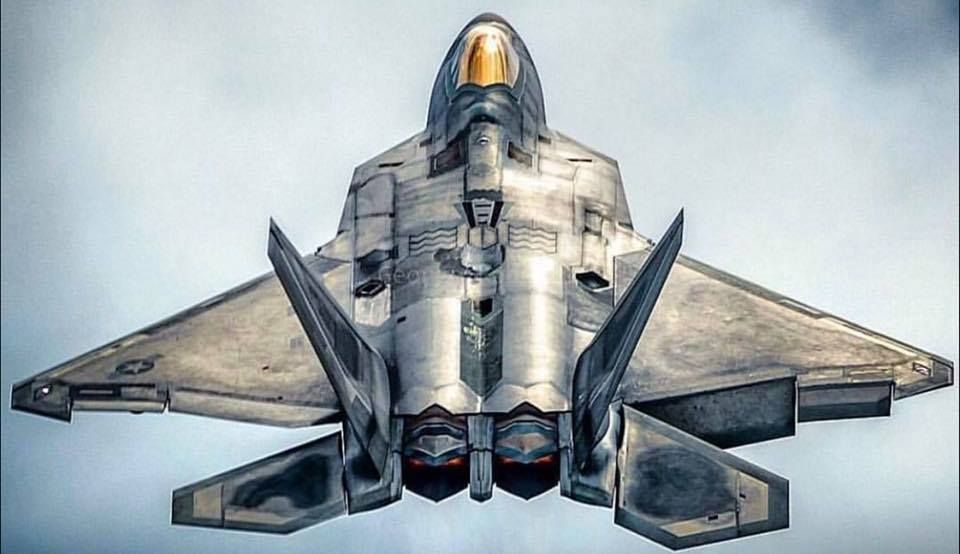
F-22 Raptor
The U.S. Air Force’s F-22 Raptor has long been considered the world’s most formidable air superiority fighter, and until 2017 was the only fifth generation air superiority platform in service anywhere in the world. An analysis of the Raptor's capabilities, in many respects fast ageing, and of the next generation heavy fighters currently entering service with rival powers indicates that the U.S. air superiority advantage once guaranteed by the F-22 is no longer secure. While the F-22’s ability to outperform the most capable fighters produced by Russia's United Aircraft Corporation or China Chengdu and Shenyang aerospace corporations was long take for granted in the United States, the Raptor’s advantage is no longer as clear cut in light of the recent air superiority platforms inducted into service by America’s potential adversaries.
The F-22 Raptor’s avionics were considered dated long before it entered operational service in December 2005. Because the fighter’s development program lasted so long, taking 24 years in total and well over a decade just to go from design to production, the Raptor entered service using a computer architecture dating back to the early 1990s, with a core processor speed of just 25MHz (very slow). The fighter’s use of specialised but somewhat obtuse software has made it extremely difficult to upgrade - causing particular difficulties when attempting to equip the fighter with the latest munitions such as the AIM-120D long range and AIM-9X short range air to air missiles. This forced the Raptor to rely on older air to air munitions far longer than intended, and these were unable to match those deployed by its Russian and Chinese counterparts. The AIM-120C for example cannot match the latest Chinese PL-15's 150km range or its manoeuvrability, or those of the Russian K-77, and even older munitions such as extended range variants of the R-27, deployed by both Russian and North Korea, surpass the range of their U.S. counterpart. This goes without mentioning newer, more manoeuvrable and longer ranged platforms inducted into service more recently such as the Russian K-77 and Chinese PL-15.
It is also important to consider that the F-22’s airframe is old by the standards of fifth generation aircraft, predating even the Soviet MiG 1.44 fifth generation fighter, and originated in the mid 1980s. Even if the Raptor's avionics are incrementally improved at great effort and expense, the fighter’s stealth profile and airframe leave something to be desired when considering next generation technologies which have since been developed. If the F-22 were still in production there would be significantly more room to modernise future production variants of the platform, and even potentially upgrade older variants, with the latest technologies. As it stands however, the Air Force has been restricted in its ability to improve the quality of its F-22 Raptor fleet.
Unfortunately for the U.S. military, none of the aforementioned factors limiting the potential of the F-22 Raptor fleet apply to the Chinese J-20 or Russian Su-57, the former which entered in service since 2017 and the latter which saw its first combat operations in February 2018. Both these fighters are not only equipped with the most advanced avionics, computer systems, processors, and missiles their countries can provide, but their airframes are set to remain in production for some time, likely several decades if the precedents set by the J-11 and Su-27 are anything to go by, which will far exceed the mere four years of F-22 production in the United States. This will give both powers significantly more room to modernise their fighters’ capabilities as new technologies are developed, and as far more modern platforms the two fighters in many ways surpass the F-22 in computing power, software and avionics - as well as fielding far more capable air to air missiles which are set to prove a decisive asset in any potential conflict.
Ultimately while the F-22 is quite possibly still the most capable fighter in the world, the question is not whether it will lose this title - but when and to which parties. The Raptor cannot be relied on to maintain the United States’ qualitative air superiority advantage over Russia or China indefinitely due to both countries’ induction of far newer fifth generation air superiority platforms - with the Su-57 in particular having been designed from the outset with the intention of incorporating sixth generation technologies. America's Raptor fleet is set to face not only a qualitative disadvantage, but also a numerical one, with F-22 having been produced to meet just 25% of the Air Force’s requirements and none of the Navy’s while both the Su-57 and J-20 are set to be produced in far greater numbers - though budgetary constraints are likely to considerably delay the Russian platform's entry into mass production. One must also consider that the United States military has considerably more defence commitments than either China or Russia, and has deployed assets to several hundred military bases across the world facing four 'great power competitors’ as referred to by the 2018 National Defence Strategy - these being Russia, China, North Korea and Iran all of which require F-22s to be based nearby. This means that the elite fighters available for deployment to any particular theatre represent just a fraction of the total U.S. fleet, to the extent that the Air Force currently deploys Raptors in squadrons of just six fighters each. J-20 and Su-57 fleets by contrast are set to see far more concentrated deployments to Eastern Europe and East Asia, rather than being spread out across the world on over multiple fronts. In light of recent developments among American military rivals, is imperative that the United States devote considerably resources to developing a sixth generation heavy fighter specialised in air superiority to replace the F-22 - and produce these in adequate numbers in both naval and ground based variants to meet emerging challenges to the U.S. military's control of the skies.
