
The Most Destructive Weapon Ever Designed; How Powerful Was Soviet Union's T-15 Torpedo and Why Was it So Dangerous?
Military Watch Magazine Editorial Staff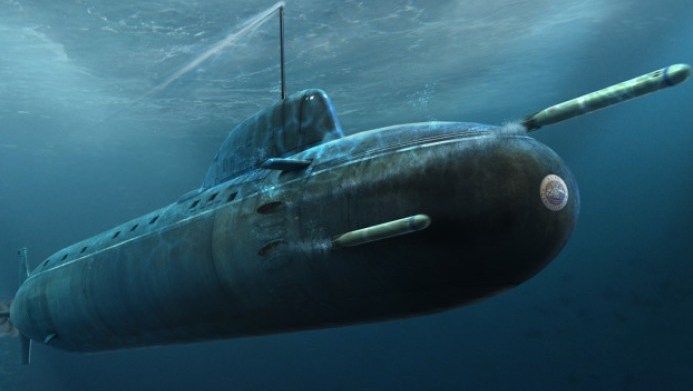
Submarine Firing Torpedoes - Artwork
From the designer of the Tsar Bomba hydrogen bomb, the largest nuclear weapon ever detonated with a 57 megaton warhead set off in 1961 (approximately 4000 times the strength of 'Little Boy’ dropped on Hiroshima), Soviet weapons designer Andrei Sakharov had sought to develop an even more lethal weapon to guarantee the USSR’s security and its future amid growing tensions with the Western Bloc. The new weapon was to deploy a 100 megaton warhead, and would be fielded as a massive submarine launched torpedo rather than an air launched bomb. With the United States having a year prior inducted the F-4A Phantom as an interceptor to protect American skies against Russian strategic bombers, and with defence planners on both sides having realised the growing vulnerability of bombers to modern combat aircraft since the Korean War in 1950, when U.S. B-29s made vulnerable targets for a small contingent of Chinese and North Korean MiG-15 jets, the Soviet Union increasingly sought alternative means of delivering nuclear warheads to the American mainland - an essential capability for the country’s strategic deterrent force.
While early intercontinental range ballistic missiles in service at the time were capable of delivering nuclear warheads to the United States, they lacked the payload to deliver a bomb as large as the Tsar Bomba - let alone a larger one the size of that Sakharov proposed deploying on a new torpedo. The torpedo would theoretically be fired at a major coastal target such as New York City or San Francisco, generating a colossal underground explosion and resulting tidal wave. This combined with the damage inflicted by the warhead, and the radiological contamination of a massive area of the enemy’s coastline reaching far inland with the tidal waters, would have represented massive and indiscriminate destruction on a scale unmatched by any other weapon of the time. Contaminated territories were intended to be rendered uninhabitable - and the potency of such a deterrent was immense as a result. With the Soviet Union having pioneered ballistic missile submarines and a submarine based second stage nuclear deterrent, it remains a considerable possibility that it would also be the first to develop a weapon such as the T-15 - the name of the colossal nuclear armed torpedo Andrei Sakharov was proposing.
The T-15 torpedo was planned as a 40 tons and 24 meter long weapon, too large for standard Soviet submarines, which would require a specially built warship to deploy it. The torpedo was so large, particularly relative to submarines of the time, that it would occupy over a fifth of the warship’s length - with each boat carrying just a single torpedo. The planned submarines would also deploy two far smaller 533 millilitre torpedo tubes for self defence. As a defence project, the T-15 was rivalled by the smaller T-5 which was designed as a tactical rather than a strategic weapon - with a considerably smaller blast yield allowing it to neutralise military targets or cripple enemy infrastructure rather than devastating an entire coastline. While there were prospects for both weapons to be deployed side by side in complementary roles, the T-15 would eventually be cancelled while the T-5 would go on to see service in the Soviet Navy. A preference for tactical weapons and longer ranged submarine launcher ballistic missiles, and faith in the adequacy of the USSR’s existing strategic deterrent assets, meant that the costly and extremely destructive asset never saw service. With the Russian military reportedly considering resurrecting the T-15 program in modern form, one of several highly destructive new strategic assets able to effectively complement the capabilities of the recently inducted Sarmat and Avangard hypersonic nuclear armed missiles, the capabilities of the country’s strategic deterrent force may well become a considerably more serious threat to its potential adversaries in the near future based on a Cold War era design concept. With new investments focusing on developing weapons which are highly survivable against the Western Bloc's air defence networks, the T-15 appears a potentially ideal platform - striking from and detonating below the water's surface which makes it effectively impossible to intercept.
