
The Middle East's Triad of Emerging Nuclear Powers; Hostilities Between Iran, Iraq and Israel in the 1980s
Military Watch Magazine Editorial Staff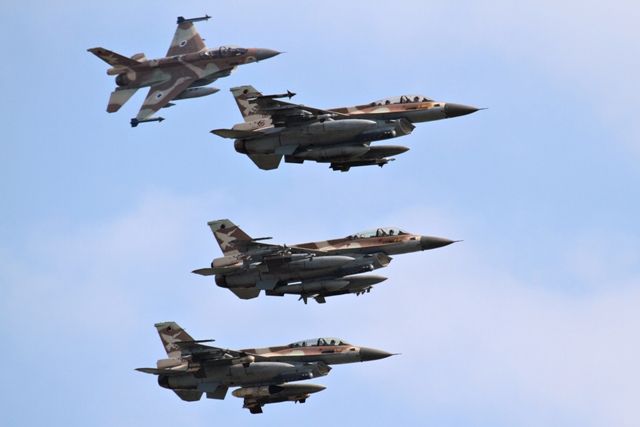
Israeli Air Force F-16 Fighters
Until the late 1970s the Middle East had been divided primarily into two power blocs, the Arab Nationalist states of Egypt, Iraq and Syria with support from the African Arab states Libya and Algeria, and the Western aligned bloc consisting primarily of Israel, Saudi Arabia and Iran - with most of the remaining Arab states being under Western aligned governments or direct British colonial rule but avoiding extensive involvement in regional conflicts. Two events which occurred in the late 1970s largely shattered this regional balance of power. One was Egypt's abandonment of the Arab Nationalist bloc, rapprochement with Israel, and realignment to join the Western bloc. Having formerly been the leader of the Arab Nationalist states, Egypt's realignment led to a collapse of the Arab Nationalist bloc and to conflict emerging between Iraq and Syria. The other event was Iran's abandonment of the Western-aligned bloc as a result of the 1979 Islamic Revolution, leading the country to form its own bloc with ideals contrary to secular Arab Nationalism and hostile to both Israeli Zionism and to Western involvement in the region.
By the 1980s Iran, Iraq and Israel all had advanced nuclear weapons programs at various stages of readiness. Israel had by 1980 long mastered nuclear weapons technology and was building a large arsenal, a measure which it perceived as necessary to deter aggression from its larger neighbours and thus guarantee its continued survival. Iran had received extensive assistance from the United States to develop a peaceful nuclear program from 1974, though a CIA proliferation assessment that year stated that there was "no doubt" that Iran would use this to develop a nuclear arsenal by the mid 1980s. Iraq too had developed a nuclear weapons program, in part as an attempt gain nuclear parity with Israel and thus affirm its status as the new leader of the Arab nationalist and anti Zionist struggle, in part to balance the military superiority of Iran whose population and military expenditure under the hostile Pahlavi dynasty were many times greater than that of Iraq. While Iran and Israel had been close military partners under Pahlavi rule, the Iranian revolution ended this alliance and Iran quickly became one of Israel's primary adversaries - sending extensive military assistance to Syria and to Lebanese and Palestinian insurgent factions at war with Israel at the time. Though Iran and Iraq shared a common enemy after 1979, relations between the states hardly improved as a result of to their ideological differences which had if anything grown with the emergence of an Islamic government in Tehran. These events led to the emergence of three Middle Eastern powers with advanced nuclear programs, all with hostile relations with one another.
Under an Iranian-Israeli partnership Iraq's position had been seriously threatened, but as Iran and Iraq could not bring themselves to form a partnership of their own after 1979 Israel's position did not face a similar threat. When Iraq invaded Iran in 1980 this ensured Israel's continued security and led to a significant weakening of its two primary adversaries. Iraq's nuclear program however continued to be perceived as the primary threat to Israel's security, as Baghdad continued to receive foreign assistance for nuclear development while Iran had lost all of its American assistance after 1979. Following Iraq's extensive use of chemical weapons against Iranian population centres, Iran too began to fear that Iraq would use its nuclear arsenal against it should the country acquire such weapons. The destruction of Iraq's nuclear facilities became a priority for the Iranian military, and using F-14 fighters to establish air superiority over the border Iranian F-4 Phantoms proceeded to target Iraq's nuclear facilities near Baghdad. To avoid any potential radioactive fallout, Iran's fighters avoided the reactor dome and targeted the control room and centrifuge facilities. This failed to significantly set back the program however, and work at the facility resumed within months.
Iran's strike on Iraqi facilities was the first ever attack on nuclear facilities to forestall the development of a nuclear weapon - a preventative strike. Following the strike Iraq's President Saddam Hussein made an announcement to reassure Iran and thereby prevent further strikes on Iraq's nuclear facilities - highly unusual considering the ongoing hostilities. He announced publicly shortly after the Iranian nuclear strike "the Iraqi nuclear reactor is not intended to be used against Iran, but against the Zionist enemy (a reference to Israel.)" Iraqi Deputy Prime Minister Tariq Aziz reiterated this point shortly afterwards in an interview with Jordanian media, and the Iraqi government appeared eager to prevent further Iranian strikes on its facilities. Iran seemed to accept this reassurance, and despite the superiority of its air force it did not launch any further strikes on Iraqi nuclear facilities.
Israel too seemed to get the message clearly, and for their own security it appeared critical more than ever to destroy Iraq's nuclear facilities. On June 7th 1981 Israel launched Operation Opera. After months of training specifically for the operation, eight F-16 Falcons and six F-15 Eagles of the Israeli Air Force launched a strike against Iraq's nuclear facilities. Though they shared no borders and could not fly through hostile Syria, the Israeli fighters were allowed to fly through friendly Saudi Arabian airspace. The timing of their airstrike was perfect, and according to members of Iraq's military it indicated that Israel had received detailed information from agents inside Iraq. The strike caught the Iraqis completely by surprise at the moment their anti aircraft crews were leaving for their dinner break, also at the precise moment when Iraq's air combat patrols had landed to refuel. The Israeli Air Force was able to carry out its operation without opposition, setting Iraq's nuclear program back significantly.
The Iran-Iraq war ended in 1988, eight years after it began, having devastated to the two formerly thriving countries. While Iraq sought to continue its nuclear program it never again neared its goal, and the country's infrastructure was crippled three years later in the 1991 Gulf War and subject to continuous bombings for the next twelve years. Harsh economic sanctions, the destruction of the sanitation system and severe environmental contamination as a result of depleted uranium munitions used by U.S. forces were among the issues that left the country in too poor a state to pursue any form of nuclear development. Iran's nuclear program had also suffered significantly setbacks due to Iraqi strikes on two of its reactors during the Iran-Iraq War, and soon after the war ended the country abandoned its policy of developing such capabilities alone and began nuclear cooperation with the Soviet Union - which continued with the formation of the Russian Federation. When its nuclear program reached the threshold of producing weponiseable materials in the late 2000s Iran was threatened repeatedly with military action by the United States and Israel. Only because of its highly capable military, the advanced North Korean built fortifications for its nuclear facilities which made them highly survivable, and its state of the art Russian made air defences was this prevented. Iran was nevertheless forced to negotiate to give up any potential for the creation of nuclear weapons under the JCPOA nuclear deal in 2015. Israel on the other hand, by staying out of a direct conflict with either of the other two powers, which proceeded to destroy one another, while taking extensive measures to prevent either of its rivals from obtaining nuclear weapons, emerged the only nuclear power in the Middle East and the only victor of the regional power struggle of the 1980s. For the small state this nuclear arsenal remains a critical advantage in any future conflict, one it is likely to retain over any potential regional adversaries for the foreseeable future.
